
Lieferung heute & morgen

Qualitätsgarantie

Willkommens-Angebote freischalten: KOSTENLOSE Lieferung | Bis zu 80 % RABATT | Kostenlose 30-Tage-JoyPlus-Testphase
App herunterladen
Shoes in the hallway, wardrobe or under the bed can quickly take up a lot of space. Stackable shoe storage boxes keep pairs visible, separate and protected from dust. But to make sure they work well in everyday life, there’s more to consider than just the number of boxes and the price of the set.
The key factors are the internal dimensions, the stability of the construction and how easy the boxes are to access. A transparent front makes it easier to choose a pair, while ventilation holes can improve air circulation. The following criteria will help you distinguish practical features from marketing claims.
A box may look big enough from the outside, but frames, connectors or doors can significantly reduce the space inside. Usable length is particularly important for trainers, walking boots and shoes with thick soles.
Before buying, make sure you:
Not every shoe box can be stacked securely and reliably. With simpler designs, boxes may shift if the connectors don’t fit together properly. A stackable solution should have suitable support surfaces or guide features.
For taller stacks, it’s also a good idea to place the boxes on a level surface and keep heavier shoes at the bottom. A low shoe rack with boxes may be more practical for pairs you wear regularly than a very tall stack.
Transparent shoe boxes let you see what’s inside, but they don’t replace air circulation. If you put worn shoes away immediately, moisture can become trapped inside. Ventilation holes are therefore a useful feature to look for.
Make sure shoes are completely dry and clean before storing them. For delicate materials, you should also follow the manufacturer’s care instructions.
For many sets, the external dimensions of each box are approximately 33 to 35 cm long, 23 to 25 cm wide and 14 to 19 cm high. That doesn’t automatically mean every style of shoe will fit. Sports shoes with thick soles, high-top trainers and boots with tall shafts need more internal height.
For a reliable choice, check the following details:
For trainer storage boxes for larger collections, a set of 12 or 18 may be more practical than buying individual boxes, provided you have enough floor space.
Many plastic shoe boxes are made from polypropylene, or PP for short. This material is often used for lightweight storage solutions that are easy to wipe clean. Doors or fronts may be made from polystyrene or plastic. ABS connectors or metal frames can also be used to reinforce the construction.
Look for:
A stated load capacity usually applies to each compartment and shouldn’t be exceeded. If you choose a modular cabinet, distribute the weight evenly.
Front-opening doors are handy for everyday use, as you won’t need to take the whole stack apart. For an entrance hall, wipe-clean surfaces and a stable design are important. You should also place shoe storage for the hallway where it won’t block doors, escape routes or walkways.
Smaller boxes can work as a wardrobe shoe organiser. For seasonal shoes you don’t wear often, foldable shoe boxes are also a good option if you want to store them away compactly when they’re not needed.
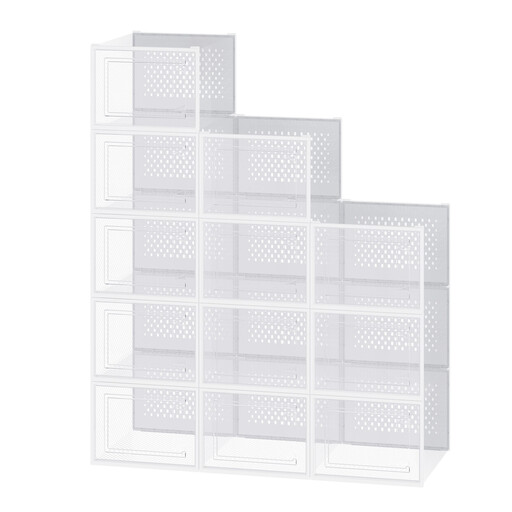
Why this product suits this profile: This set of 12 is ideal for households looking to store several pairs neatly in a wardrobe or hallway. The stated external dimensions are 35 x 25 x 18,5 cm per box.
The transparent front means you don’t need to open every box to find the pair you want. Ventilation holes help address the lack of air circulation that can be an issue with closed plastic boxes.
12 PP plastic boxes, front door made from PS plastic, stackable design and stated ventilation.
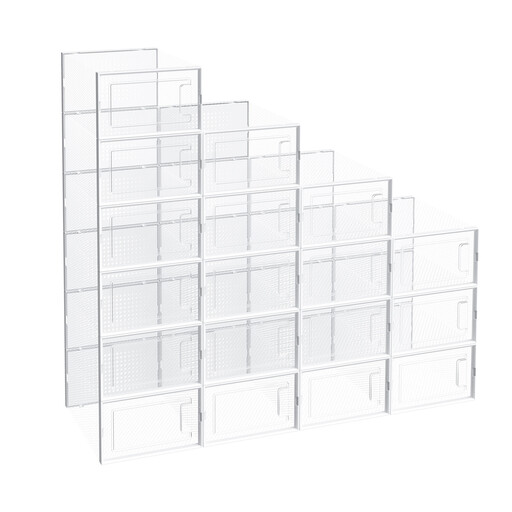
Why this product suits this profile: This set of 18 is designed for people with a large shoe collection who want a consistent storage solution. The boxes are foldable and are stated to fit shoes up to UK size 11.
The product details list dimensions of 35 x 25,2 x 19 cm and ventilation holes. This makes it easier to check the available space and whether your shoes will fit before you buy.
18 foldable boxes, transparent fronts, front-opening doors and PP plastic with ventilation holes.
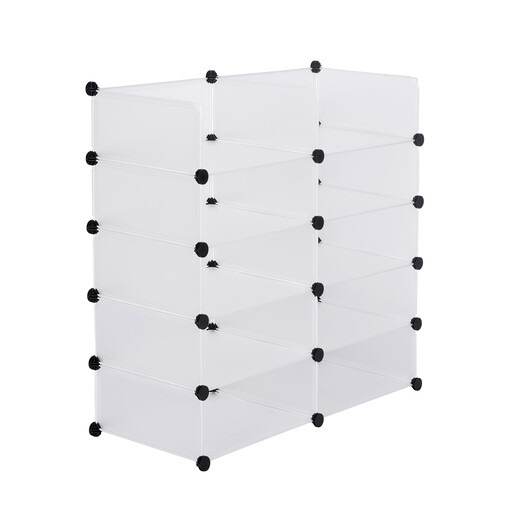
Why this product suits this profile: This modular cabinet is a good fit for a hallway or any room where you’d prefer a closed piece of furniture to separate stacks of boxes. It has 10 compartments and stated dimensions of 48 x 173 x 36 cm.
The compartments and doors offer a neatly organised alternative to loosely stacked boxes. Make sure you stay within the stated load capacity of up to 10 kg per compartment.
10 compartments, PP panels, ABS connectors, steel frame, doors and tool-free assembly according to the product details.
We’ve put together a complete, regularly updated list of products that meet these strict selection criteria and the safety regulations applicable in the EU.
Even the right box will only be practical if you use it correctly:
Start by counting the pairs you wear regularly, then allow for extra boxes for seasonal shoes or sports shoes. A set of 12 is often suitable for a smaller household, while a set of 18 may work well for a larger collection. The space you have available is still the deciding factor.
Yes, as long as they’re placed securely and there’s enough room to open the front doors. If your hallway is narrow, measure the width and depth first. For a taller stack, a closed shoe rack with boxes may be a better option.
Their lifespan depends on the material thickness, assembly, load and where they’re kept. Nearby heat sources, strong sunlight, overfilled compartments and unevenly loaded stacks can put more strain on plastic parts and connectors. Check the connectors regularly to spot signs of wear early.