
Lieferung heute & morgen

Qualitätsgarantie

Willkommens-Angebote freischalten: KOSTENLOSE Lieferung | Bis zu 80 % RABATT | Kostenlose 30-Tage-JoyPlus-Testphase
App herunterladen
If you’re looking to buy STAEDTLER Karat Aquarell Watercolour Pencils, you’re probably hoping for a combination of precise coloured pencil drawing and classic watercolour effects. Water-soluble coloured pencils can be suitable for illustrations, sketches, mixed-media projects and watercolour painting. However, their application, colour selection and paper requirements are noticeably different from ordinary coloured pencils.
With many offers, a STAEDTLER Karat Aquarell 6-pack contains six pencils of the same colour. This makes sense if you use a particular shade frequently – for example, green for botanical drawings or warm grey for shadows. If you’re looking for the broadest possible colour spectrum, you’ll need a set with different shades or you’ll need to buy several individual colour variants.
Before you buy, you should therefore check the pack size, colour name and colour number. In the variants listed here, the product description “6 pcs” refers to the quantity, not necessarily six different colours.
Watercolour pencils work dry on drawing paper, but they develop their watercolour properties better on paper with sufficient weight and surface texture. Thin printer paper can buckle or roughen when water is added. For regular wet-on-wet techniques, watercolour paper is a more practical base.
The water solubility can also vary depending on the amount of colour applied, the paper and the amount of water used. A damp brush distributes pigments in a controlled way; too much water, on the other hand, can dissolve the outlines significantly.
Soft watercolour pencils are usually easy to apply, but they are more delicate when sharpening than harder coloured pencils. A blunt or unsuitable sharpener can damage the wood and the lead. The product details for several STAEDTLER Karat Aquarell variants mention the Mars double-hole sharpener 510 25 or the Noris sharpener 512 002 as suitable options.
The pencils should be stored in a dry place at room temperature. After a wet application, it’s advisable to let the tip dry completely before putting the pencil back in its case.
The key difference from conventional coloured pencils lies in the water-soluble colour core. Applied dry, the pencils are suitable for hatching, outlines and fine details. You can then spread the colour layers with a damp brush.
Three techniques are particularly useful:
If you want to create both detailed drawings and broad watercolour washes, you should look for a soft, water-soluble lead and sufficiently absorbent paper.
Colour names like Light Carmine, Warm Grey 5, Grass Green or Burnt Sienna give you an initial guide. For repeatable illustrations, the colour number is also relevant. This allows you to buy specific shades later and use them consistently in series work.
Light shades are suitable for highlights, plant and sky details, for example. Grey, sepia and ochre tones support shading, architectural drawings and natural textures. For a larger project, it can make sense to order a small colour selection first and create your own colour test on the paper you intend to use.
The STAEDTLER Karat Aquarell pencils have a classic hexagonal wooden casing. This shape can reduce rolling on your work surface and provides a defined grip when hatching. In the product details, several variants mention FSC-certified wood from sustainably managed forests.
The FSC information refers to the origin of the wood. It doesn’t automatically tell you anything about the water solubility, colour intensity or lightfastness of the lead. These properties should be considered separately and checked against the respective product description.
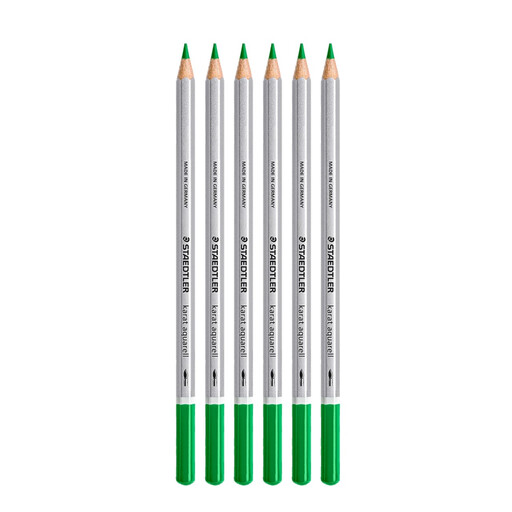
Why this product suits the profile: A single green shade with six pencils is ideal for getting to know water solubility or as a stock for botanical drawings and landscapes.
The quantity and the specific colour shade are clearly stated. Buyers therefore don’t expect a mixed colour assortment, but six pencils in Grass Green.
Water-soluble colour core, hexagonal wooden body and, according to the product details, FSC-certified wood.
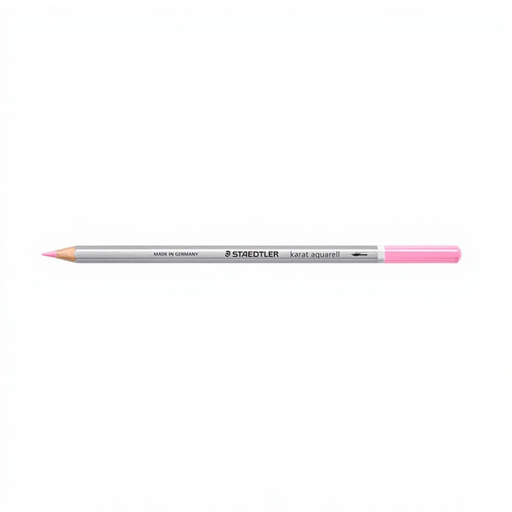
Why this product suits the profile: Light Carmine is interesting for users who want to work specifically with a red shade, fine gradients and floral or illustrative details.
The combination of dry application and subsequent blending can be realistically planned before purchase based on your intended paper and brush.
Soft, water-soluble lead; hexagonal grip; according to the product description, suitable for dry, dry-on-wet and wet-on-wet applications.
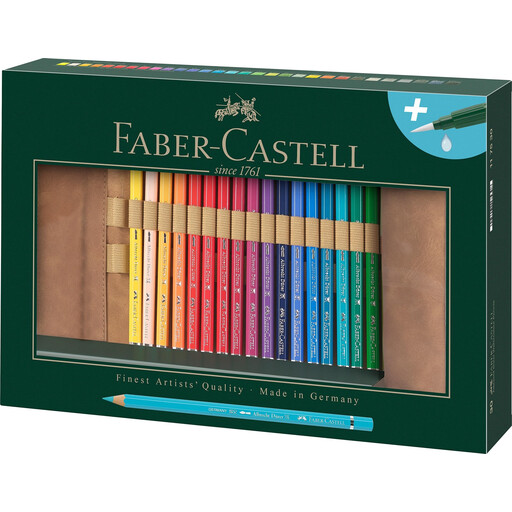
Why this product suits the profile: This set is aimed at illustrators, students and heavy users who need several colour shades and portable storage.
The 30 included colour shades are clearly stated as an assortment. The roll-up case supports organised storage and transport.
30 water-soluble coloured pencils, 3.8 mm lead, roll-up case and a water brush according to the product details.
We’ve put together a complete, regularly updated list of products that fully meet these strict selection criteria and the safety regulations in force in the EU.
For controlled results, you should first create a small colour swatch on the paper you’re using. Then, using brushes with different levels of dampness, you can test how much the colour application spreads. When layering, it’s a good idea to let the first wash dry before adding further dry details or colour layers.
Durability depends mainly on storage, sharpening technique and intensity of use. Direct moisture can affect the wooden casing and the colour core. Dropping the pencils can cause internal damage, even with break-resistant construction. A sharp sharpener with even pressure reduces material loss. These pencils are not suitable for children under three years of age due to small parts and pointed ends.
Yes, as long as you understand the basic differences between dry and wet application. A single colour shade in a 6-pack is suitable for practising individual techniques. For your first colour compositions, a mixed set with several colour shades is more practical.
For occasional, sparing water application, good-quality drawing paper can be sufficient. For washes, dry-on-wet or wet-on-wet techniques, watercolour paper with a higher weight is more practical. Paper of around 200 g/m² or more offers greater stability in many applications; you should check suitability with a colour test.
The pencils should be stored in a dry place, protected from direct sunlight and at room temperature. After blending, the tip must be allowed to dry. A case or a pencil roll prevents the leads from knocking against each other. For heavy users, organised storage is also helpful for quickly finding colour numbers again.