
Lieferung heute & morgen

Qualitätsgarantie

Willkommens-Angebote freischalten: KOSTENLOSE Lieferung | Bis zu 80 % RABATT | Kostenlose 30-Tage-JoyPlus-Testphase
App herunterladen
The STAEDTLER Lumocolor Permanent Marker F 0.6 mm is designed for fine, permanent marking on smooth surfaces. Individuals, offices, schools, laboratories and warehouses use markers like this on materials such as glass, plastic, metal, films and photographic film. Before you buy, though, it’s worth taking a closer look at the ink, tip construction and intended use.
The name “Lumocolor marker” covers several different product types. A waterproof permanent marker is not the same as a non-permanent marker for overhead projector films. Permanent ink adheres to many non-porous surfaces and can’t simply be wiped away with a damp cloth. Non-permanent ink, by contrast, is water-soluble and can be wiped off suitable films with a damp cloth.
So, if you want to reuse presentation films, you’ll need a non-permanent marker. For inventory, laboratory equipment or permanent labelling, a fine 0.6 mm permanent marker is a better choice.
For the models featured here, “F” indicates a line width of around 0.6 mm. This makes them suitable for small labels and detailed sketches. However, the actual line width also depends on the writing angle, pressure and surface. On rough or absorbent materials, the line may look wider than it does on glass or smooth plastic.
Pay attention to the tip construction, too. A synthetic tip with a metal sleeve may hold its shape better with regular use than an unprotected fibre tip. Consistent tip control is especially useful for technical drawing, warehouse labelling and detailed diagrams.
Permanent ink is typically intended for smooth, non-porous surfaces. Once dry, it can be wipe- and water-resistant on glass, metal and plastic. On paper, textiles, leather, unsealed wood or wallpaper, however, it may soak in deeply. Removing it later without leaving visible marks is often difficult.
Test the marker on an inconspicuous area before applying a final label. This is particularly important for expensive equipment, coated surfaces and delicate laboratory utensils.
The F tip, at around 0.6 mm, is suitable for:
A synthetic tip helps deliver an even flow of ink. If you write frequently, make sure the cap is firmly closed after use, even if the model has DRY SAFE properties.
Permanent models are described as having fast-drying, virtually odourless ink. Claims such as “waterproof” and “smudge-resistant” apply once the mark is fully dry and on suitable surfaces. The ink usually dries quickly on smooth materials, but for delicate applications, leave the mark to dry briefly before touching it.
The distinction is particularly important for overhead projections: a permanent marker for films leaves a lasting mark, while a non-permanent Lumocolor marker with water-soluble ink is designed for reusable films.
Several models are compatible with a STAEDTLER refill station. The 487 17 is listed for permanent markers, while non-permanent versions use the 487 15. This can extend the life of the pen and reduce the need for replacement barrels.
For certain permanent models, DRY SAFE technology is described as allowing the marker to be left uncapped for several days, in accordance with ISO 554. This is useful when you need to label several items in a row at school, in the office or in a warehouse. It doesn’t, however, replace the need to cap the marker carefully after use.
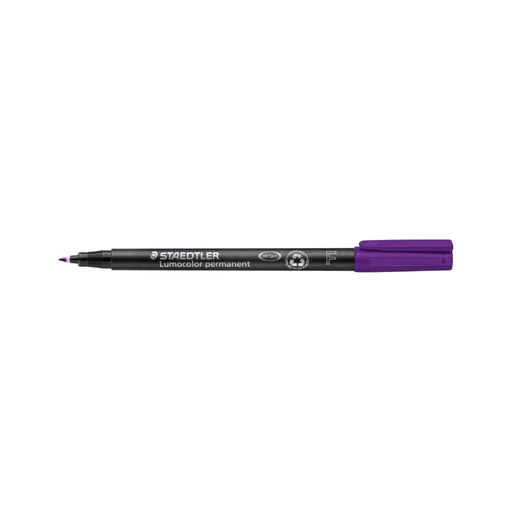
Why this product suits this user: This purple permanent marker is ideal for occasional labelling, colour-coding and fine notes on smooth, non-porous surfaces.
Clearly identified as a permanent model, it won’t be confused with wipe-clean Lumocolor versions for films.
Fine line of around 0.6 mm, DRY SAFE in accordance with ISO 554, and refillable using station 487 17.
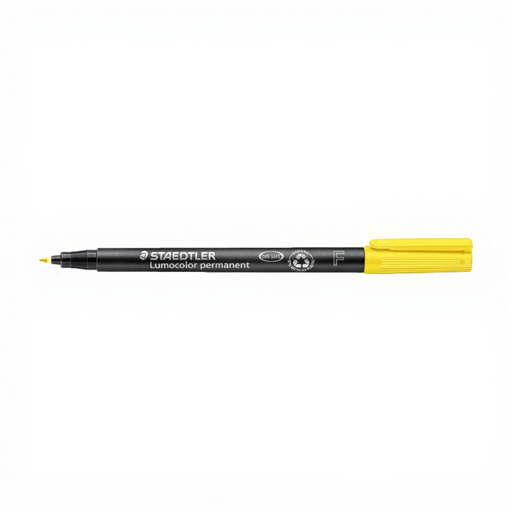
Why this product suits this user: This yellow permanent marker combines a fine F tip with a vivid colour, making it suitable for laboratory labelling, films and colour-coding.
Details about the permanent ink, drying time and suitable surfaces make its intended use clear, rather than relying on a bold colour alone.
0.6 mm synthetic tip, water- and smudge-resistant marks once dry, and compatibility with refill station 487 17.
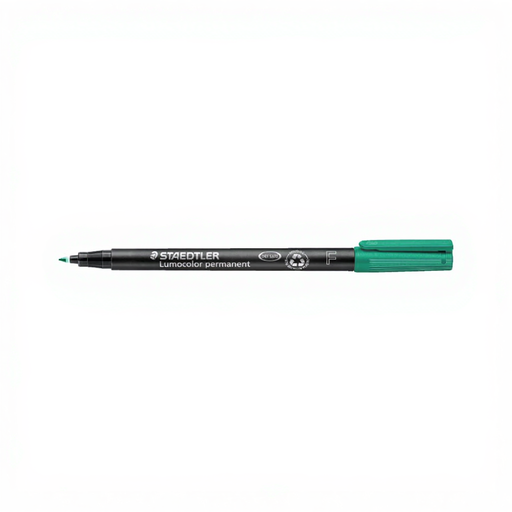
Why this product suits this user: The green version comes in a pack of ten, making it a good choice for schools, warehouses, workshops or regular labelling jobs.
The pack size helps prevent shortages when markers are used frequently, while the refillable design and DRY SAFE feature make storage and use more predictable.
Pack of ten with green ink, fine 0.6 mm tip, barrel made from 97% recycled plastic according to the product details, and a refillable design.
We’ve put together a complete, regularly updated list of products that meet these strict selection criteria and fully comply with the safety regulations in force in the EU.
According to the product details, the permanent models are designed for almost all smooth, non-porous surfaces, including glass, plastic and metal. Check that the ink adheres as intended on an inconspicuous area before applying a final label.
For DRY SAFE models, uncapped storage for several days is specified in accordance with ISO 554. Actual usable life depends on the environment, temperature and ink level. To help the marker last as long as possible, close the cap straight after writing.
Yes. The permanent models listed are designed for the STAEDTLER refill station 487 17. According to the product details, non-permanent versions use station 487 15. When buying a refill, make sure the refill station is compatible with the ink type.