
Lieferung heute & morgen

Qualitätsgarantie

Willkommens-Angebote freischalten: KOSTENLOSE Lieferung | Bis zu 80 % RABATT | Kostenlose 30-Tage-JoyPlus-Testphase
App herunterladen
If you want to write on glass, plastic, film or laminated materials, an ordinary felt-tip pen will not do. A STAEDTLER Lumocolor non-permanent marker is designed for temporary markings on smooth, non-porous surfaces. Even so, the models differ considerably in line width, colour, handling and refillability.
Before buying, pupils, students, teachers, office workers and creative users should avoid three common mistakes: choosing a film marker that is too broad for small labels, using the ink on the wrong surface, or confusing a wipeable marker with a classic whiteboard marker.
The designations S, F, M and B represent different nib widths among the available variants:
A fine marker nib is not automatically suitable for every task. On a large projection film, a very thin line may be harder to read from a distance. Conversely, a broad marker can cover small planning fields or film labels.
According to the product information, the water-soluble ink is intended for smooth, non-porous materials. These include glass, plastic, OHP film, laminated surfaces and certain whiteboards, for example. On textiles, untreated wood, wallpaper or other absorbent materials, however, the ink can soak in and leave stains.
Before the first extensive application, it is advisable to carry out a quick test in an inconspicuous area. On many suitable surfaces, a lightly moistened cloth is all that is needed for removal. On a whiteboard, therefore, a non-permanent marker should not necessarily be regarded as the same as a dry-wipe whiteboard marker.
A refillable marker can be more practical than a disposable product if used regularly. According to the product descriptions, several STAEDTLER Lumocolor variants are compatible with refill station 487 15. Some offers mention refill station 487 17. You should therefore check the relevant product page for the suitable station before buying.
To ensure an even flow of ink, keep the pen capped after use and store it horizontally wherever possible. A cap that is not fully clicked into place can allow the nib to dry out.
A water-soluble marker is useful for changing labels when you want to remove the marking later with a damp cloth. According to the available product information, a universal marker from the Lumocolor non-permanent range is suitable for numerous smooth surfaces, including glass, plastic, metal, film and projection materials.
However, “universal” should not be taken as approval for every surface. The nature of the material, coatings and any grease or dust residue can affect the writing result. Dry-cleaning the surface before writing can help the ink adhere more evenly.
M or B variants are suitable for presentations, teaching materials and large-scale markings. For calendar fields, film notes, technical sketches and small labels, S or F is usually more appropriate.
Choose the colour according to the distance from which the surface will be viewed. A red, blue, green or black marker can be useful for colour-coded processes. Black generally provides neutral labelling, while red, blue or green can make different categories easier to distinguish.
The STAEDTLER product information describes the ink as fast- or instant-drying. This can reduce the risk of smudging, but should not be taken to mean that it is completely resistant to rubbing. On very smooth surfaces, it is sensible to give the marking a little time to dry before touching it or placing items on top of it.
According to the specifications, several variants feature an automatic pressure-equalisation system for transport by air. This function may be relevant for people who travel for work. Regardless, the cap should always remain fully closed.
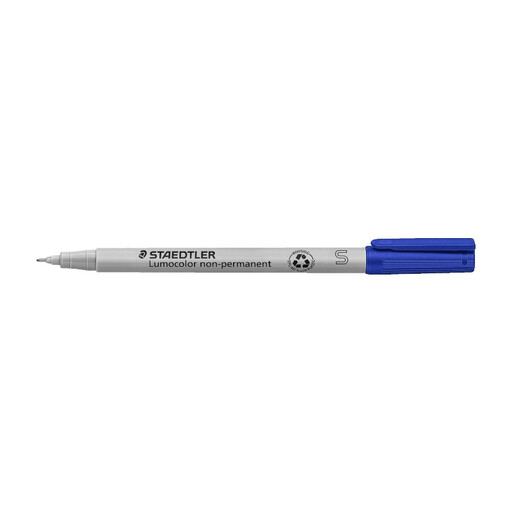
Why this product suits this profile: The superfine synthetic nib is ideal for precise notes on film, glass and plastic, without a broad line taking up unnecessary space.
The specified line width of approximately 0.4 mm reduces the risk of overcrowding small labelling areas with an overly bold line.
Water-soluble ink, fine 0.4 mm nib and, according to the product information, refillability with station 487 15.
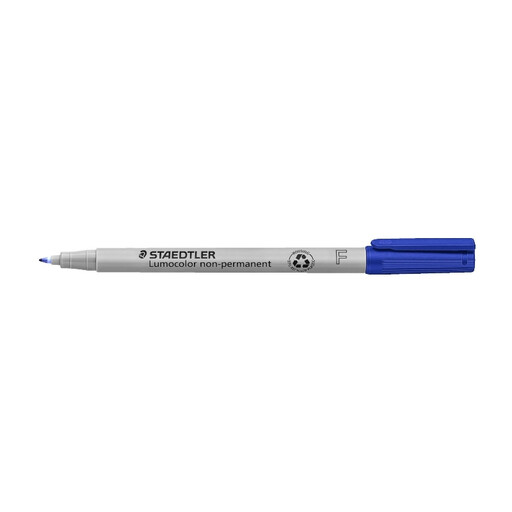
Why this product suits this profile: The F nib combines well-controlled lines with enough visibility for teaching, office work and presentations.
The medium-fine width strikes a balance between lines that are too thin and a B nib that is too broad for detailed work.
Approximately 0.6 mm line width, blue colour, water-soluble ink and, according to the product information, refillable design.
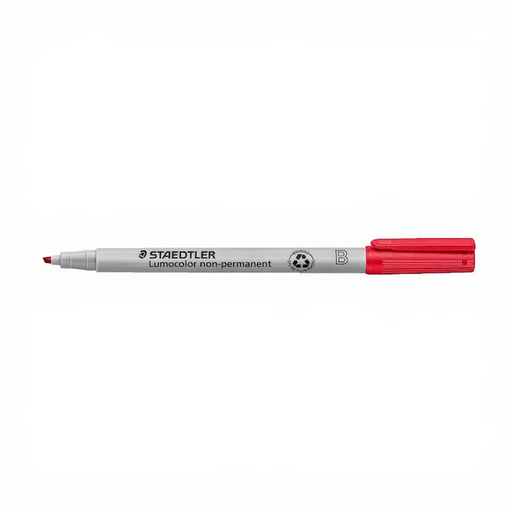
Why this product suits this profile: The broad plastic nib is designed for bold red markings on presentation film, whiteboards and other smooth surfaces.
The clearly specified B width prevents you from choosing a film marker that is too fine for markings viewed from a distance.
Red ink, broad 1.0/2.5 mm nib, plastic barrel and, according to the product information, fast drying.
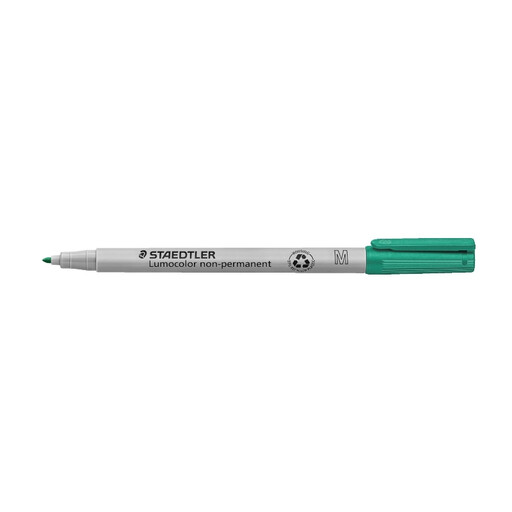
Why this product suits this profile: The green medium nib is ideal for colour-coded processes, teaching sketches and reusable planning materials.
Its stated water solubility makes the marking more suitable for changing content than a permanent marker.
Green 1.0 mm nib, PP barrel, wipeable ink and, according to the product information, refillability with 487 15.
We have compiled a complete, regularly updated list of products that fully meet these strict selection criteria and the safety regulations applicable in the EU.
According to the product information, the water-soluble ink can be removed from smooth, non-porous surfaces with a damp cloth. For dry removal with a felt eraser, a classic whiteboard marker is generally the more suitable product category. The surface should be tested before use.
The S nib, at approximately 0.4 mm, is intended for small labels and fine drawings. The F variant, at approximately 0.6 mm, offers greater visibility while still providing precise lines. For presentations viewed from a greater distance, M or B, at approximately 1.0 mm or 1.0/2.5 mm respectively, may be more suitable.
The most important step is to close the cap fully immediately after use. Storing the marker as horizontally as possible helps maintain an even flow of ink. With compatible models, refill station 487 15 or the station specified on the relevant product page can enable continued use. Only refill systems specified by the manufacturer should be used.