
Lieferung heute & morgen

Qualitätsgarantie

Willkommens-Angebote freischalten: KOSTENLOSE Lieferung | Bis zu 80 % RABATT | Kostenlose 30-Tage-JoyPlus-Testphase
App herunterladen
Whether in the office, garden, warehouse or for arts and crafts: a STAEDTLER Lumocolor Permanent Marker should write reliably without becoming illegible at the first contact with water or rubbing. At the same time, the models differ considerably in terms of line width, tip shape, colour, drying time and refillability.
If you only look at the colour description or the word “Permanent”, it is easy to choose a product that does not really suit your needs. The following selection criteria will help you find the right permanent marker for Germany and a range of everyday situations.
A permanent marker can adhere to glass, metal, plastic, wood or paper. However, this does not mean that the marking will remain visible for equally long on every surface. Porous materials such as untreated wood, cardboard or textiles absorb the ink. Once applied, it may be difficult or even impossible to remove completely.
On smooth surfaces, a permanent marking may be partially removed with suitable cleaning products. It is therefore advisable to test the marker on an inconspicuous area before using it for the first time.
A chisel tip measuring around 1.0 to 2.5 mm or 2 to 5 mm is suitable for headings, boxes and clearly visible markings. For small labels, diagrams or precise notes, a marker with a fine tip is more suitable.
The designations “B”, “M”, “F” or “S” usually describe the tip shape or line width. Buyers should check the measurement in millimetres instead of relying solely on the letter.
According to the available product information, a marker with DRY SAFE technology can remain open for several days after ISO-554 testing without drying out immediately. This is practical in the classroom, warehouse or during longer tasks. Nevertheless, closing the cap securely provides better long-term protection for the ink.
Storage is also relevant: many models are recommended to be stored horizontally so that the ink reaches the tip evenly.
A round tip produces an even line. A chisel tip allows you to create different widths depending on how you hold the marker. For varied tasks, this can avoid the need to buy several different markers.
A waterproof marker is suitable for labels that may be exposed to splashes or moisture. “Smudge-resistant” should always be understood in relation to the specific surface. On many smooth materials, the ink dries quickly and offers good resistance to rubbing; on dusty, greasy or very uneven surfaces, adhesion may vary.
The Lumocolor models in this selection are described as having permanent, quick-drying and low-odour ink. Several variants are stated to be free from xylene and toluene. As alcohol-based ink can be flammable, users should follow the safety instructions on the packaging and work in well-ventilated areas.
A marker for glass, metal, plastic and wood should be used on a clean, dry surface. Garden labels may also involve terracotta, stone and rough wooden sticks. For outdoor labels that need to remain visible for longer, a model with weather- and light-resistant ink is a practical choice.
If you mainly label paper or films, however, you do not necessarily need a dedicated outdoor version. In this case, line width, colour and refillability are often more important.
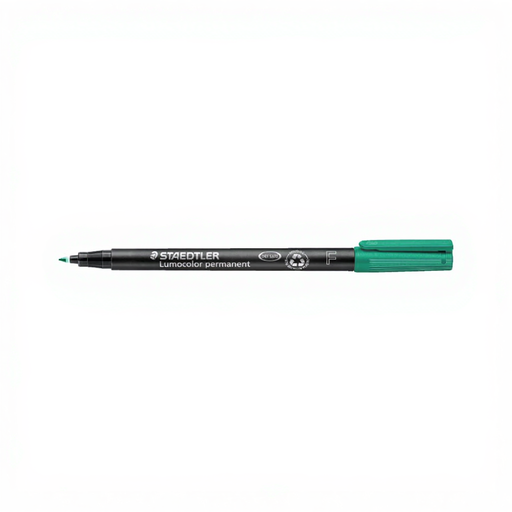
Why this product suits this profile: The fine line width of around 0.6 mm is suitable for labelling around the home, at university and in the office. The pack of ten green markers is practical if you regularly need several pens.
The defined F tip reduces the risk of covering small labels with a line that is too broad. DRY SAFE provides additional protection if the cap is left open briefly.
Approx. 0.6 mm line width, permanent ink, DRY SAFE and refillable with Station 487 17.
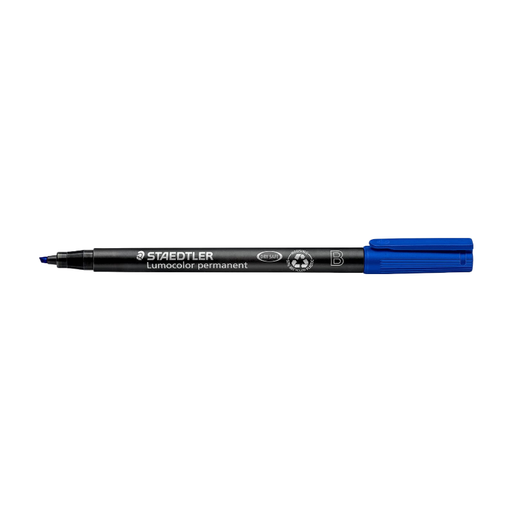
Why this product suits this profile: The blue universal ink and chisel tip measuring around 1.0 or 2.5 mm cover both precise labelling and clearly visible markings.
The two usable line widths mean you do not need a separate pen for every marking size. The product information also specifies DRY SAFE according to ISO 554 and automatic pressure regulation.
Specified for almost all surfaces, smudge-resistant and water-resistant once dry, and refillable with Station 487 17.
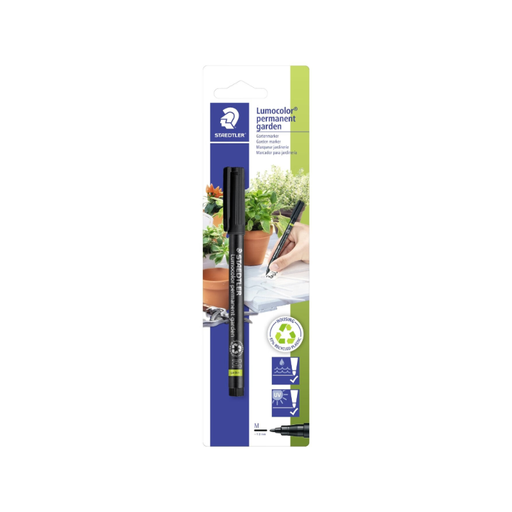
Why this product suits this profile: The round tip, approximately 1.0 mm wide, and the stated weather and light resistance make it suitable for gardeners, landscapers and crafters who need to label items outdoors.
This version is described not merely as a general permanent marker, but specifically as suitable for labels exposed to the weather. Soil, oil and moisture should be removed before use.
Black, quick-drying ink specified as water-, smudge-, weather- and light-resistant on a range of outdoor materials.
We have put together a complete, regularly updated list of products that fully meet these strict selection criteria and the safety regulations applicable in the EU.
Permanent ink should not be applied to the skin. When using solvent-based variants, ensure adequate ventilation. Caps and small parts are not suitable for children under three years of age. On textiles, wallpaper and untreated wood, markings may remain permanent.
The product information describes several Lumocolor models as waterproof or water-resistant and smudge-resistant on almost all surfaces. Actual resistance depends on the material, drying time and level of exposure. On a clean, smooth surface, the ink will generally adhere more evenly than on a greasy or heavily textured surface.
Its service life depends on how often it is used, how it is stored, the line width and whether the cap is closed completely. Models with DRY SAFE technology are more tolerant if left open briefly. A refillable permanent marker can continue to be used regularly as long as the tip and barrel are still intact and the appropriate refill station is available.
Models with a tip measuring approximately 0.4 mm or 0.6 mm are better suited to small writing and fine details. An M marker measuring around 1.0 mm offers greater visibility on medium-sized labels. For large cartons, signs and bold areas of colour, a chisel tip measuring approximately 2 to 5 mm is more practical.