
Lieferung heute & morgen

Qualitätsgarantie

Willkommens-Angebote freischalten: KOSTENLOSE Lieferung | Bis zu 80 % RABATT | Kostenlose 30-Tage-JoyPlus-Testphase
App herunterladen
Whether in the office, seminar room, at university or for creative projects, a STAEDTLER Lumocolor marker may be suitable for transparencies, glass, plastic, paper and other surfaces. However, the key question is not simply “Which colour do I like?” but rather: Should the writing be permanent, wipeable or especially visible on paper?
The term “universal marker” sounds comprehensive, but it does not replace checking the ink. A Lumocolor Permanent Marker is designed for permanent markings, while a Lumocolor Non-Permanent Marker can be removed from smooth surfaces. On porous materials such as untreated wood, cardboard or textiles, even water-based ink can leave stains.
A 0.4 mm marker is suitable for fine lettering, technical notes and small areas. For headings or presentations viewed from a greater distance, a medium or broad tip is usually easier to read. A 1.0 mm marker offers a balanced compromise for notes, labelling and simple drawings.
According to STAEDTLER product information, water-based ink can be removed from suitable smooth surfaces, such as transparencies, with a damp cloth. Nevertheless, you should test compatibility on an inconspicuous area before first use. Plastic surfaces in particular can have different coatings, which may affect how the ink adheres.
For changing information on overhead transparencies, glass or smooth plastic surfaces, a water-based Staedtler marker or a Lumocolor Non-Permanent Marker is a suitable choice. According to STAEDTLER product information, this variant can be wiped off transparencies with a damp cloth.
A permanent Staedtler marker, on the other hand, is designed for labelling that should remain in place for as long as possible. STAEDTLER product information lists glass, plastic, metal, paper and transparencies among its possible areas of use. However, removing it from porous surfaces can be difficult. Therefore, check beforehand whether a permanent marking is really what you need.
The tip determines more than just the appearance; it also affects readability:
An overhead projector marker should be clearly legible on transparencies without producing unnecessarily broad lines. For flipcharts, a bolder tip is more suitable, so that text can still be read from several metres away.
Fast-drying ink can help reduce smudging while you write. According to STAEDTLER product information, selected Lumocolor models also feature DRY SAFE technology. Under the specified test conditions, the marker can remain uncapped for a certain period without drying out. Nevertheless, the cap should be replaced after use.
If you use markers regularly, look for a refillable marker. According to product information, several Lumocolor models are compatible with suitable STAEDTLER refill stations. This can reduce the need to replace complete pens. Storing many models horizontally helps maintain an even distribution of ink.
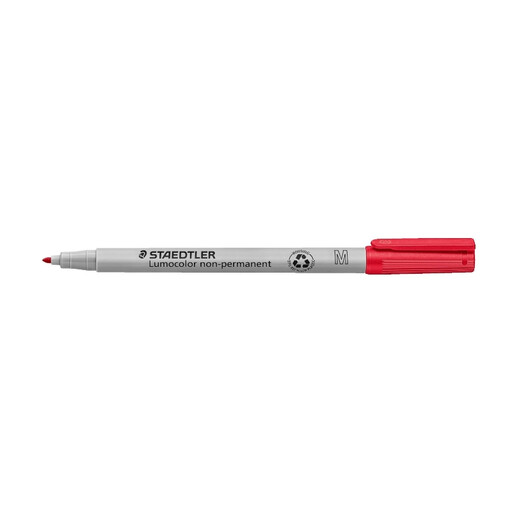
Why this product suits this profile: The medium 1.0 mm tip is suitable for everyday notes, transparencies and markings on smooth surfaces. The red colour makes it easier to distinguish between different items in the classroom or office.
The water-based, non-permanent ink prevents a short-term marking on a transparency from becoming unnecessarily permanent. Suitability for porous materials should be checked separately.
According to STAEDTLER product information, the ink can be wiped off a transparency with a damp cloth, and the marker is refillable.
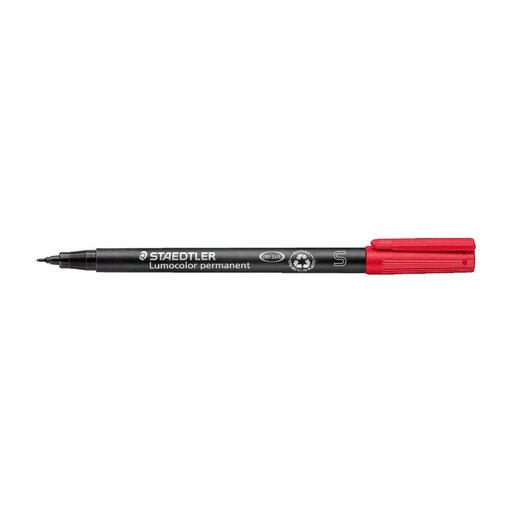
Why this product suits this profile: The superfine 0.4 mm tip is designed for precise labelling on suitable smooth and porous surfaces when a permanent marking is required.
The clear permanent designation prevents confusion with wipeable variants. Before using it on glass, plastic or textiles, it is advisable to test it on a small area.
According to STAEDTLER product information, the ink dries quickly, is virtually odourless and the marker can be used with refill station 487 17.
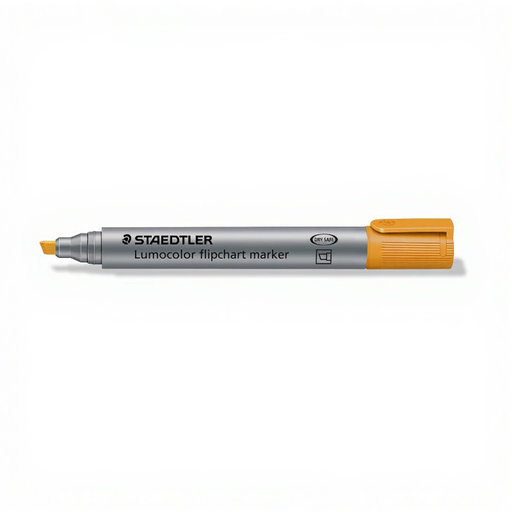
Why this product suits this profile: The chisel tip is designed for varying line widths, making it suitable for workshops, conferences, lessons and presentations on flipchart paper.
The broad 2 to 5 mm tip prevents presentation text from becoming difficult to read from a distance when written with a tip that is too fine for the purpose.
According to STAEDTLER product information, the ink is water-based, intended for paper and can be used with a suitable refill station.
For cards, scrapbooking and dark paper, metallic markers are worth considering. According to product information, the STAEDTLER Metallic Marker Bullet Green has water-based metallic pigment ink and a round tip producing a line width of approximately 1 to 2 mm. The purple metallic pen also has a round plastic tip for lines of around 1 to 2 mm. For both variants, horizontal storage and replacing the cap after use are recommended.
If you want to write permanently on glass, plastic or metal, you can choose a permanent marker with a medium 1.0 mm tip. For changing markings on transparencies or smooth surfaces, the non-permanent variant with a similar line width is the more straightforward choice.
We have put together a complete, regularly updated list of products that fully meet these strict selection criteria and the safety regulations applicable in the EU.
For changing markings on overhead transparencies, a Lumocolor Non-Permanent Marker is suitable. An S tip of approximately 0.4 mm is intended for fine notes, while the M tip of approximately 1.0 mm is better suited to clearly visible standard labelling.
Its service life depends on writing pressure, line width, frequency of use and storage. According to STAEDTLER product information, a refillable marker can be replenished with ink using the appropriate refill station. Check the specific compatibility against the model number before buying.
This depends on the type of ink, the surface and the time it has been left in place. Permanent ink is specifically designed to create a durable marking and can be difficult to remove from porous materials. Suitable cleaning products may help on smooth surfaces, but residue-free removal cannot be guaranteed in every case.