
Lieferung heute & morgen

Qualitätsgarantie

Willkommens-Angebote freischalten: KOSTENLOSE Lieferung | Bis zu 80 % RABATT | Kostenlose 30-Tage-JoyPlus-Testphase
App herunterladen
A STAEDTLER Lumocolor Non-Permanent Marker is designed for situations where markings need to be visible but not permanent. Pupils and students use it for overhead projector film, teachers for presentations, office workers for temporary labelling, and creative users for smooth materials such as glass or plastic.
However, buying one can often lead to misunderstandings. Not every marker described as “wipeable” is suitable for every surface or line width. The following points will help you avoid unnecessary unsuitable purchases.
A water-soluble film marker can usually be removed from smooth, non-absorbent surfaces with a damp cloth. On paper, card, textiles, untreated wood or wallpaper, however, the ink may soak in and leave stains. If you are looking for a non-permanent marker for changing labels, you should therefore check material compatibility first.
For small notes on film or detailed drawings, 0.4 mm or 0.6 mm are practical choices. For headings, highlighting and presentation content that needs to be easy to see, a chisel tip measuring 1.0/2.5 mm may be more suitable. A tip that is too broad makes precise writing more difficult, while a very fine tip may be less legible from a greater distance.
According to the product information, the ink in the Lumocolor Non-Permanent range dries quickly on the surface. This reduces the risk of smudging while writing. However, as soon as the marking comes into contact with water or a damp cloth again, it may come off. A permanent marker is therefore required for lasting labels.
The tip should be selected according to the available space and the level of readability required:
A universal marker for smooth surfaces should also write as evenly as possible. With chisel tips, the line width depends on the angle at which the marker is held.
The water-soluble ink is primarily intended for film, glass, plastic and other non-porous materials. A soft, slightly damp cloth is normally all that is needed for removal. Before using it for the first time on sensitive materials, testing it on an inconspicuous area is recommended.
Dust, grease and fingerprints should be removed from glass or plastic wherever possible. This helps the marking adhere more evenly and makes it easier to wipe off in a controlled manner later.
A refillable marker can be more economical and resource-efficient than a disposable product if used regularly. According to the product information, several Lumocolor models are compatible with the STAEDTLER refill station 487 15. The cap should be closed fully after every use. Storing the marker horizontally or in its original box can help distribute the ink evenly.
For travellers, the specified automatic pressure regulation is also relevant. It is intended to reduce the risk of ink leakage caused by changes in pressure during air travel. The marker is therefore described as aircraft-safe; the cap should nevertheless remain closed during transport.
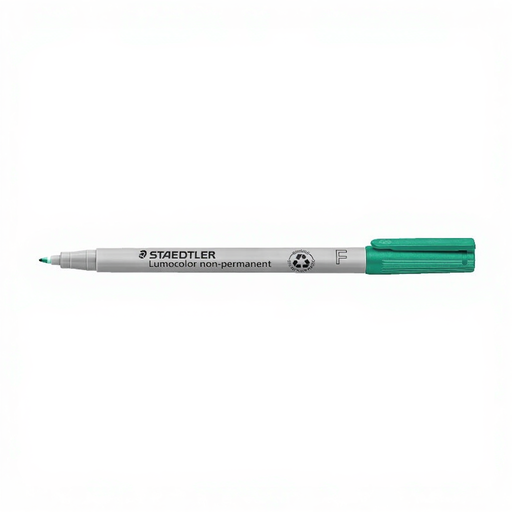
Why this product suits this profile: The fine 0.6 mm tip is suitable for everyday labelling on film, plastic and glass, without relying on an extremely narrow 0.4 mm tip.
The water-soluble ink is designed to be wiped off film with a damp cloth. It should not be used on absorbent materials without testing it first.
Approx. 0.6 mm line width, water-soluble ink, PP barrel and refillable using station 487 15.
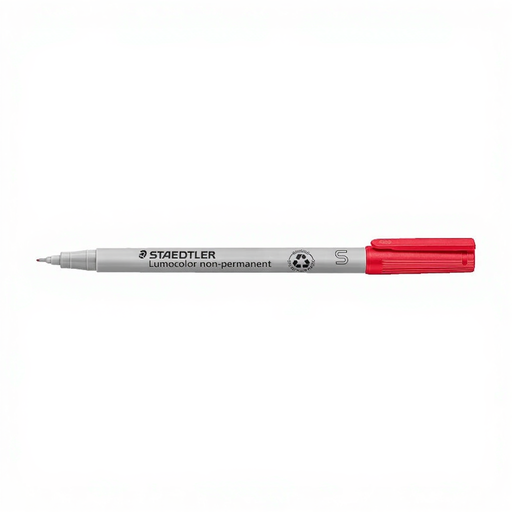
Why this product suits this profile: The superfine tip is designed for small writing, detailed sketches and densely labelled overhead projector film.
The clearly defined 0.4 mm tip prevents an overly broad line from covering small details. The same applies to absorbent materials: test it first on an inconspicuous area.
Very fine line definition, red ink with high colour brilliance according to the product description, and refillable using 487 15.
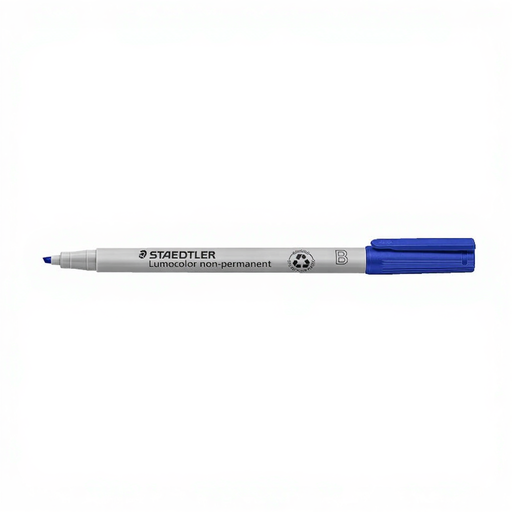
Why this product suits this profile: The chisel tip allows variable line widths, making it suitable for presentations, conferences, labelling and frequent use.
The variable width makes the actual line size easy to understand. For fine details, however, an F or S tip offers greater control.
Chisel tip with approx. 1.0 and 2.5 mm widths, water-soluble ink, quick drying and stated aircraft safety.
We have put together a complete, regularly updated list of products that fully meet these strict selection criteria and the safety regulations applicable in the EU.
The surface should be clean and dry before you start writing. For film, glass or plastic, a soft cloth without aggressive cleaning products is recommended. Once the ink has dried, avoid unnecessary contact between the surface and water. A slightly damp cloth is all that is needed for removal; the surface can then be wiped dry.
The cap must close fully and audibly. For longer-term storage, protect the marker from heat, direct sunlight and significant temperature fluctuations. The actual service life depends on line width, writing pressure, frequency of use and storage conditions. It is therefore not possible to give a reliable general shelf-life estimate.
On smooth glass, the water-soluble ink can normally be wiped off with a damp cloth according to the product information. For coated or porous materials, test it first on an inconspicuous area.
Yes. The Lumocolor Non-Permanent models are designed as overhead projector markers for film. The appropriate line width depends on the available space and the viewing distance: 0.4 or 0.6 mm for details, and 1.0/2.5 mm for clearly visible markings.
There is no fixed service life, as it depends on the amount of ink, the tip selected and how often the marker is used. When the ink level is low, a compatible model can be refilled using the STAEDTLER refill station 487 15. Closing the cap securely helps prevent the marker from drying out prematurely.