
Lieferung heute & morgen

Qualitätsgarantie

Willkommens-Angebote freischalten: KOSTENLOSE Lieferung | Bis zu 80 % RABATT | Kostenlose 30-Tage-JoyPlus-Testphase
App herunterladen
If you want to label transparencies, glass, plastic or other smooth surfaces temporarily, you need more than an ordinary felt-tip pen. The STAEDTLER Lumocolor non-permanent Marker is designed as a water-soluble marker for non-porous materials. However, you should check a few features carefully before buying, so that the marker is genuinely suitable for its intended use in the office, classroom, laboratory or while travelling.
A marker with a broad tip may be highly visible on an overhead projection transparency, but it takes up a lot of space in small labelling areas. For technical sketches, tables or small labels, a fine tip is usually more practical. The Lumocolor models are available with, among others, a 0.6 mm fine tip and a 0.4 mm superfine tip.
A wipeable transparency pen is primarily intended for smooth, non-absorbent surfaces. On glass, plastic, coated transparencies or smooth metal, the ink can be removed with a damp cloth. On textiles, wallpaper, untreated wood or other porous materials, however, it may leave stains. A quick test in an inconspicuous area is therefore advisable.
Fast-drying ink helps reduce smudging while writing. On very smooth surfaces, however, it may still be sensible to wait a few seconds before touching the label. It is equally important to replace the cap securely after every use. Otherwise, the synthetic tip may dry out, regardless of how robust the barrel is.
For these models, the designations S and F indicate different tip widths:
If you regularly write on OHP transparencies, you should also consider colour intensity. Brilliant colours may be easier to see when projected. However, actual visibility also depends on the projector, transparency material and ambient lighting.
An OHP marker with water-soluble ink should adhere to smooth materials without penetrating permanently. According to the product information, the Lumocolor models are intended for almost all smooth surfaces, including transparencies, glass and plastic. To remove the ink, use a soft cloth moistened with water.
On a traditional whiteboard, the marker cannot automatically be removed with a dry felt eraser. As the ink is water-soluble, moisture is normally required. If you want to erase exclusively when dry, you should choose a whiteboard marker designed for this purpose instead.
A refillable marker can reduce ongoing costs and material consumption if it is used frequently. The STAEDTLER models mentioned are compatible with refill station 487 15. Refilling should be carried out in accordance with the manufacturer’s instructions.
For business trips, seminars or air travel, the so-called Airplane-safe version is also relevant. According to the product description, an automatic pressure compensation system is designed to prevent ink from leaking due to pressure changes on board an aircraft. This feature does not replace careful closure and secure storage in a bag.
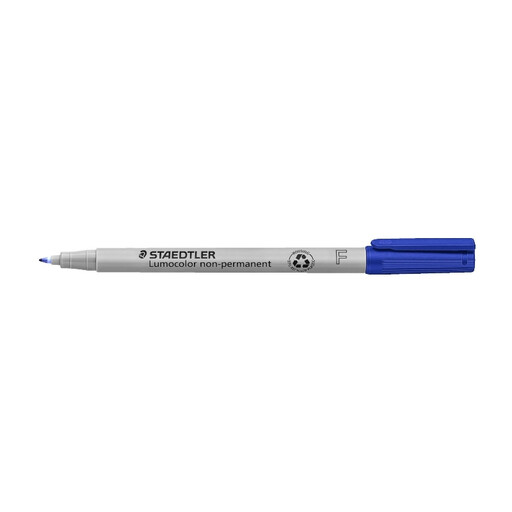
Why this product suits this profile: The blue fine tip is an easy choice for the office, university and classroom when you need lines that are easy to read without being too broad.
The defined line width of approximately 0.6 mm prevents an overly broad marker tip from unnecessarily filling small labelling areas. The water-soluble ink can be wiped from transparencies with a damp cloth.
Fine synthetic tip, water-soluble ink, polypropylene barrel and refill option using station 487 15.
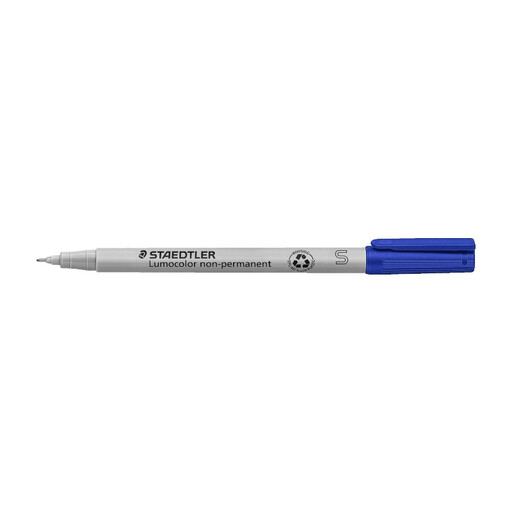
Why this product suits this profile: The superfine tip is ideal for users who want to create particularly small, controlled markings on transparencies, glass or plastic.
The 0.4 mm tip reduces the risk of details becoming illegible because of an overly thick line. The water-soluble formula remains suitable for temporary markings.
Superfine synthetic tip, highly vibrant colour, fast drying and Airplane-safe pressure compensation.
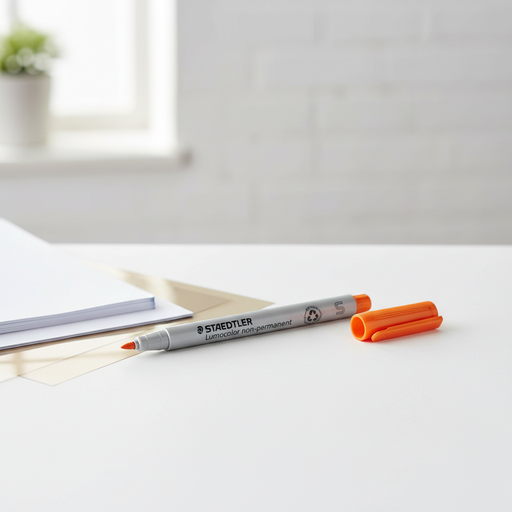
Why this product suits this profile: Orange is useful as an additional identification colour in laboratories, technical work, training and creative workflows, while the fine tip allows for detailed markings on small areas.
The wipeable, water-soluble ink is intended for temporary markings on non-porous surfaces. Thanks to its refillable design, the pen does not need to be replaced immediately when the reservoir is empty.
0.4 mm superfine tip, bright orange ink, damp wiping and compatibility with refill station 487 15.
We have put together a complete, regularly updated list of products that fully meet these strict selection criteria and the safety regulations applicable in the EU.
For an even finish, the surface should be free from grease, dust and moisture. Before using the marker over a large area, it is advisable to make a quick test stroke. This allows you to check whether the ink is sufficiently visible and can be removed with a damp cloth.
Care involves three simple steps:
The caps may present a choking hazard and should therefore be kept away from children under three years of age. The ink is not intended to be swallowed or applied to the skin. Even water-soluble ink can leave permanent marks on absorbent materials.
On smooth, non-porous surfaces, the water-soluble ink can usually be removed with a damp cloth. Coated or delicate materials should be tested first in an inconspicuous area.
The superfine tip, measuring approximately 0.4 mm, is intended for particularly small writing and fine drawings. The fine tip, measuring approximately 0.6 mm, produces slightly stronger lines and may be easier to read on presentations or calendars.
The models mentioned can be refilled using the STAEDTLER refill station 487 15. This helps extend their usable life. To maintain an even ink flow, always close the cap securely and store the marker correctly.