
Lieferung heute & morgen

Qualitätsgarantie

Willkommens-Angebote freischalten: KOSTENLOSE Lieferung | Bis zu 80 % RABATT | Kostenlose 30-Tage-JoyPlus-Testphase
App herunterladen
Finding the right pen for specialised tasks can be a challenge. Whether for a presentation on an overhead transparency, permanently labelling lab equipment, or organising CDs, not every marker adheres reliably to smooth surfaces. The STAEDTLER Lumocolor series offers specialised solutions for a variety of applications. This article serves as a guide to help you understand the features of the different models and make an informed choice.
As your Joybuy Product Recommendation Officer, I have compiled the relevant product information to give you a factual overview of the Lumocolor pens.
The decision for the right pen depends on three key factors: the desired durability of the ink, the properties of the surface, and the required precision.
The most fundamental distinction lies in the permanence of the ink.
Not every ink adheres equally well to every material. While standard Lumocolor pens are suitable for a wide range of surfaces like paper, cardboard, plastic, and metal, some materials require a specialty marker for smooth surfaces. These include optical lenses, lab utensils, or specially coated CDs. The Lumocolor permanent special series was developed for such cases, with ink optimised for maximum adhesion on difficult substrates.
The line width, specified in millimetres, determines the fineness of the lines. A Fine liner 0.6mm (designated "F" for "Fine") allows for detailed and clean labelling in small spaces, as required for marking CDs or small components. For labels that need to be easily legible from a distance, wider tips (e.g., "M" for "Medium") are the better choice.
Based on different requirements, we have selected three models from the Lumocolor series that cover specific areas of application.
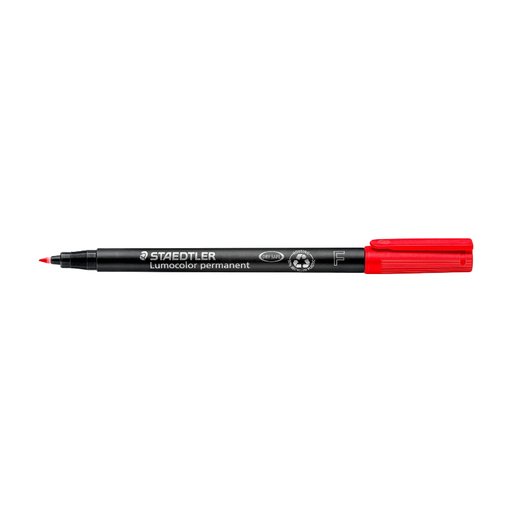
What makes it stand out: This universal pen is a reliable tool for permanent markings on almost any surface. Its ink is quick-drying, which makes it particularly practical for left-handers. According to the manufacturer, the DRY SAFE technology ensures that the pen can be left uncapped for days without drying out (in accordance with ISO 554).
Advantages:
Who it's for: Users in the office, logistics, or at home who need a versatile and reliable waterproof red marker for the permanent labelling of folders, transparencies, or plastic boxes.
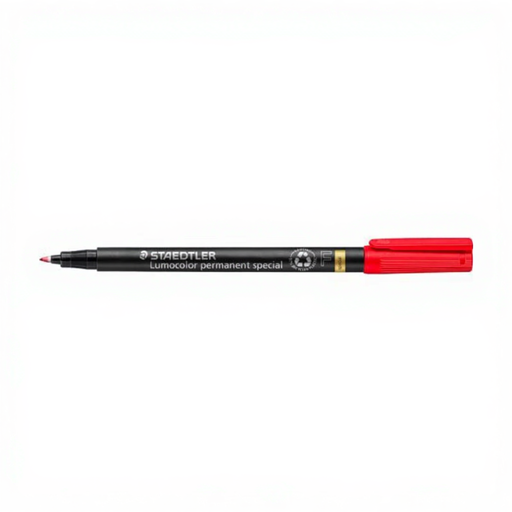
What makes it stand out: This specialty marker was developed for surfaces where conventional permanent markers do not adhere. Its ink adheres reliably to coated surfaces, nano-coatings, optical glass, and lab utensils. According to the manufacturer, the barrel is made of 97% recycled plastic (in accordance with ISO 14021).
Advantages:
Who it's for: Technicians, lab staff, and industrial users who require a permanent labelling solution for special, non-porous, or coated materials.
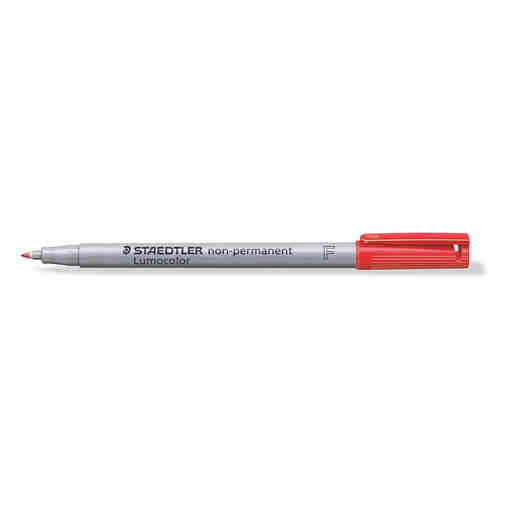
What makes it stand out: This Lumocolor non-permanent pen is the right choice for temporary markings. Its water-soluble ink can be easily wiped off smooth surfaces like transparencies, glass, or whiteboard films with a damp cloth. Nevertheless, the ink dries quickly to prevent smudging while writing.
Advantages:
Who it's for: Teachers, lecturers, and office professionals looking for a pen for presentations, brainstorming sessions on transparencies, or temporary labelling of wipeable surfaces.
The Lumocolor series offers a wide variety of colours, line widths, and sets. If the models presented here do not exactly meet your requirements, you may find a suitable alternative in our range.
Discover more options in our selection of red fine-tip pens.
1. What is the difference between Lumocolor permanent and non-permanent? The main difference is the ink. Lumocolor permanent uses waterproof ink for durable markings that cannot be easily removed. Lumocolor non-permanent uses water-soluble ink that can be wiped off smooth, non-porous surfaces with a damp cloth.
2. Can you use a STAEDTLER Lumocolor pen on glass? Yes, both versions can be used on glass. For permanent labelling that needs to withstand weather or cleaning, a permanent or specialty marker is suitable. For a temporary mark that you want to remove later (e.g., on a window or in a lab), the non-permanent pen is the correct choice.
3. How do you remove Lumocolor non-permanent ink? The ink of the Lumocolor non-permanent pen is water-soluble. To remove it from smooth, sealed surfaces like film or glass, a clean, damp cloth is all you need. No special cleaning agents are required.