
Lieferung heute & morgen

Qualitätsgarantie

Willkommens-Angebote freischalten: KOSTENLOSE Lieferung | Bis zu 80 % RABATT | Kostenlose 30-Tage-JoyPlus-Testphase
App herunterladen
If you’re looking for a STAEDTLER Lumocolor Permanent B blue marker for the office, warehouse, workshop or technical drawings, don’t focus on the colour name alone. The key considerations are line width, ink type, surface compatibility and long-term usability. A blue permanent marker can adhere reliably to glass, metal or plastic, provided the model is designed for the task.
“Permanent” describes the durability of the ink, but it doesn’t guarantee the same level of adhesion on every material. Smooth surfaces such as glass or metal may be greasy, dusty or damp. This can make the mark look faint at first or mean it rubs off more easily. Before writing on a surface, make sure it’s clean, dry and free from release agents.
A marker with a round tip is ideal for a consistent line, but is less versatile when switching between small details and large markings. A chisel-tip permanent marker can produce different line widths depending on the angle. According to the product specifications, the STAEDTLER Lumocolor Permanent B produces lines of around 1.0 mm and 2.5 mm.
Slow-drying ink can smudge on warehouse labels, film or technical sketches. At the same time, costs add up if you have to replace the whole marker when it runs out. A quick-drying marker with a refillable system can be more economical and convenient if you use it regularly. Even so, make sure you close the cap firmly after every use.
A chisel tip is a good choice if you need to write at different sizes. Its narrow edge allows you to add finer details, while the broad side is useful for prominent markings. The Lumocolor Permanent B 348 is designed as a blue marker with a 1.0 mm and 2.5 mm line width, making it suitable for two common types of task.
A medium round tip of around 1.0 mm, on the other hand, is ideal for consistent lettering. Models with a round tip of around 0.4 mm offer greater precision for very fine technical details, but don’t provide a broad marking surface.
A waterproof marker is a good option for permanent marking on many smooth materials. According to the product description, the Lumocolor Permanent B uses alcohol-based permanent ink that is free from xylene and toluene. It is designed for surfaces such as glass, metal, plastic, film, and CD and DVD media.
Actual adhesion depends on the surface. If you’re marking coated plastics, painted surfaces or items that are subject to heavy wear, test the marker on a small, inconspicuous area first. Marks can be particularly difficult to remove from paper, card or textiles.
According to the product specifications, the DRY SAFE feature has been tested in accordance with ISO 554 and is designed to prevent the marker from drying out for several days without its cap. This helps reduce the risk of interruptions to your workflow, but doesn’t replace the need to recap the marker after use.
The marker is compatible with the STAEDTLER refill station 487 17. For an even distribution of ink, store it horizontally. According to the manufacturer, the barrel and cap are made from polypropylene, while the tip is made from bonded polyester fibres.
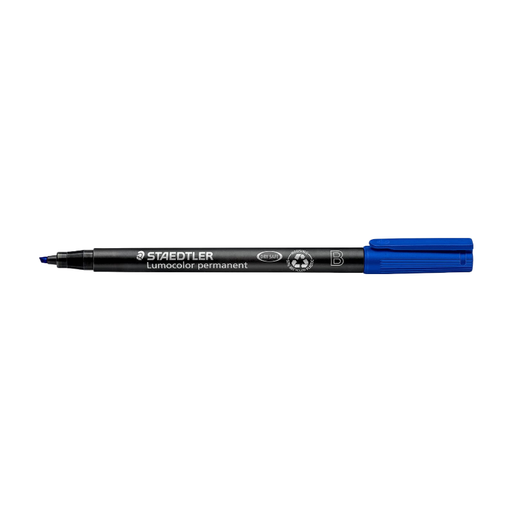
Why it suits this profile: The chisel tip handles both fine lettering and broader markings, so you only need one marker. This makes it a practical choice for occasional use at home, in the office or in the warehouse.
The variable line width means you don’t need two different tips for narrow and broad markings. The DRY SAFE feature also helps during brief periods when the cap is off.
Blue ink, a line width of around 1.0/2.5 mm, permanent ink for a range of smooth surfaces, and refillability with station 487 17.
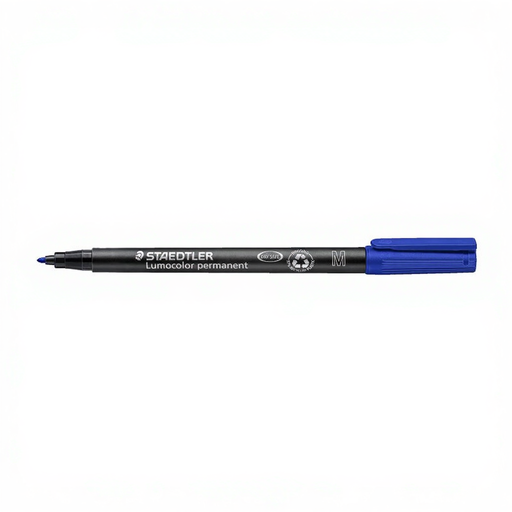
Why it suits this profile: If you regularly need to write with a consistent line, the medium tip offers a clearly defined alternative to a chisel tip.
The fixed line width helps avoid inconsistent marking thickness, which can happen with an unsuitable tip when you change the angle of your hand.
A line width of around 1.0 mm, smudge-resistant permanent ink, DRY SAFE and the option to refill using 487 17.
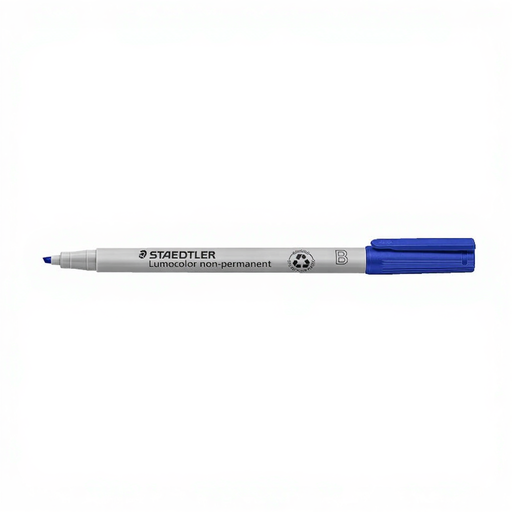
Why it suits this profile: For glass, film and other smooth surfaces where you’ll need to change the information later, water-soluble ink is a better choice than permanent ink.
It helps you avoid the common mistake of using permanent ink for temporary markings. You can wipe the writing off smooth surfaces with a damp cloth.
Chisel tip with a line width of around 1.0/2.5 mm, water-soluble universal ink, quick drying and refillable with 487 15.
Before using the marker for the first time, prime the tip briefly on a scrap piece of material. For glass and metal, use a suitable cleaner to remove grease. Make sure the cap clicks firmly into place to minimise ink evaporation. If you use markers frequently, a refill station can reduce the number of replacements you need. Make sure you use the right station: Permanent and Non-Permanent models aren’t necessarily compatible.
If you need a wipe-off marker rather than a permanent one, check the ink type carefully. The name Lumocolor Permanent marker doesn’t refer to the Non-Permanent versions.
We’ve put together a complete, regularly updated list of products that meet these strict selection criteria and fully comply with the safety regulations in force in the EU.
According to the product specifications, the permanent ink is designed for almost all surfaces, including glass, metal and plastic. It’s a good idea to test it on an inconspicuous area first, as coatings and dirt can affect adhesion.
How long it lasts depends on the line width, writing pressure, frequency of use and storage. A refill system extends the useful life of the barrel. Close the cap firmly after every use and store the marker horizontally where possible.
For information that needs to be changed frequently on glass, film or smooth plastic surfaces, a Non-Permanent model is usually more suitable. A permanent marker is intended for markings that aren’t meant to be removed easily.