
Lieferung heute & morgen

Qualitätsgarantie

Willkommens-Angebote freischalten: KOSTENLOSE Lieferung | Bis zu 80 % RABATT | Kostenlose 30-Tage-JoyPlus-Testphase
App herunterladen
A permanent marker needs to match both the surface and the intended use. If you choose based solely on colour or price, you may end up with a pen whose nib is too broad for small labels, whose ink will not adhere to plastic or which dries out during extended use. The STAEDTLER Lumocolor Permanent Marker is available in a range of line widths, colours and designs. The key consideration is therefore not just the brand name, but choosing the right variant.
A waterproof marker can adhere reliably to glass, metal or plastic, while water-based ink is intended for flipcharts and behaves differently on other materials. Even when using a marker designed for almost all surfaces, you should check the specific product description. On porous materials such as untreated wood or cardboard, permanent ink can soak in deeply and be difficult to remove.
A fine marker with a line width of around 0.4 or 0.6 mm is suitable for small labels, cable marking and detailed work. For boxes, signs and prominent headings, however, a broad marker with a line width of 2 to 5 mm is more practical. A chisel tip can offer several line widths, while a round tip usually produces a more consistent line.
DRY SAFE can be useful if the cap is left off briefly during a meeting or stocktaking. However, this feature does not replace carefully recapping the marker after use. Similarly, a refillable permanent marker is only a worthwhile long-term choice if the correct refill station is available. For an informed choice, buyers should therefore consider the ink, nib, refillability and storage requirements together.
For durable marking on glass, plastic, metal or smooth films, permanent, quick-drying ink is important. Depending on the model, the Lumocolor variants featured here are described as offering properties such as smudge resistance, water resistance and low odour. Performance can vary depending on the material, contamination and drying time. Before marking a large area, testing the marker on an inconspicuous spot is recommended.
A marker for glass and plastic should be used on a dry, grease-free surface. With metal and wood, the surface and its coating are also important. For garden labels, weather and light resistance are key considerations. According to the product information, the “Garden Marker” is designed for outdoor materials such as plastic, wood, ceramic, metal, glass and stone.
The main variants can be broadly categorised as follows:
A chisel nib is versatile but requires controlled movement. For consistently fine lines, a fine marker is the more practical choice.
Several Lumocolor Permanent Markers are listed with DRY SAFE. The product information refers to testing in accordance with ISO 554, under which the marker should not dry out for several days without its cap. This is practical protection against brief lapses in use, not a recommendation to store the marker open for extended periods.
Many permanent variants can be refilled using the STAEDTLER refill station 487 17. Buyers should check the compatibility of the specific model, as some product descriptions also mention station 488 50. For an even supply of ink, certain variants are designed to be stored horizontally. Making sure the cap clicks firmly into place after use remains the simplest way to prevent the marker from drying out.
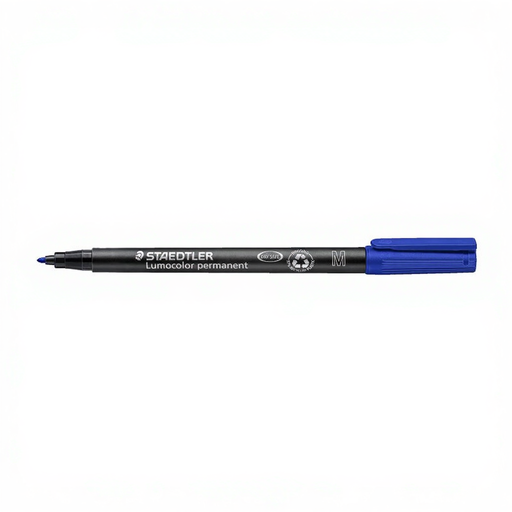
Why this product suits the profile: With a medium line width of around 1.0 mm, this marker covers typical tasks around the home, office and warehouse. The blue colour makes it easier to distinguish labels visually.
The clearly specified M nib helps prevent buying a marker that is too fine or too broad for standard labelling. DRY SAFE reduces the risk of the marker drying out quickly during short interruptions.
Permanent ink, an approximately 1.0 mm line width, DRY SAFE and refillability with station 487 17 according to the product information.
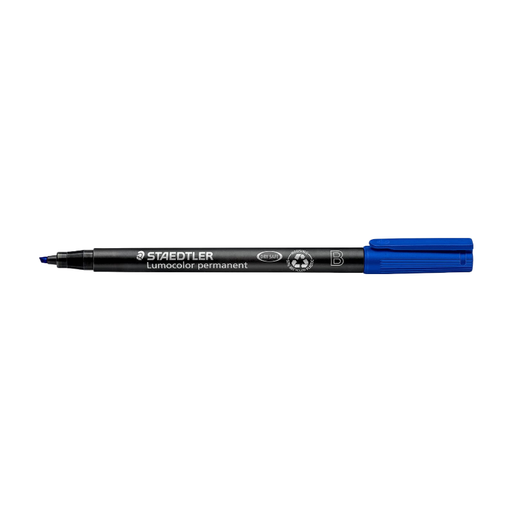
Why this product suits the profile: According to the product information, the chisel nib offers line widths of approximately 1.0 and 2.5 mm. This makes the marker suitable for finer markings as well as clearly visible lettering.
The two usable line widths reduce the need for several markers. DRY SAFE and the stated refillability help limit the need for frequent replacements.
Chisel nib with two specified widths, quick-drying permanent ink, DRY SAFE and refill station 487 17.
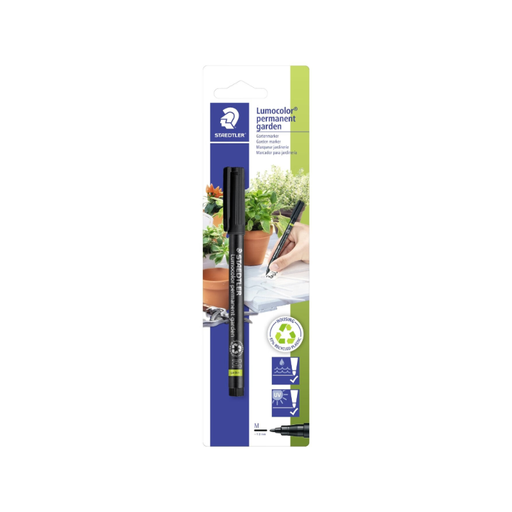
Why this product suits the profile: The version with a black M nib and an approximately 1.0 mm line width is designed for gardeners, landscaping and outdoor labelling.
Being identified as a Garden Marker distinguishes it from markers designed solely for flipcharts. According to the product information, its weather and light resistance are intended for outdoor materials such as wood, plastic, ceramic and metal.
Black M nib, quick-drying ink and, according to the product description, water-, smudge-, weather- and light-resistant properties.
We have compiled a complete, regularly updated list of products that fully meet these strict selection criteria and the safety regulations applicable in the EU.
Before marking, the surface should be dry, clean and as free from grease as possible. With permanent inks, testing on a sample is advisable, as markings on textiles, wallpaper and untreated wood may be difficult to remove. The pens are not intended for use on skin or food containers. Children under three should not have unsupervised access to markers and caps because of the risk of swallowing small parts.
Good ventilation is recommended for rooms where the marker will be used for extended periods. A flipchart marker is not automatically waterproof: the water-based ink used in Lumocolor flipchart variants is designed for paper presentations. Suitable permanent variants are therefore required for weatherproof garden labels or permanent warehouse marking.
The product information for the permanent variants states that they use water- and smudge-resistant ink. Actual adhesion depends on the surface and complete drying. Flipchart markers, on the other hand, use water-based ink and are designed for paper.
The service life depends on the line width, amount of writing, storage conditions and whether the marker is properly capped. DRY SAFE can reduce drying out when the cap is left off temporarily. Once the ink has run out, a compatible version can be used again with the specified STAEDTLER refill station.
Around 0.4 or 0.6 mm is suitable for fine details. For general labelling, an M nib with a line width of approximately 1.0 mm is a good choice. Large lettering on cardboard and flipchart text usually benefit from 2 to 5 mm. The crucial factor remains the distance from which the writing needs to be legible.