
Lieferung heute & morgen

Qualitätsgarantie

Willkommens-Angebote freischalten: KOSTENLOSE Lieferung | Bis zu 80 % RABATT | Kostenlose 30-Tage-JoyPlus-Testphase
App herunterladen
A STAEDTLER Lumocolor permanent marker can handle a range of tasks in the office, workshop, garden or laboratory. However, ‘permanent’ does not automatically mean waterproof, weatherproof or suitable for every surface. If you choose based solely on colour or price, you may end up with a marker whose nib is too broad for the job, whose ink will not adhere to glass or whose writing fades outdoors.
A permanent marker adheres differently depending on the ink formula and the surface. On paper or untreated wood, the ink can soak in and become difficult to remove. On glass, metal or plastic, the surface condition determines how well it adheres. Grease, dust, moisture or a coating can affect legibility.
A waterproof permanent marker may resist moisture once dry. For long-lasting outdoor labelling, however, additional properties such as lightfastness and resistance to changing temperatures are also important. A marker for plant labels therefore needs to be chosen differently from a pen for indoor cardboard boxes.
A fine nib is suitable for small labels, serial numbers and precise lines. For large boxes, wooden posts or highly visible headings, a broader nib is more practical. With a chisel-tip marker, you can create lines of different widths depending on how you hold it. Before buying, make sure that the line width and nib shape match the size of the labelling you intend to create.
For permanent labelling on a range of materials, universal markers with waterproof ink are worth considering. For delicate or smooth surfaces, a specialist marker for glass and plastic may be the better choice. For laboratory glassware, porcelain, metal or transparent surfaces, erasable wax crayons such as Lumocolor Omnichrom are more suitable.
On many smooth surfaces, a non-permanent glass marker can be removed with a damp cloth. This is useful when containers, boards or work surfaces need to be relabelled regularly. Before applying it over a large area, test how easily it can be removed in an inconspicuous spot.
A nib width of around 0.4 to 0.6 mm is suitable for fine lettering. Around 1.0 mm is a balanced choice for labels and general marking. Broader or chisel-shaped nibs are intended for headings and highly visible labelling.
A refillable marker can reduce the need to purchase replacement pens when used regularly. For the Lumocolor models described, suitable refill stations such as STAEDTLER 487 17 or 488 50 are specified depending on the version. The key point is to ensure that the refill system is genuinely compatible with the model.
After use, replace the cap fully. Wax-based glass markers should also be stored at moderate temperatures, as heat can soften the core.
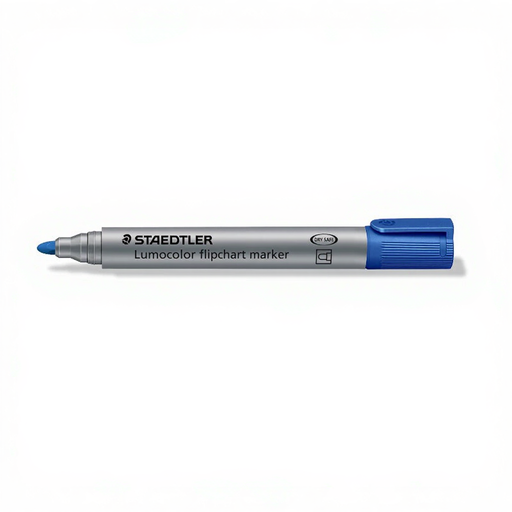
Why this product suits this profile: For presentations, brainstorming and writing on paper, it offers a clearly defined 2 mm round nib. According to the product information, the water-based ink has a low odour and is free from xylene and toluene.
Its design for flipchart paper prevents an industrial marker intended for glass or plastic from being used incorrectly for presentations.
2 mm round nib, refillable design and, according to the product description, usable for several days without a cap.
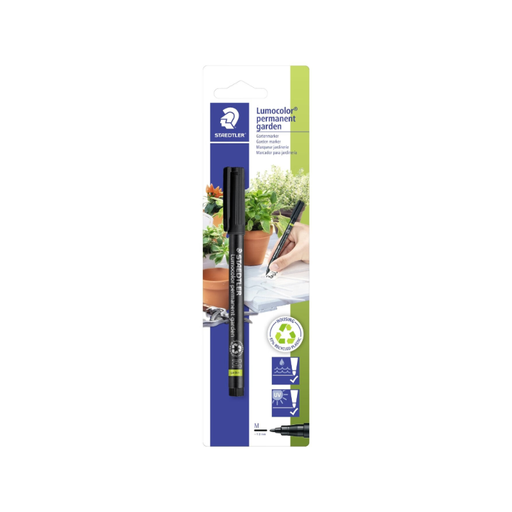
Why this product suits this profile: This version is intended for plant labels, wooden sticks, ceramic pots and other outdoor materials. The product information states that it is water-, weather- and light-resistant.
The choice is based not only on it being ‘permanent’, but specifically on stated light and weather resistance for garden use.
Medium round nib of approximately 1.0 mm; according to the product description, suitable for glass, plastic, metal, wood and stone.
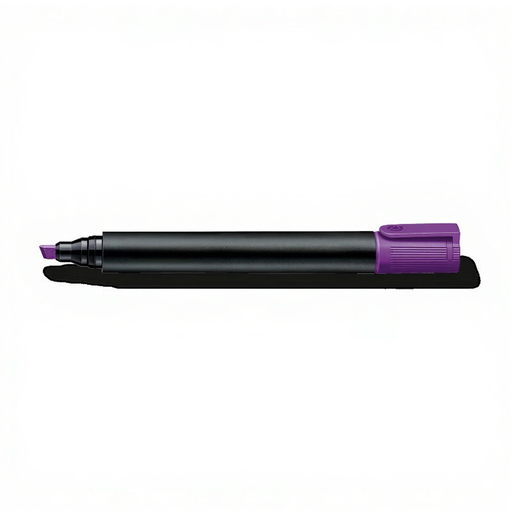
Why this product suits this profile: The chisel tip covers both broader markings and narrower lines. This model is designed as a refillable universal marker with permanent ink for a wide range of surfaces.
The variable nib width reduces the need for several pens when both broad and narrower markings are required.
2–5 mm chisel tip, DRY-SAFE technology according to the product information and refillable with the STAEDTLER 488 50 station.
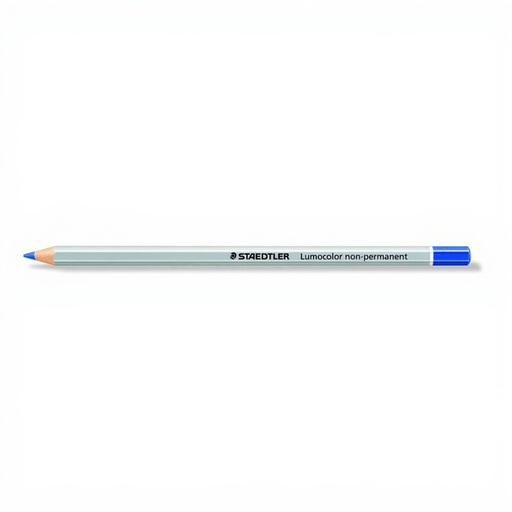
Why this product suits this profile: This wax-based marker is intended for glass, porcelain, metal, plastic and other smooth surfaces. According to the product description, the marking can be removed with a damp cloth.
It avoids the common mistake of buying a permanent pen when markings on laboratory or work surfaces need to be changed regularly.
Water-soluble Omnichrom core, high visibility on dark or transparent surfaces and wipeable use on many smooth substrates.
We have put together a complete, regularly updated list of products that fully meet these strict selection criteria and the safety regulations applicable in the EU.
Follow the safety instructions on the packaging when using the product. Permanent ink is not intended for use on skin or for cosmetic applications. Keep small caps and nibs away from children under three years of age.
That depends on the specific model. Several permanent markers in the Lumocolor range are described as having waterproof or water- and smudge-resistant ink. A flipchart marker with water-based ink, on the other hand, is designed for paper and presentations and should not be treated as an outdoor marker.
For permanent labelling on glass, specialist Lumocolor Glasochrom models or suitable permanent markers may be considered. If the marking needs to be removed later, a Lumocolor Omnichrom non-permanent glass marker is the better choice. The surface should be clean and dry, and removal should be tested beforehand.
Its lifespan depends on the writing surface, pressure, storage conditions and frequency of use. A refillable model can continue to be used as long as the nib and barrel are still in working order and the correct refill station is used. Without specific details about the conditions of use, it is not possible to give a reliable fixed lifespan.