
Lieferung heute & morgen

Qualitätsgarantie

Willkommens-Angebote freischalten: KOSTENLOSE Lieferung | Bis zu 80 % RABATT | Kostenlose 30-Tage-JoyPlus-Testphase
App herunterladen
A STAEDTLER Textsurfer highlighter can be a practical aid when studying, organising documents or structuring notes. However, highlighters vary considerably in terms of nib shape, line width, ink type and paper compatibility. A bright neon colour alone says little about whether a highlighter is suitable for its intended purpose.
Before buying, you should therefore look beyond the number of colours. The key factor is choosing technical features that suit your everyday writing needs.
Many highlighters are sold with a chisel tip without clearly stating the line widths actually available. A broad mark is useful for highlighting entire lines of text, but can seem imprecise when underlining individual words. Look out for specific details such as 1–5 mm highlighter or 1–4 mm highlighter.
Water-based ink can dry quickly and still show through to the reverse side of thin paper. Conversely, a highlighter with no bleed-through is not guaranteed to work perfectly on every type of paper. Newspaper, Bible pages, thin legal documents and photocopies all react differently. A quick test on an inconspicuous area is still advisable.
More colours offer greater flexibility, but can create unnecessary expense if you only use yellow and green in everyday life. Consider whether you really need a highlighter set, or whether a single highlighter is enough for school, the office or university. For frequent users, however, a large ink supply can reduce the number of replacements needed.
A highlighter with a chisel tip is suitable for broad areas and fine underlining, provided it can be used at different angles. The STAEDTLER Textsurfer Classic features a soft, pressure-resistant chisel tip of approximately 1–5 mm. This is practical for documents with lines of text in different sizes.
Models with a round, flexible tip typically cover around 1–4 mm. They can be a useful alternative if you want to switch between a fine line and a broad mark without significantly changing the angle of the pen.
Water-based ink is widely used in classic highlighters. It can be used on paper, fax documents and photocopies, but should be tested on the specific document before intensive use. Fast-drying ink can help reduce smudging, but it does not replace testing on very absorbent or thin paper.
Another option is a dry highlighter in pencil form. Instead of liquid ink, it uses a fluorescent wax lead, making it an interesting choice for delicate paper pages. The marking is generally more narrowly defined – for the STAEDTLER Textsurfer dry models mentioned, the lead diameter is approximately 4 mm.
The shape of the casing can be important during long writing or study sessions. A triangular barrel feels different in the hand from a classic flat or round highlighter. A securely closing cap and a casing that does not easily roll off the desk are also practical features.
With liquid highlighters, it is advisable to close the cap immediately after use. Some models should be stored horizontally so that the ink remains evenly distributed at the tip.
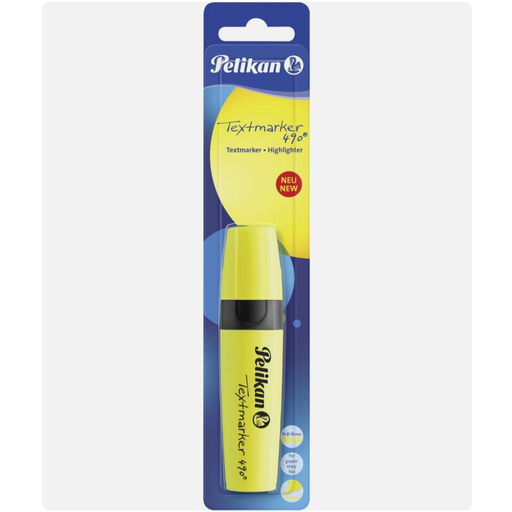
Why this product suits the profile: This single yellow highlighter covers the essentials for school, university and the office without requiring a large set.
The three stated line widths of 1, 2 and 5 mm make the possible uses clearer than a simple description of the colour.
Chisel tip, fluorescent yellow ink and water-based ink with reduced show-through according to the product details.
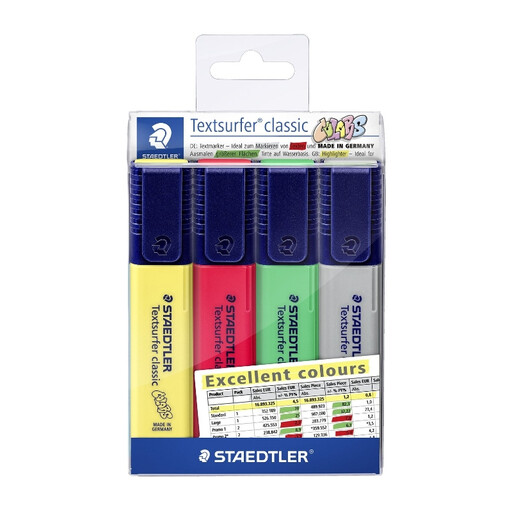
Why this product suits the profile: This four-colour set is ideal for users who want to organise study content or documents by subject, priority or category.
The product details specify both the approximately 1–5 mm line width and the large ink supply, as well as the fast-drying ink.
Four colours, a soft pressure-resistant chisel tip, a polypropylene casing and automatic pressure stabilisation according to the product description.
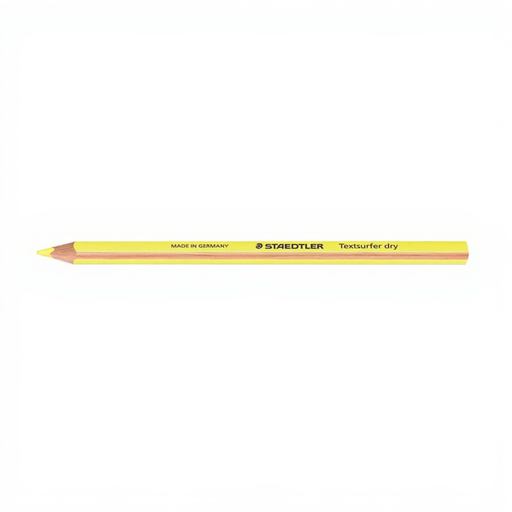
Why this product suits the profile: The dry wax lead is an interesting option for frequent writers and users who want to mark thin pages such as newspapers or legal documents.
As no liquid ink is applied, the product details state that the risk of bleed-through on thin paper is lower.
Triangular jumbo shape, fluorescent lightfast wax lead and a stated lead width of 4 mm.
We have put together a complete, regularly updated list of products that fully meet these strict selection criteria and the safety regulations applicable in the EU.
Models with a variable tip are a good choice for fine lines. The classic Textsurfer offers approximately 1–5 mm, while the triplus textsurfer offers approximately 1–4 mm. By changing the angle, you can vary the mark from narrow to broad.
Yes. Leaving it open frequently allows the ink at the fibre tip to evaporate. Replacing the cap securely after each use extends its practical service life. With a dry highlighter, this ink-related issue does not arise, although a wax pencil should still be stored cleanly and protected.
A set is useful if you want to distinguish between several categories using different colours. If you only need to highlight important passages, a single yellow or green highlighter is often sufficient. As well as the number of colours, the key considerations are the line width, paper compatibility and the preferred casing shape.