
Lieferung heute & morgen

Qualitätsgarantie

Willkommens-Angebote freischalten: KOSTENLOSE Lieferung | Bis zu 80 % RABATT | Kostenlose 30-Tage-JoyPlus-Testphase
App herunterladen
A STAEDTLER Lumocolor Permanent Marker can be used in many ways in the office, home, warehouse, garden or workshop. However, not every permanent marker is suitable for every surface or line width. If you choose based solely on colour or a low price per marker, you may end up with a product that writes too broadly for the intended purpose, adheres poorly to smooth surfaces or cannot be refilled.
This buying guide explains what private users, creatives, technical illustrators, laboratory staff and tradespeople in the UK should consider when comparing products.
The description permanent marker for almost all surfaces does not automatically mean that the mark will be equally visible or durable on every surface. Glass, metal and plastic are smooth, generally non-absorbent materials. Wood, card or uncoated ceramics, on the other hand, may be absorbent and textured.
You should therefore check the following before buying:
Many Lumocolor models are suitable for glass, metal, plastic and wood. However, for particularly smooth or specialised surfaces, an industrial marker, a wax-based Omnigraph or a specialist marker may be a better choice.
A broad chisel tip is practical for headings, labelling boxes and making prominent marks. For small labels, technical drawings or laboratory containers, however, a 2–5 mm tip may release too much ink.
As a guide:
A fine-tip Lumocolor marker is not automatically better suited to every application. The key factors are the size of the labelling area and how easily the writing needs to be read from a normal distance.
According to the relevant product information, DRY SAFE technology can help a marker remain usable for several days without its cap. This is useful in everyday work, for example during stocktaking or lengthy drawing tasks. Nevertheless, the cap should be closed firmly after use. This reduces evaporation and helps extend the marker’s service life.
DRY SAFE is not a substitute for suitable storage either. Storing many models horizontally can help maintain a more even ink flow. Direct sunlight, high temperatures and naked flames should be avoided.
Many STAEDTLER Lumocolor Permanent Markers use fast-drying, alcohol-based permanent ink. The product information for several models lists features such as waterproof, smear-resistant or low-odour. These properties relate to the specific ink and surface. On non-absorbent materials, a mark may sometimes be removed with alcohol or a suitable solvent.
On textiles, untreated wood, paper and other porous materials, however, the ink may penetrate deeply. Removing it may be difficult or impossible. We therefore recommend testing the marker on an inconspicuous area before first use.
Synthetic fibre tips are suitable for producing even lines on paper, film, plastic or metal. A chisel tip can create different line widths by rotating the marker body. Metal-clad or particularly fine tips are useful for detailed labelling.
Wax-based models such as the Lumocolor Glasochrom or Omnigraph differ from conventional ink markers. They can be used on very smooth, dark, rough or partially damp surfaces. The mark is water-resistant, but depending on the substrate it may be scraped off or removed with a suitable product from non-porous surfaces.
A refillable permanent marker can extend its usable life and reduce the need to buy individual replacement pens. It is important to check the correct STAEDTLER refill station for the model in question. The product information mentions stations including 487 17, 488 50, 488 88 and 485 23.
Not every model uses the same refill station. Checking this before buying helps you avoid unsuitable purchases and assess running costs more accurately if you use the marker frequently.
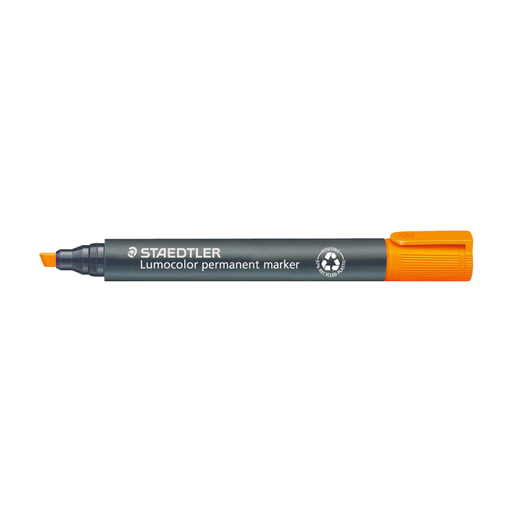
Why this product suits this profile: The 2–5 mm chisel tip handles both prominent labelling and narrower lines with a single marker. Orange is ideal for colour-coding folders, containers and work materials.
The variable tip reduces the risk of needing two different pens for broad and narrow marks. The cap should still be closed after every use.
Chisel tip of approximately 2–5 mm; according to the product information, suitable for glass, plastic, metal and wood; orange ink for highly visible marking.
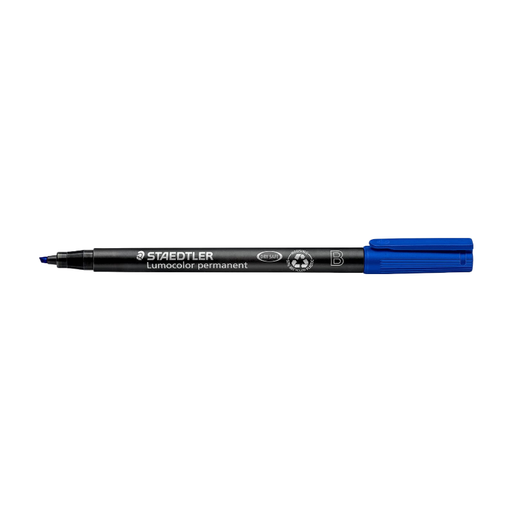
Why this product suits this profile: The blue chisel tip combines approximate line widths of 1.0 and 2.5 mm. This makes it suitable for technical marking, warehouse identification and recurring labelling tasks.
The two line widths make the choice clearer than a generic “all-purpose” tip. The product information also states DRY SAFE according to ISO 554 and refillability using station 487 17.
Line width of approximately 1.0/2.5 mm; waterproof and smear-resistant ink according to the product description; refillable marker with pressure equalisation for air travel.
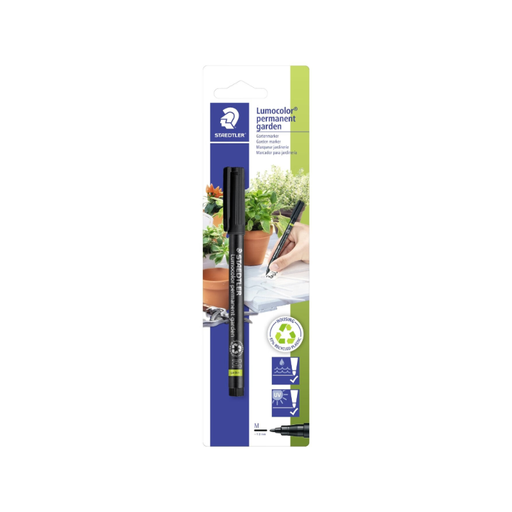
Why this product suits this profile: This version is designed for outdoor labelling, such as plant labels, wooden sticks, ceramic pots and garden signs. The black line, measuring approximately 1.0 mm, is suitable for clear, legible marking.
The choice is based not only on the permanent-marker description, but also on its stated resistance to weather and light. For particularly harsh conditions, adhesion should still be tested on the specific material.
Black ink with stated resistance to weather and light; suitable for glass, metal, plastic, wood and stone; approximately 1.0 mm tip.
We have put together a complete, regularly updated list of products that fully meet these strict selection criteria and the safety regulations applicable in the EU.
Before marking, the surface should be as dry and clean as possible and free from grease. On glass, metal and plastic, a quick clean will often improve even adhesion. After writing, allow the ink to dry sufficiently before touching or stacking the surface.
Follow these basic rules to extend the marker’s service life:
According to the product information, several Lumocolor models are described as waterproof and smear-resistant on almost all surfaces, including glass. The result depends on cleaning, drying time and the specific type of glass. Alcohol or specialist solvents may be required if the mark needs to be removed later.
Service life depends on how often the marker is used, line width, storage conditions and the refill station in question. DRY SAFE can reduce drying out for several days if the cap is accidentally left open. To maximise service life, the cap should still be kept closed and the correct refill system used.
For small labels, laboratory containers and technical details, fine tips measuring approximately 0.4 or 0.6 mm are usually suitable. For boxes, cartons and clearly visible headings, medium tips or chisel tips up to 2.5 or 5 mm are more practical. The key factors are the available space and the desired distance from the text.