
Lieferung heute & morgen

Qualitätsgarantie

Willkommens-Angebote freischalten: KOSTENLOSE Lieferung | Bis zu 80 % RABATT | Kostenlose 30-Tage-JoyPlus-Testphase
App herunterladen
A stainless steel frying pan with a ceramic coating combines the robust exterior of stainless steel with a coated cooking surface. It sounds like a straightforward solution for frying, sautéing and braising. In practice, however, models vary considerably in their construction, heat resistance and care requirements.
Many households in Germany are particularly interested in a PFAS-free frying pan, even heat distribution and induction compatibility. Three common misconceptions can lead to unnecessary spending:
A tri-ply frying pan typically consists of stainless steel, an aluminium core and another layer of stainless steel. Aluminium conducts heat faster than stainless steel, so this multi-layer construction can help distribute heat more evenly across the base of the pan.
With a coated stainless steel frying pan, you should also check which type of steel makes up the cooking surface. Product details may specify 304 stainless steel or 316 stainless steel. These terms describe the material used; they do not, on their own, guarantee a particular cooking performance.
Induction cooking requires a magnetic layer in the base. The 430 stainless steel base on the ZEROPAN models listed here is described as suitable for induction. Even so, check for an explicit ‘suitable for induction’ label, as not every stainless steel frying pan will work on every hob.
If you’re looking for a PFAS-free, PFOA-free or PTFE-free frying pan, check each claim separately. PFAS is a broad group of substances, while PFOA and PTFE are specific terms within or related to this materials topic. So a claim such as ‘PFOA-free’ does not automatically answer every question about whether a product is free from PFAS or PTFE.
The ceramic coating on the selected ZEROPAN models is described in the product details as free from PFAS, PFOA and PTFE. These claims apply to the specific product, so check the product page before you buy. For other brands and coatings, refer to the manufacturer’s information.
A honeycomb frying pan can affect the contact between cooking utensils and the coating. However, laser-engraved or textured surfaces don’t mean you can use metal turners without care. If the care instructions recommend wooden or silicone utensils, follow that advice.
A 20–24 cm pan is often enough for one or two people. A 28–30 cm pan gives you more room for family-sized portions, but it also needs more storage space and can become much heavier when full.
A deep frying pan with a lid is also useful for braising, deglazing and reducing sauces. Before using a pan in the oven, always check three things:
The following ZEROPAN models are listed as oven-safe up to 260 °C. According to the product details, the glass lid on the hybrid model is suitable for temperatures up to 148 °C only. Remove the lid before putting the pan in the oven, unless the instructions say otherwise.
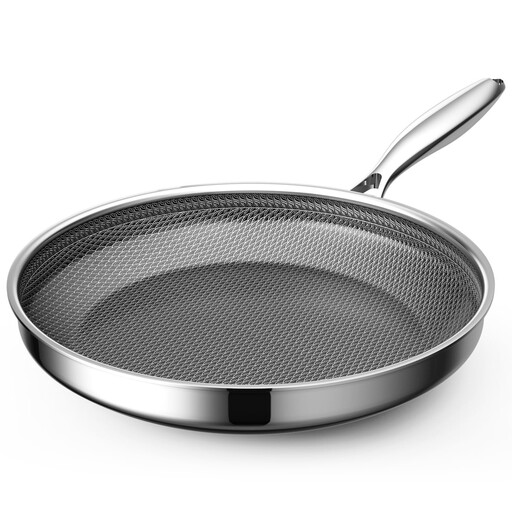
Why it suits this profile: The 24 cm size is well suited to everyday portions and works with a range of hob types, without taking up as much space as a large sauté pan.
Its multi-layer construction and explicitly stated compatibility with induction, gas, electric, ceramic and halogen hobs make the key technical details clear.
304 stainless steel interior, aluminium core, ceramic honeycomb structure, described in the product details as free from PFAS, PFOA and PTFE, and oven-safe up to 260 °C.
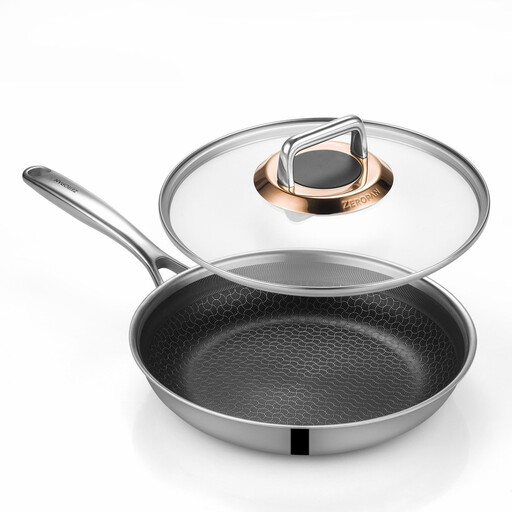
Why it suits this profile: The 30 cm version is designed for households cooking larger portions and looking for a multi-layer construction with 316 stainless steel on the inside.
The product details specify the material layers, hob compatibility and maximum oven temperature, rather than relying on a vague hybrid label.
316 stainless steel cooking surface, aluminium core, 430 stainless steel induction base, laser-engraved honeycomb structure and a lid included.
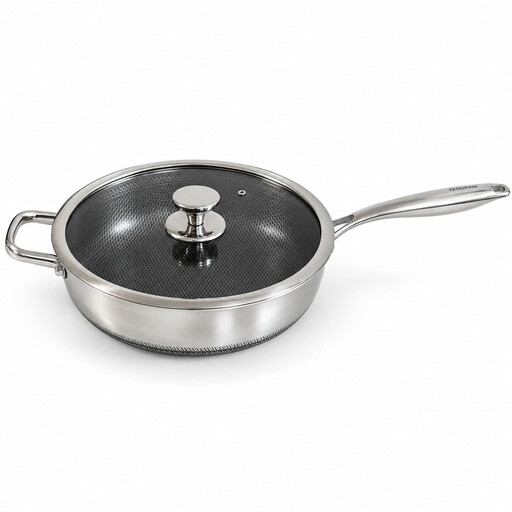
Why it suits this profile: The high sides and extra helper handle are practical for family-sized portions and braised dishes, and make it easier to move the pan when it’s full.
The product details distinguish between oven use for the pan and the lid. Hand-washing is also recommended despite the pan being dishwasher-safe, which can help protect the coating in everyday use.
30 cm diameter, high sides, glass lid, helper handle, tri-ply construction and ceramic coating described in the product details as free from PFAS, PFOA and PTFE.
We’ve put together a complete, regularly updated list of products that meet these strict selection criteria and fully comply with the safety regulations in force in the EU.
Only if it has a magnetic base and is explicitly approved for induction use. Multi-layer stainless steel construction alone isn’t proof of compatibility. According to the product details, the ZEROPAN models listed here are suitable for induction, gas, electric, ceramic and halogen hobs.
Its lifespan depends on the temperature, cleaning methods and kitchen utensils you use. Prolonged overheating, metal utensils and abrasive cleaners can put more strain on the surface. So it isn’t possible to give a reliable lifespan that applies to every ceramic-coated frying pan.
No. ‘PTFE-free’ is a specific material claim and shouldn’t be treated as a comprehensive safety assessment. If you’re specifically looking for a PFAS-, PFOA- and PTFE-free frying pan, check that all three claims are explicitly listed in the product details.