
Lieferung heute & morgen

Qualitätsgarantie

Willkommens-Angebote freischalten: KOSTENLOSE Lieferung | Bis zu 80 % RABATT | Kostenlose 30-Tage-JoyPlus-Testphase
App herunterladen
A stainless steel colander is one of those kitchen essentials that comes into contact with water, food and washing-up liquid every day. Yet models can vary considerably in diameter, perforation, stability and storage. A cheap buy can prove impractical if the colander does not fit in your sink, tips over when draining or is difficult to clean.
For households, families, home cooks and professional kitchens, three common buying misconceptions are particularly relevant:
When choosing a stainless steel kitchen colander, look for a product description that clearly states whether it is made from stainless steel, 304 stainless steel or another alloy. The PURECOOK models featured here are listed as made from food-grade 304 stainless steel (18/8). This designation describes the material composition, but it is not automatically a general quality mark for every product.
Also look for:
A stated stainless steel grade is particularly relevant if you wash the colander frequently or use it for rice, fruit, vegetables and acidic foods. Even a rust-resistant stainless steel colander should be rinsed and dried thoroughly after use.
A kitchen draining basket needs to suit the way you work. A medium-sized model that is easy to store may be a good choice for a small rented flat. In a family kitchen or professional setting, a larger capacity and secure support are more important.
Before buying, check:
A small sink strainer with a 7 cm diameter serves a different purpose from a vegetable colander. According to the product description, the Set of 2 Stainless Steel Sink Grids are designed to protect small drain openings or act as a barrier against food scraps. They are not a substitute for a large pasta colander, but can be a useful addition to your sink.
An expandable sink strainer is useful if you have a sink of varying size or limited storage space. The key is whether the extendable sections rest securely and stay in place when loaded. One model measuring 29.5 × 6.9 cm is listed as having a telescopic 304 stainless steel design.
When it comes to the perforations, evenly spaced holes help water drain in a controlled way. Very fine holes are better suited to rice or small grains, while larger openings can make it easier to drain pasta and vegetables. Dry the colander thoroughly after cleaning. Avoid scouring products and steel wool, which can scratch the surface, unless the manufacturer advises otherwise.
The selection below matches specific models with different uses and the product details provided. This makes it easier to choose a sink draining basket, rice strainer or pasta colander to suit your needs.
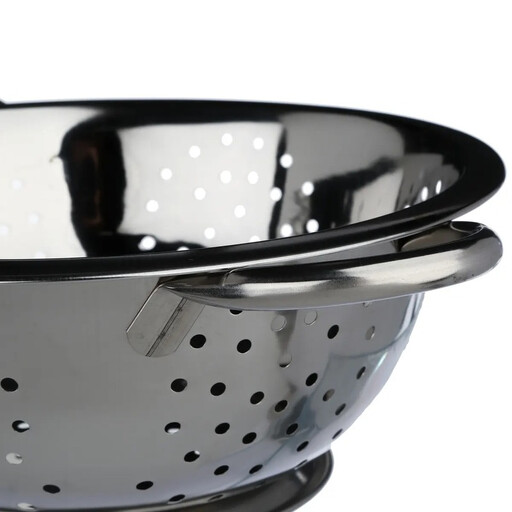
Why this product suits you: With a 2.2-litre capacity and a 24 cm diameter, this model handles everyday tasks such as washing fruit and vegetables and draining pasta, without taking up much storage space.
The stated diameter and capacity make it clear what the colander can be used for, rather than relying on a vague claim that it is a universal size.
24 cm diameter; listed as suitable for pasta, vegetables, fruit and dry ingredients.
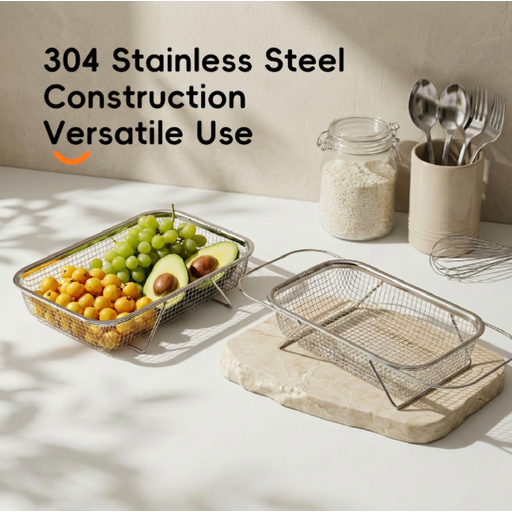
Why this product suits you: The stated 304 (18/8) grade, coating-free surface and adjustable design will appeal to buyers who compare technical details before placing an order.
Its 29.5 cm length and telescopic design make it easier to assess whether it will fit your space before buying.
304 stainless steel (18/8); expandable and listed as suitable for use across sinks of different sizes.
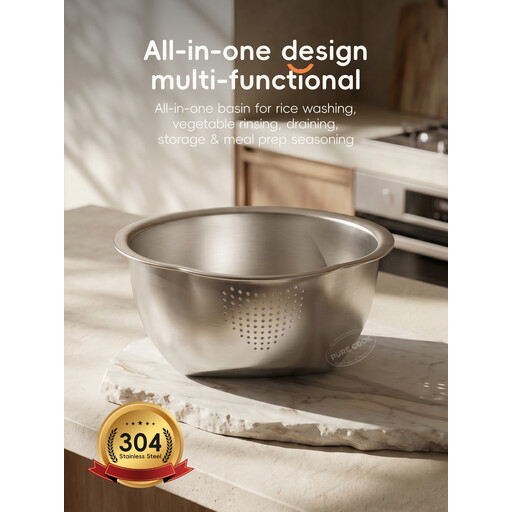
Why this product suits you: With a 27 cm diameter, side handles and a sloped base, this colander is designed for rice, quinoa, fruit, vegetables and other food-preparation tasks.
The stated dimensions, perforations and handles give you more to go on than a generic label such as “multi-purpose strainer”.
304 stainless steel; listed as dishwasher-safe, with smooth, polished edges.
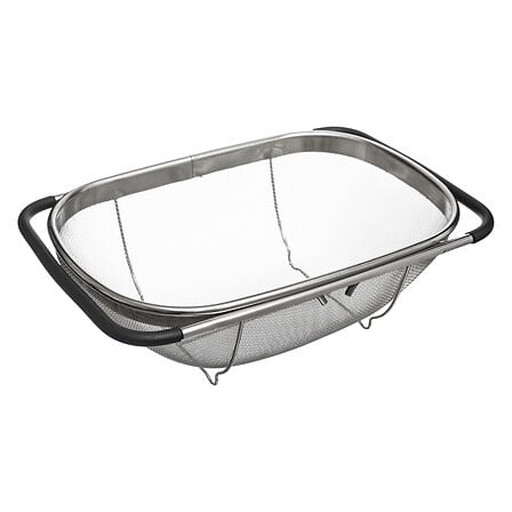
Why this product suits you: Its extendable length of 53.5 cm and stated capacity of 3.6 litres make it suitable for sinks of different sizes and larger quantities.
The maximum length and width are provided, so you can check in advance whether your sink has enough space to support it.
3.6-litre capacity; expandable design and stainless steel mesh, according to the product description.
We’ve put together a complete, regularly updated list of products that meet these strict selection criteria and fully comply with the safety regulations in force in the EU.
No. With a fixed model, the diameter and support area need to suit your sink. For an expandable sink strainer, the minimum and maximum length are key. Measure the usable width between the edges of your sink, and allow for the tap, drain and any existing support areas.
Its lifespan depends on the material, wall thickness, finish and care. There is no single answer that applies to every colander. Dry it after cleaning, avoid harsh scouring products and do not overload expandable models. Rust spots, sharp edges or loose handles are signs that it may be time for a replacement.
A vegetable colander is usually designed for washing and draining larger pieces. A pasta colander needs enough capacity and a stable base to hold hot, heavy food safely. A rice strainer should have suitable, evenly spaced holes so the grains are not rinsed away accidentally. A multi-purpose model can handle several tasks, provided its dimensions, hole size and handle design suit each use.