
Lieferung heute & morgen

Qualitätsgarantie

Willkommens-Angebote freischalten: KOSTENLOSE Lieferung | Bis zu 80 % RABATT | Kostenlose 30-Tage-JoyPlus-Testphase
App herunterladen
A stainless steel colander is one of the most versatile kitchen helpers: it washes vegetables, drains rice, strains pasta and, depending on the design, can serve as a fruit and vegetable basket or as a rack over the sink. The choice may seem straightforward at first. In practice, however, incorrect measurements, unstable telescopic arms or mesh that is difficult to clean can quickly lead to a poor purchase.
This buying guide from the Joybuy Product Recommendation Officer objectively assesses the key features and shows which kitchen strainer suits different households and usage situations.
An expandable draining basket is often described as universally fitting. What really matters, however, is the actual length when pushed in and pulled out, as well as the width of the resting surfaces. A model with an extension range of 29 to 44 cm may be suitable for many sinks, but it won't automatically fit every sink.
Before buying, you should therefore measure:
A large capacity is practical for a pasta strainer or when washing vegetables. However, more volume does not necessarily mean greater load-bearing capacity. Thin telescopic constructions can shift under heavy crockery, wet potatoes or larger amounts of water.
Look for a sturdy frame, secure resting points and clear usage instructions regarding the weight limit. A draining basket for the sink should not tip over or slide on the sink rim during use.
Very fine-mesh strainers trap small particles but can clog more quickly with starchy pasta water or rice. Larger, evenly spaced holes usually let water drain quickly, but they won't hold back every small food item.
For a rice strainer and quinoa, a uniform, finer perforation makes sense. For pasta, salad or chunky vegetables, a classic stainless steel colander with larger drainage holes may be sufficient.
Several of the models presented specify 304 stainless steel or 18/8 stainless steel. This material designation describes a grade of stainless steel with chromium and nickel content. It is commonly used for kitchen utensils because of its corrosion resistance and robust surface.
An uncoated surface can be beneficial because no additional layer of paint or plastic can chip off. Nevertheless, the colander should be thoroughly dried after cleaning. Salty and acidic foods should not be left in it for extended periods, as the surface may discolour.
A 3.6-litre kitchen strainer is suitable for larger quantities of pasta, vegetables or fried foods. For a one- or two-person household, a more compact model may save space. The specification "diameter" for round strainers refers to the top rim; for expandable baskets, length, width and height are more important.
Also check whether the basket fits in your fridge if you want to store washed fruit or prepared ingredients in it.
A dishwasher-safe kitchen strainer saves time, provided the manufacturer explicitly states this feature. For the PURECOOK 304 rice strainer, dishwasher cleaning is specified. For other models, you should follow the manufacturer's instructions, especially for woven mesh or moving telescopic parts.
For hand washing, warm water, mild washing-up liquid and a soft sponge are usually sufficient. Steel wool and abrasive cleaners can scratch the surface. After rinsing, thorough drying prevents water spots and reduces the build-up of deposits.
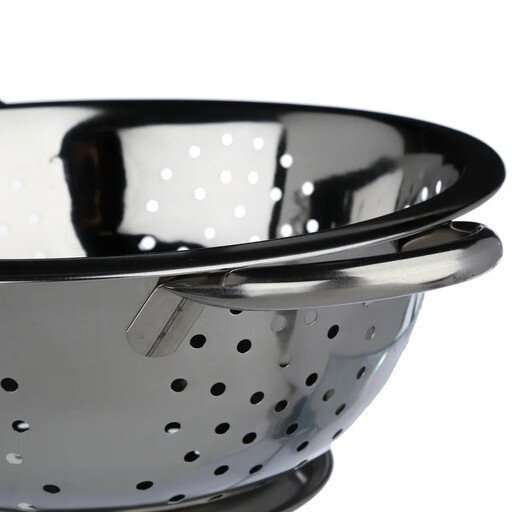
Why it fits: The 24 cm colander with a 12 cm height is designed for everyday portions of pasta, vegetables and fruit.
The stated size and capacity make it easy to compare with your own household quantities.
Compact dimensions, 2.2-litre capacity and stainless steel construction for regular kitchen tasks.
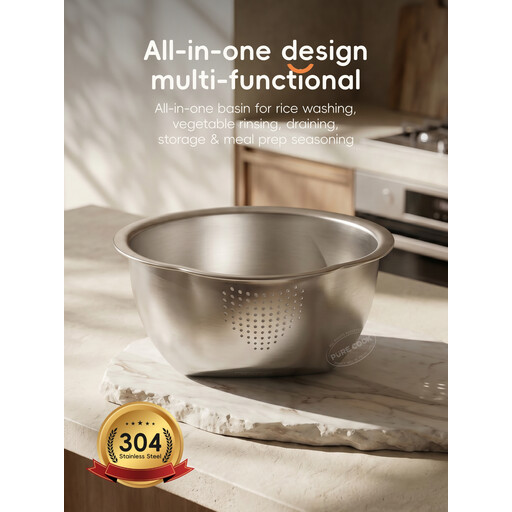
Why it fits: The 27 cm strainer with a slanted base is designed for rice, quinoa, fruit, vegetables and draining crockery.
Evenly spaced drainage holes and polished edges are specifically named construction features rather than vague marketing claims.
304 stainless steel, uncoated surface, side handles and, according to the product information, suitable for the dishwasher.
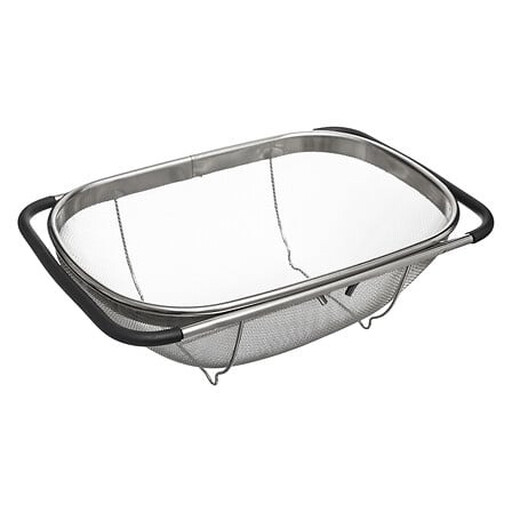
Why it fits: This model measures 53.5 × 24.7 × 10.5 cm and offers 3.6 litres of volume for larger quantities and various sinks.
The specific external dimensions prevent the term "large" from being assessed without comparing it to your own sink.
Expandable design, ergonomic handle, 3.6-litre capacity and stainless steel mesh structure.
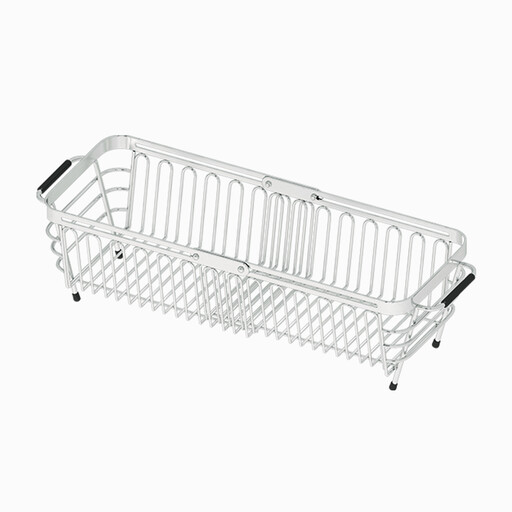
Why it fits: The medium-sized basket extends from 29 to 44 cm and, with a width of 15.5 cm, is designed for limited worktop space.
The extendable length is stated specifically. However, you should still check whether the resting surfaces sit securely on the sink rim before use.
Telescopic frame, 304 stainless steel and raised mesh surface for draining directly over the sink.
In the full selection you will find products by material, size and area of use for different kitchens and sinks.
No. The extension range alone is not enough to judge. Measure the required length, the sink width and the depth of the resting surfaces. The basket must sit securely and must not slip when loaded.
Rinse off food residue immediately after use. Use warm water, mild washing-up liquid and a soft sponge. If the manufacturer explicitly states that it is dishwasher-safe, the colander can be cleaned in the machine according to the care instructions. Afterwards, it should be dried thoroughly.
A fixed lifespan cannot be reliably stated. It depends on material thickness, workmanship, load, cleaning method and storage. A colander made from specified 304 stainless steel with sturdy edges can be suitable for regular use. However, avoid overloading, direct heat and abrasive cleaning products.