
Lieferung heute & morgen

Qualitätsgarantie

Willkommens-Angebote freischalten: KOSTENLOSE Lieferung | Bis zu 80 % RABATT | Kostenlose 30-Tage-JoyPlus-Testphase
App herunterladen
A stainless steel colander can wash fruit, drain pasta, rinse rice or store food in the fridge. Yet not every model suits every kitchen. Mistakes often happen not because of the material itself, but because of unsuitable dimensions, poorly placed handles or a design that takes up too much storage space after use.
This buying guide shows you which features actually matter when choosing a kitchen drain basket, a sink colander or a classic stainless steel kitchen sieve.
An expandable drain basket can be positioned over the sink. What really counts, however, is the actual length adjustment and the resting surface. If the colander is too short, it will sit unsteadily. If it’s too long, the handles may stick out over the rim of the basin or clash with the taps.
Before you buy, you should therefore measure the internal width of your sink, the rim edges and the available space next to the tap.
A densely perforated colander can drain water quickly. But for very small foods like rice, herbs or berries, the hole size is especially important. Openings that are too large let bits of food through, while mesh that is too fine drains more slowly and can clog up with residue more quickly.
A fruit and vegetable colander for versatile use should therefore have evenly spaced openings. For pasta, larger holes are usually fine, but for rice and small berries, a finer structure makes more sense.
“Stainless steel” doesn’t automatically describe the same material quality. Specifications like 304 stainless steel or 18/8 give a more concrete indication of the material grade. The finishing of the edges, the stability of the base and how easy it is to clean also count.
With coated products, you should check whether the surface is suitable for contact with food according to the manufacturer. An uncoated stainless steel colander can be simpler to care for, but it still needs to be dried completely after washing.
For single-person households or small portions, a small pasta strainer with a capacity of around 0.5 litres is sufficient. Families and home cooks will need a model with 2 to 4 litres for pasta, salad or larger quantities of vegetables.
A diameter of 24 cm offers enough surface area for everyday portions in a classic colander. With a drain basket with handles, you should also check whether the model fits into your existing pot, a bowl or the sink.
Look for rounded or smoothly rolled edges so your hands don’t slide against sharp metal when emptying. After use, remove food residue and rinse the colander. For dishwasher cleaning, always follow the manufacturer’s instructions.
A drain basket must not be placed on hob rings, in the oven or on any other direct heat source. With expandable models, the construction must sit stably on the sink before you load it.
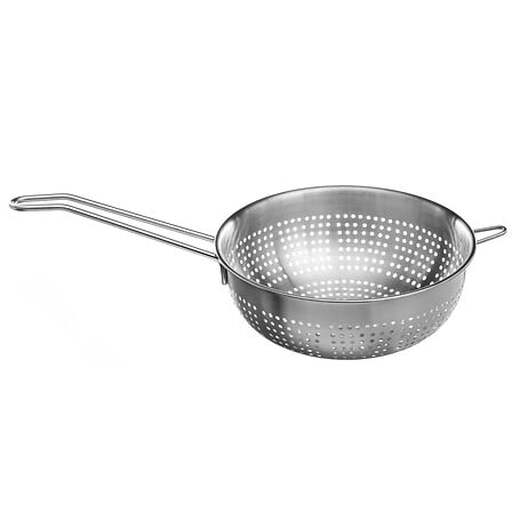
Why this product fits the profile: The 0.5-litre capacity is ideal for small portions, berries, herbs or individual side dishes. The long handle makes it easy to use over bowls and small pots.
The clearly stated small capacity prevents a compact colander from being mistakenly bought for large family portions. Dimensions are 35.2 × 19.1 × 7.5 cm.
Compact design, integrated handle and numerous drainage holes; weight according to product information 0.145 kg.

Why this product fits the profile: According to the product information, this model is made from food-grade 304 stainless steel (18/8) and is designed as a medium-sized, expandable drain basket for daily washing and draining.
The adjustable length reduces the risk of the sink basket not fitting your basin. Measuring your sink before purchase is still necessary.
304 stainless steel, uncoated surface and expandable construction; dimensions according to product information 29.5 × 6.9 cm.
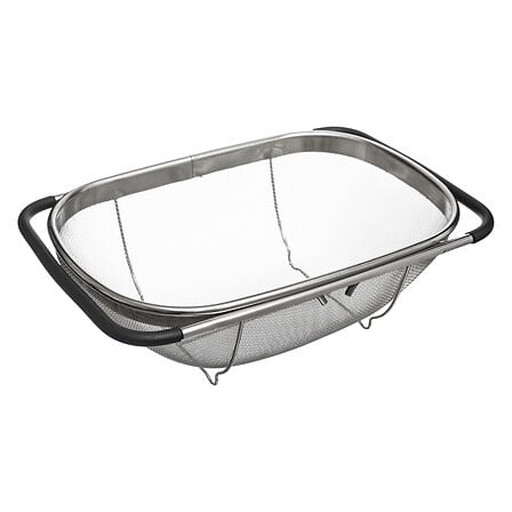
Why this product fits the profile: The 3.6-litre model is aimed at households that regularly drain pasta, vegetables or larger quantities of food and want a colander that can be used flexibly over different sinks.
The capacity is clearly stated, preventing a small colander from being planned for large quantities. The adjustable length does not replace checking the sink width, however.
3.6-litre capacity, stainless steel construction, expandable design and ergonomic handle; dimensions according to product information 53.5 × 24.7 × 10.5 cm.
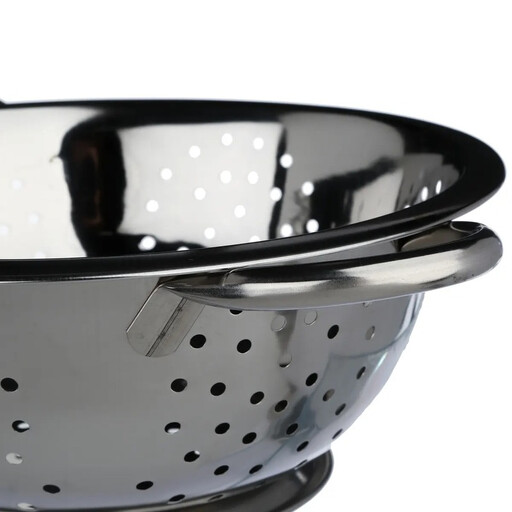
Why this product fits the profile: The classic colander with a 24 cm diameter and 2.2-litre capacity is suitable for draining pasta as well as washing fruit and vegetables.
The fixed shape makes the application clear: the colander is used over a pot or bowl and doesn’t need to be adapted to a specific sink size.
2.2-litre capacity, 24 cm diameter and 12 cm height according to the product description; suitable for various draining and washing tasks.
We’ve put together a complete, regularly updated list of products that fully meet these strict selection criteria and the safety regulations in force in the EU.
A sink colander for food is not the same as a sink strainer. Sink grids with a diameter of around 7 cm are designed to catch debris in the drain and should not be used for washing or draining food.
For single portions, around 0.5 litres is enough. For a small household, 2 to 2.5 litres is versatile. Families or people who often prepare pasta and larger quantities of vegetables can choose a model with around 3.6 litres.
No. The expandable design offers flexibility, but it doesn’t replace measuring. Check the internal width, rim edges, sink depth and the distance to the tap. The load capacity and stability should also be considered before use.
The lifespan depends on the material, workmanship, usage and care. An uncoated stainless steel surface can be used regularly with proper cleaning. Abrasive cleaners, hard brushes, prolonged moisture and overloading can damage the surface or affect stability.