
Lieferung heute & morgen

Qualitätsgarantie

Willkommens-Angebote freischalten: KOSTENLOSE Lieferung | Bis zu 80 % RABATT | Kostenlose 30-Tage-JoyPlus-Testphase
App herunterladen
A stainless steel cooking pot is part of the basic kitchen equipment in many households. It can be used for soups, pasta, stews, rice dishes and braising. However, unclear material specifications, an unsuitable size or an incompatible base often lead to disappointing purchases.
“Stainless steel” alone says little about the pot’s actual construction. Specifications such as 304 stainless steel pot or 18/10 stainless steel describe a specific material grade. It is also important to know whether the pot has a multi-layer base, an aluminium core or simply a thin magnetic disc on the base.
A 304 stainless steel pot is often listed in the product specifications as food-grade stainless steel. With 18/10 stainless steel, the ratio is stated as approximately 18 per cent chromium and 10 per cent nickel. However, neither designation alone proves that heat will be distributed evenly. That depends mainly on how the pot’s base is constructed.
An induction cooking pot requires a magnetic base. A standard stainless steel base is not automatically induction-compatible. Before buying, check the specifications for induction, gas, electric, ceramic and, where applicable, halogen hobs.
With gas hobs, the base diameter is also relevant. A very small pot may heat unevenly on a large burner. With induction, the base should sit as closely as possible over the cooking zone to ensure reliable energy transfer.
A 24 cm cooking pot can hold significantly different quantities depending on its height. A shallow pot with a diameter of 24 cm is better suited to sauces, smaller braised dishes or side dishes. A tall soup pot with the same diameter offers greater capacity.
For two to three people, a capacity of around 2 to 4 litres is often sufficient. Families and hosts generally need between 5 and 9 litres, depending on the dish. However, a large cooking pot should only be chosen if it fits your hob, sink and storage space.
The following specifications are particularly relevant for everyday use:
An uncoated stainless steel pot is used differently from a coated pot. With stainless steel, using enough liquid, moderate heat and preheating without overheating can help. Models with a ceramic coating may be more practical for delicate foods. This coating should not be treated as equivalent to a pure stainless steel surface.
A cooking pot with lid helps reduce splashes and makes controlled cooking easier. Glass lids let you see the food without having to lift the lid. Stainless steel lids are robust, but they do not allow you to see the cooking process.
For handles, the material, attachment method and heat development are important. Integrated stainless steel handles are durable, but they can become hot. Silicone handles reduce heat transfer, but should only be used in accordance with the manufacturer’s instructions.
A dishwasher-safe cooking pot makes cleaning easier. Nevertheless, washing by hand with a soft sponge can help keep the surface looking its best for longer. Abrasive cleaners and aggressive pot-cleaning products can scratch polished surfaces.
White limescale or starch deposits and rainbow-coloured discolouration can occur on stainless steel. Diluted vinegar can be used to remove such deposits on suitable models. The pot should be dried after washing to reduce water marks.
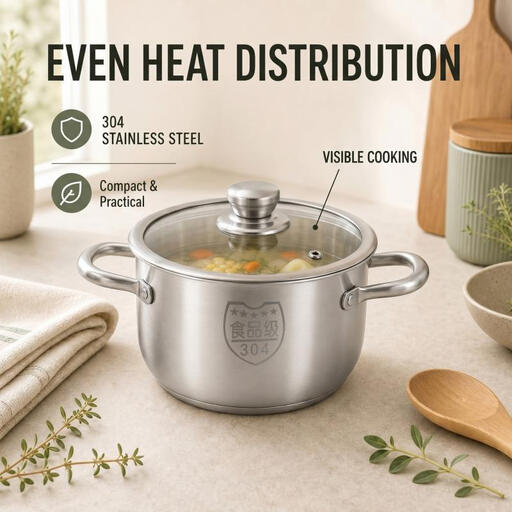
Why this product suits this profile: With a compact 19.5 cm diameter and a 3.0 Quart capacity, this pot is suitable for smaller households, soups, noodles and porridge.
The product specifications state 304 stainless steel, a multi-layer magnetic base and suitability for induction, gas and ceramic hobs.
Uncoated interior, glass lid, pouring rim and, according to the product information, dishwasher-safe construction.
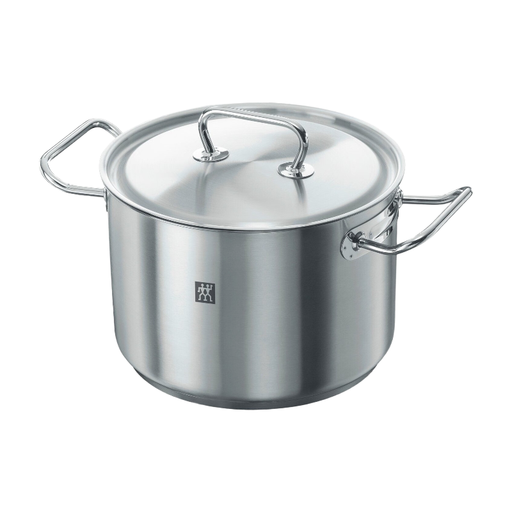
Why this product suits this profile: With a diameter of 24 cm and a capacity of 6 litres, this pot is designed for family meals, soups and larger quantities of pasta.
The SIGMA Classic sandwich base with aluminium core is clearly specified, making the base construction easy to understand.
18/10 stainless steel, integrated measurement scale, stainless steel lid and suitability for induction, gas, electric and ceramic hobs.

Why this product suits this profile: Its large capacity is suitable for hot pot, soups and sociable meals with several people.
The specifications state 316L stainless steel, a bonded base and compatibility with gas, induction, electric, ceramic and halogen hobs.
6.5-litre capacity, glass lid and heat-insulating silicone handles; according to the product information, hand washing is recommended.
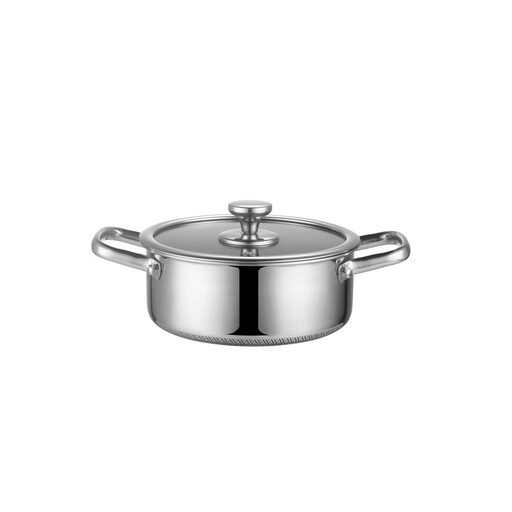
Why this product suits this profile: The combination of stainless steel, ceramic coating and three-layer construction is aimed at buyers who value food that releases easily.
The product description explicitly mentions a ceramic coating, an aluminium core and the permitted oven temperature.
24 cm diameter, 10.5 cm depth, suitability for induction and other hob types, plus oven use up to 260 °C according to the product information.
We have put together a complete, regularly updated list of products that fully meet these strict selection criteria and the safety regulations applicable in the EU.
Not every stainless steel cooking pot works on induction. Look for the specific “induction-compatible” marking or a magnetic bonded base. A magnet test can provide an initial indication, but the manufacturer’s specifications remain decisive.
A 24 cm cooking pot with a capacity of around 5 to 6 litres is suitable for many family meals. For larger quantities, celebrations or hot pot, a 28 cm cooking pot or a 30 cm model with a capacity of more than 6 litres may be a sensible choice. The key factors are the size of your household, the dish and your available storage space.
No. An uncoated stainless steel pot does not have a conventional non-stick layer. Food can stick if the temperature is too high or there is too little liquid. Models with a ceramic coating offer different cooking properties, but require material-friendly care.