
Lieferung heute & morgen

Qualitätsgarantie

Willkommens-Angebote freischalten: KOSTENLOSE Lieferung | Bis zu 80 % RABATT | Kostenlose 30-Tage-JoyPlus-Testphase
App herunterladen
Stainless steel cookware is considered a durable, robust, and healthy choice for the modern kitchen. It is free from chemical coatings and, with proper care, is virtually indestructible. However, the market is flooded with products whose marketing promises often fail to deliver in practice. Before you invest, it's crucial to understand the common pitfalls that lead to disappointment and unnecessary expense.
This guide shows you what really matters and how to avoid the three most common mistakes when buying stainless steel pans and pots.
Many buyers rely on advertising claims that obscure crucial technical details. These three points most frequently lead to a poor purchase:
To avoid these traps, you should focus on two verifiable technical parameters. These determine the longevity, performance, and safety of your cookware.
Look for the designation 18/10 stainless steel or Type 304 stainless steel. These numbers represent the alloy's composition: 18% chromium and 10% nickel.
This material quality is food-safe, non-reactive, and resistant to food acids. It is the foundation for healthy cooking, as no harmful substances are released into the food. For even higher corrosion resistance, 316-grade stainless steel is often used in professional kitchens.
The thermal conductivity of pure stainless steel is moderate. To ensure fast and even heating, a multi-layered base construction (often called a "sandwich base" or "encapsulated base") is essential.
A proven design is a three-layer construction (Tri-Ply):
This construction prevents hot spots, reduces sticking, and ensures the pan remains warp-resistant even at high temperatures. Such a scratch-resistant pan is also robust enough for use with metal utensils.
Based on these quality criteria, we have identified several products suitable for different needs and cooking habits.
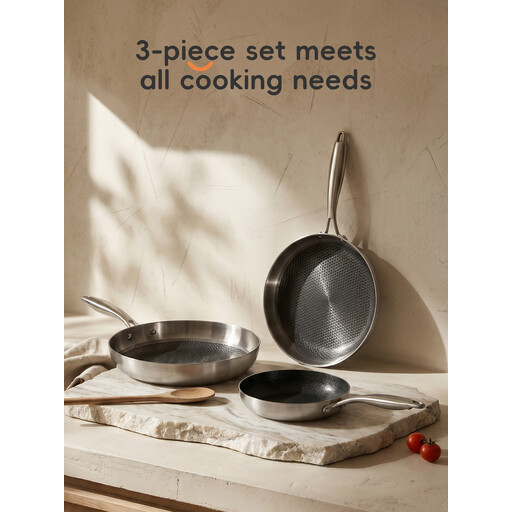
Why This Fits Their Persona: With three different sizes (20 cm, 26 cm, 30 cm), this set provides a versatile foundation for daily use—from a fried egg in the morning to a family dinner in the evening. It's a practical starter kit or a great addition to any household.
The multi-layer composite base ensures all three pans remain stable and distribute heat evenly, thus avoiding the trap of a thin, warping base.
Made from food-grade 304 stainless steel. The magnetic base is suitable for all cooktops, including induction.

Why This Fits Their Persona: Those who value precise cooking results will benefit from its superior thermal performance. Ideal for high-heat searing of meat or for dishes requiring exact temperature control. The glass lid also allows for monitoring the cooking process.
The full Tri-Ply construction (stainless steel-aluminium-stainless steel) offers outstanding stability and heat conduction that goes far beyond a simple encapsulated base. This is the direct answer to inferior, thin materials.
Fast and very even heat distribution across the base and up the sides. The scratch-resistant surface is suitable for metal utensils.
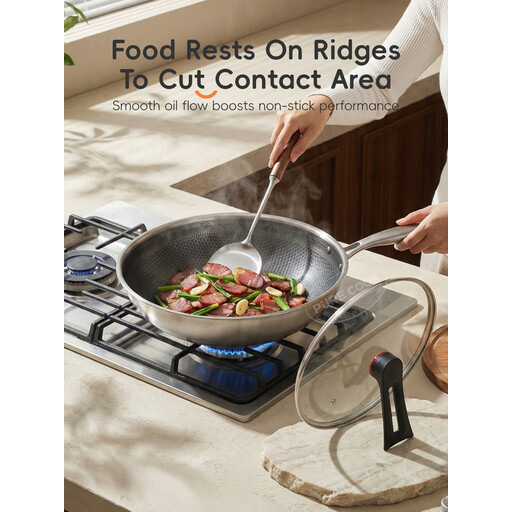
Why This Fits Their Persona: This stainless steel wok pan, with its large diameter and high sides, is specifically designed for stir-frying. It offers ample space to cook ingredients quickly at high heat without anything spilling out.
Instead of a false non-stick promise, this wok relies on a physical solution: the internal honeycomb texture minimises the contact area with food and, when heated correctly, creates an air-cushion barrier that reduces sticking.
Tri-ply construction from 304 stainless steel for fast, even heat. The texture is extremely scratch-resistant and suitable for all cooktops.
We have compiled a complete, up-to-date list of products that fully meet these strict selection criteria and German safety regulations.
1. How do you prevent food from sticking in a stainless steel pan? The key is proper preheating. Heat the empty, dry pan over medium heat. Do the water drop test: splash a few drops of water into the pan. If the drops sizzle and evaporate, it's not hot enough yet. If the drops bead up and dance across the surface like pearls (the Leidenfrost effect), the pan has reached the right temperature. Only then should you add oil or fat, spread it, and then add your food.
2. Is all stainless steel cookware suitable for induction cooktops? No. For a pan or pot to work on an induction stove, its base must be magnetic. High-quality 18/10 stainless steel is not naturally magnetic. Therefore, induction-compatible models require an outer base layer of a ferromagnetic material (e.g., Type 430 stainless steel). Look for the induction symbol (a stylized coil) on the product packaging or in the description.
3. How do you properly clean and care for a scratch-resistant stainless steel pan? After use, let the pan cool down slightly before cleaning it with hot water and dish soap. For stubborn stuck-on food, you can fill the pan with water and bring it to a brief boil to loosen the residue. Avoid aggressive scouring pads or steel wool, which could scratch the surface. A soft sponge or brush is sufficient. For a streak-free shine, dry the pan with a cloth after washing.