
Lieferung heute & morgen

Qualitätsgarantie

Willkommens-Angebote freischalten: KOSTENLOSE Lieferung | Bis zu 80 % RABATT | Kostenlose 30-Tage-JoyPlus-Testphase
App herunterladen
A stainless steel dish drying rack should reliably hold plates, bowls, cups and cutlery after washing up, channel water away effectively and keep the kitchen worktop dry. In small and medium-sized kitchens, however, the material alone does not determine how practical it is for everyday use.
Three common buying mistakes often lead to unnecessary expense:
For a rust-resistant dish drainer, stainless steel and the stability of the construction are key criteria. According to the product specifications, the featured models are made from stainless steel and PP, or polypropylene. PP is used, among other things, for drip trays, holders and drainage components.
The term “rust-resistant” should nevertheless be viewed objectively: prolonged exposure to moisture, salt and acid residues, as well as harsh cleaning products, can damage surfaces. For care, use a mild washing-up liquid, a soft sponge and dry the rack afterwards. Steel wool and abrasive cleaners can cause scratches.
A robust construction is also evident in stable feet, neatly joined supports and sufficiently sturdy holders. With tiered models, the worktop should be level so that the weight is not distributed unevenly.
Before buying, measure the available space, including the drainage route. A dish rack with drip tray needs room not only for the rack itself, but potentially also for a clear connection to the sink.
The following practical guidelines apply to different household sizes:
A space-saving dish rack is therefore not always the smallest one. A two-tier model can hold more crockery on the same footprint, but it needs sufficient clearance above the worktop.
A kitchen dish drying rack should either collect water in a removable tray or direct it towards the sink through a carefully positioned outlet. A dish drainer with a drain is particularly practical when the rack is placed directly next to the sink.
Look for:
Water should not run onto the worktop. A wrongly positioned drainage pipe can also create a slipping hazard on the floor. That is why the outlet’s position is part of everyday usability, not merely a product specification.

Why this product suits this profile: The single-tier design, measuring 42 × 29 × 12.7 cm, is ideal for households looking for a manageable dish holder with plenty of usable space for the kitchen worktop.
The integrated PP drip tray collects water, while the adjustable outlet allows it to be directed towards the sink. This removes the need for a separate collection solution.
Stainless steel construction, drip tray and integrated water outlet; according to the product specifications, no assembly is required.
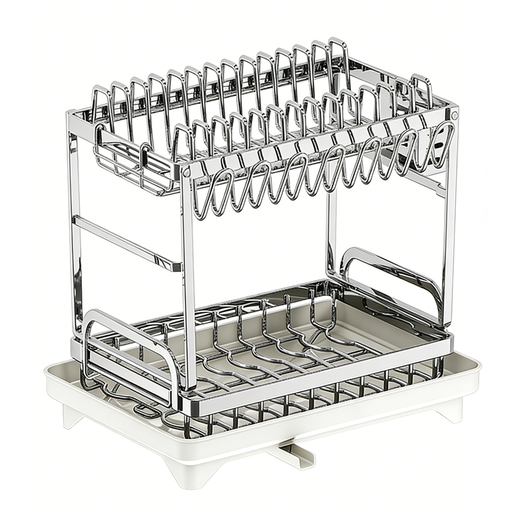
Why this product suits this profile: The two-tier design, measuring 42 × 32 × 30 cm, is aimed at households that want to dry plates, bowls and cutlery separately while making efficient use of limited floor space.
The separate tiers and compartments reduce the need to stack wet dishes. The drainage pipe at the base should be directed towards the sink to prevent water from collecting on the worktop.
Two-tier storage, stainless steel and PP materials, plus a removable drainage component for more thorough cleaning.
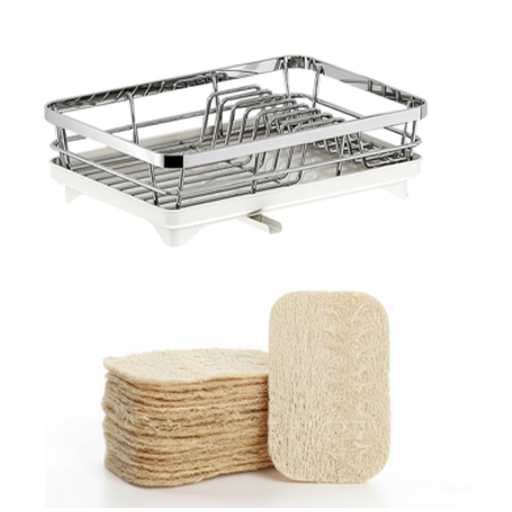
Why this product suits this profile: This bundle combines a single-tier stainless steel rack with 30 natural loofah washing-up sponges, making it suitable for households that wash dishes regularly.
The integrated PP drip tray prevents draining water from running directly onto the worktop. The single-tier design also keeps everything easy to access.
Rack dimensions: 42 × 29 × 12.7 cm; plus 30 washing-up sponges made from natural loofah fibre, described in the product specifications as compostable.
Place the dish drying rack on a level, sturdy surface and keep the drainage route clear. Plates should go into the designated slots, while bowls should be positioned with the opening facing downwards or at a slight angle. This allows water to drain away more effectively.
Empty and clean the drip tray regularly. Depending on the manufacturer’s instructions, limescale can be removed with a suitable mild cleaning product. After cleaning, wipe stainless steel surfaces dry. Do not exceed the stated load capacity, and keep the rack away from naked flames and direct heat.
We have compiled a complete, regularly updated list of products that fully meet these strict selection criteria and the safety regulations applicable in the EU.
Choose a model with a drip tray or water outlet. The outlet must point towards the sink and should not be blocked by dishes or kitchen utensils. If the rack has a collection tray, emptying and drying it regularly is recommended.
Its lifespan depends on the material quality, load, moisture and care. A sturdy construction, regular drying and avoiding steel wool can help extend its service life. It is not possible to give a general durability estimate without specific manufacturer conditions.
The rack does not require electricity. Ongoing costs may only arise from cleaning products, replacement parts or, where applicable, new washing-up sponges. With a bundle, you should therefore check not only the purchase price but also which components are included and how they will actually be used in your household.