
Lieferung heute & morgen

Qualitätsgarantie

Willkommens-Angebote freischalten: KOSTENLOSE Lieferung | Bis zu 80 % RABATT | Kostenlose 30-Tage-JoyPlus-Testphase
App herunterladen
By Joybuy Product Recommendation Officer, August 30, 2026
Choosing a stainless steel food container set is a conscious step away from plastic towards greater durability and sustainability in the kitchen. However, the market is flooded with products that often fail to live up to their promises in practice. Before you invest, it's crucial to understand the common pitfalls that lead to disappointment and unnecessary expense.
Many buyers report three central problems:
This guide helps you avoid these problems by highlighting the critical quality features you should look for before making a purchase.
To find a set that will serve its purpose reliably and for the long term, you should carefully examine three technical aspects. These features are often more important than the manufacturer's marketing.
Not all stainless steel is created equal. The material designation provides information about its corrosion resistance and food-grade safety.
The lid is the most common point of failure. A good lid not only creates an airtight seal but also retains its shape and function after repeated use and cleaning. Look for stainless steel containers with lids that feature a thick, removable silicone gasket. Removable gaskets can be cleaned separately, which improves hygiene. Four-sided locking clips generally provide more even and firm pressure than simple press-on lids.
For an organised kitchen, stackable kitchen storage boxes are essential. Check if the containers in a set can fit inside one another (are nestable) to save space when not in use. It's equally important that the containers can be stacked stably on top of each other with their lids on, without slipping. Rectangular or square shapes typically make more efficient use of available space in cabinets and refrigerators than round containers.
Based on the quality criteria mentioned, we have identified some products that are suitable for different user profiles and requirements.
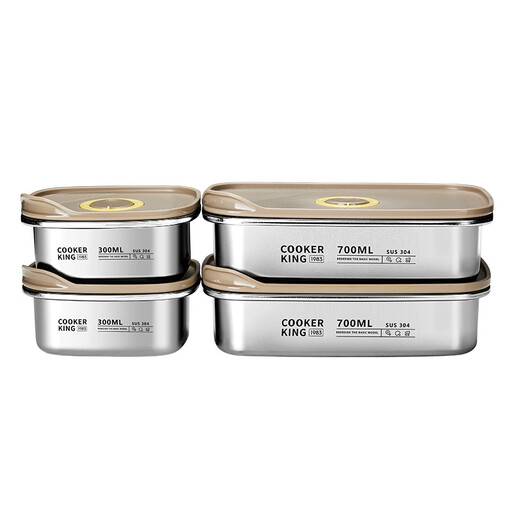
Why This Fits Their Persona: Ideal for those who want to switch to stainless steel without making a large initial investment. With two different sizes (300 ml and 700 ml), the set provides a good basic kit for snacks, small meals, or leftovers.
It bypasses the pitfall of inferior materials by using proven food-grade 304 stainless steel, which is sufficiently rust-resistant for most everyday applications.
The set is stackable, saving space. The combination of small and medium sizes offers flexibility for various storage needs.

Why This Fits Their Persona: Perfect for users who regularly prepare meals (meal prep). The three different sizes (600 ml, 1100 ml, 2200 ml) are excellent for separately storing main courses, side dishes, and salads.
By using 316 stainless steel, it avoids the trap of corrosion from acidic dressings or marinades. The lids are designed for a tight seal, which is crucial for transport as a stainless steel bento box.
The high-quality material ensures durability and flavour neutrality. The versatile sizes make this meal prep box set highly flexible.

Why This Fits Their Persona: This set is designed for households that store large quantities. The four identical 1600 ml containers are ideal for family-sized portions, weekend leftovers, or storing food bought at the market.
It relies on 316L stainless steel, an even purer grade than 316, offering maximum corrosion resistance and hygiene. The uniform, rectangular design avoids the pitfall of impractical shapes and allows for highly efficient, stackable storage.
The high material quality and large, uniform volume make this set a durable solution for demanding food storage.
We have compiled a complete, up-to-date list of products that fully meet these strict selection criteria and relevant safety standards.
Are stainless steel food containers dishwasher-safe? Most stainless steel containers themselves are dishwasher-safe. However, hand-washing is often recommended for the lids. High temperatures and harsh detergents in the dishwasher can degrade the elasticity of the silicone seal over time, which can reduce its leak-proof capability. It's always wise to check the manufacturer's instructions.
Can stainless steel containers go in the microwave? No, under no circumstances. Metal should never be placed in a microwave oven. It can cause sparks, damage the appliance, and create a fire hazard. Food must be transferred to a microwave-safe container before heating.
How do 304 and 316 stainless steel differ in practice? For most everyday applications, such as storing sandwiches, nuts, or cooked vegetables, 304 stainless steel is perfectly adequate and a cost-effective choice. However, if you frequently store foods with high acid or salt content, like tomato sauces, salads with vinaigrette, or pickled items, 316 or 316L stainless steel offers superior resistance and is a worthwhile investment in the longevity of your set.