
Same-day & Next-day Delivery

Quality Guaranteed

Unlock Your Welcome Offers: FREE Delivery | Up to 80% OFF | Free 30-day JoyPlus trial
Download the APP
Stainless steel food containers are ideal for the fridge, pantry, meal prep and transporting food. However, not every product labelled “leak-proof”, “airtight” or “thermal” automatically leads to the right purchase decision. What really matters is the material specification, closure, capacity and the actual intended use.
A general mention of “stainless steel” tells you very little about the specific grade. For food containers, you’ll often see 304 stainless steel or 316 stainless steel listed. 304 is a common material choice for everyday household use, the fridge and transporting food. 316 (or 316L) is also used for food containers and, according to product descriptions, offers higher corrosion resistance.
However, the material grade alone doesn’t replace a full product check. The lid, seals, closures and interior surfaces must also be suitable for your intended use.
A lid with a silicone seal can improve the closure, but it doesn’t automatically make a container safe for liquids in every position. Look for:
Even a container described as leak-proof should be fully closed before transport and not turned upside down unnecessarily.
Stainless steel should never go in the microwave. With some products, the lid may be suitable for certain heating methods, but the metal container itself must not be microwaved. When in doubt, always follow the instructions on the individual product page.
Freezer and dishwasher suitability also vary by product. Lids made from plastic, glass or silicone may have different care instructions than the stainless steel body.
304 stainless steel is a practical choice for everyday stainless steel storage containers, lunch boxes and food keepers. It is used in the products listed here for fridge storage, meal prep and transporting snacks.
316L stainless steel is found, for example, in containers and stainless steel thermal food jars from Maxcook. According to product descriptions, these models offer higher corrosion resistance. This can be relevant if you frequently store moist or salty foods. However, a 316L container is not automatically suitable for every heat source, dishwasher or transport position.
The right size depends on how you plan to use it:
Rectangular shapes are often more space-efficient in the fridge. Stackable storage containers or models that nest inside each other save space in drawers and kitchen cupboards. A stainless steel lunch box with one or two compartments is better suited to solid foods, packed lunches and snacks.
BPA-free PP lids and silicone seals are part of the construction in several products. Check whether the seal is removable. This makes thorough cleaning easier and reduces residue build-up in the seal grooves.
“Dishwasher-safe food containers” are convenient, but this approval may only apply to certain components. For example, the Maxcook vacuum thermal container recommends hand washing; the lid’s seal area should not be soaked for long periods. With glass lids, also be mindful of the risk of dropping and breakage.
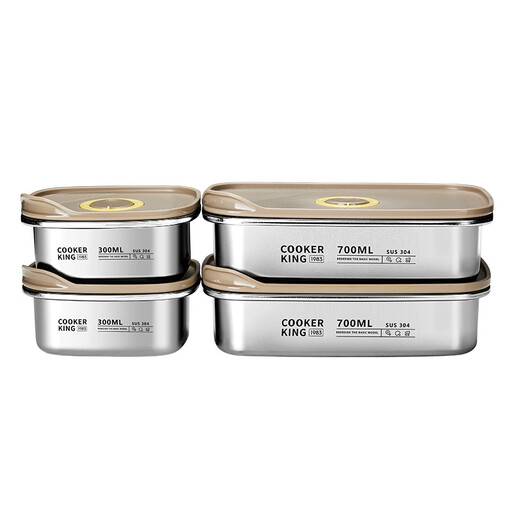
Why it fits: Two sizes at 300 ml and 700 ml each cover small portions, snacks and leftovers around the home.
The product description specifically mentions 304 stainless steel, four containers, stackability and dishwasher suitability, rather than just generic material claims.
304 stainless steel, rust-resistant construction and two usable capacity ranges. Not intended for microwave or oven use.

Why it fits: Four identical containers support regular meal prep, larger portions and consistent fridge organisation.
The material specification of 316L is clear. The lids are designed to close securely; however, a leak test before transport is still recommended for liquids.
Four containers at 1,600 ml each, suitable for freezer and dishwasher according to the product information.

Why it fits: The vacuum thermal container is designed for soups and hot meals on the go, and comes with an insulated bag.
The construction mentions vacuum insulation, a wide filling opening and a tightly sealing lid. This makes the relevant functions clearer than a simple “thermal” label.
316 stainless steel, 1.5 l capacity and lunch bag. Hand washing is recommended; not suitable for microwave or carbonated drinks.
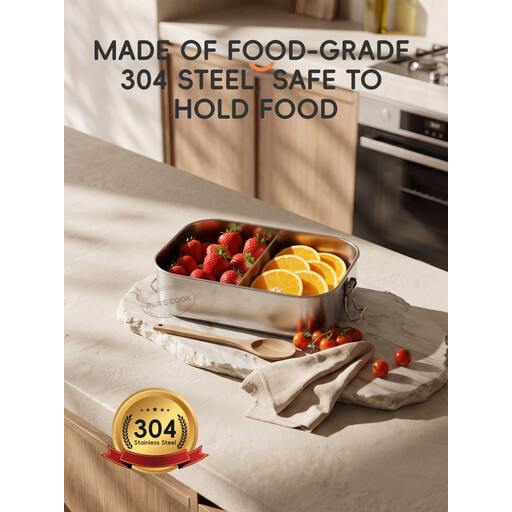
Why it fits: The separate internal compartments are ideal for school, the office, days out and solid meals with a side dish.
The product description mentions clips and a removable silicone seal. Both should be checked for correct fit and ease of cleaning before purchase.
304 stainless steel, two compartments and dishwasher safe according to the product information. For liquid foods, the clips must be fully closed.
In the full category you’ll find a current selection of stainless steel bento boxes and matching food containers in various sizes and for different uses.
Wash new containers thoroughly before first use. Remove seals if the instructions allow, and dry all parts completely. Abrasive cleaners and sharp objects can damage stainless steel surfaces, seals or coatings.
For a stainless steel thermal container, the product description recommends pre-warming with hot water or pre-cooling with cold water. Fill hot food carefully and check the temperature before eating directly. Carbonated drinks should not be used in the thermal containers listed, as pressure can build up.
The stainless steel body is not suitable for the microwave. Even if a product mentions that the lid or a specific heating method is allowed, you should always follow the manufacturer’s instructions. Only containers explicitly designed for heating without metal should be used.
The lifespan depends on material thickness, the lid, seal, cleaning and daily wear. The stainless steel body can last a long time with proper care. Seals and plastic lids are consumable parts and should be replaced when they become brittle, permanently smell or no longer close securely.
Some of the models listed are described as freezer-safe on the product page. Before freezing, check the individual product page, leave enough space for the contents to expand and do not place hot food directly into the freezer.