
Lieferung heute & morgen

Qualitätsgarantie

Willkommens-Angebote freischalten: KOSTENLOSE Lieferung | Bis zu 80 % RABATT | Kostenlose 30-Tage-JoyPlus-Testphase
App herunterladen
A stainless steel food storage container set can make storing food in the kitchen, fridge and on the go much easier. However, products vary considerably in terms of lid mechanisms, material specifications, capacities and cleaning requirements. If you only look at the number of containers or terms such as “airtight”, you could end up buying a set that does not suit the way you use it every day.
Not every product description specifies the exact grade of stainless steel. For everyday contact with food, clear material information is more useful than a general reference to metal. 304 stainless steel is specified for several of the stainless steel food storage containers featured here. You should also check whether the container is coated and what material the lid is made from.
A plastic or glass lid is not automatically a disadvantage either. What matters are the details about the seal, temperature range, cleaning and intended use.
A container may help to contain odours in the fridge without being suitable for transporting liquids. For soups, sauces or dressings, airtight food storage containers need a continuous silicone seal and a reliable closing mechanism. Clips on several sides can support the seal, but they do not replace checking the lid itself.
Before buying, it is worth looking at the following points:
A set with lots of containers may seem versatile at first glance. In practice, however, small containers can go unused while the right sizes for leftovers, side dishes or meal prep are missing. For a one-person household, 300-ml containers may be useful; families often also need sizes from 1,000 ml upwards.
You should also consider the external dimensions and shape. Stackable food storage containers save space when the lids and bases sit securely on top of one another. Round containers are easy to clean, while rectangular models often make better use of the available space in the fridge.
With a 304 stainless steel storage container, the container is made from a widely used grade of stainless steel for food storage, according to the product details. The following information should also be available when making your decision:
A smooth interior surface makes it easier to rinse away oil or food residue. However, this does not mean that every model will continue to look the same without proper care. After washing, the container should be allowed to dry completely, particularly if it will be stored closed for a longer period.
For stainless steel food storage, several different sizes are more practical than containers all with the same capacity:
If you are looking for a set for meal prep, check that the sizes are genuinely large enough for the portions you plan to prepare. For a stainless steel lunch box, compact containers with secure closures and a convenient format are important. For the pantry, on the other hand, stackable containers without complex closures may be sufficient.
A stainless steel container is not automatically suitable for every appliance. Stainless steel must not be used in the microwave, as metal can cause sparks. Oven and steam-cooker use are also subject solely to the specifications for the individual product. The lid may have a different temperature range from the container.
With glass lids, sudden changes in temperature should also be avoided. When freezing food, leave enough room for water-based foods to expand. Always check the safety instructions on the product page before use.
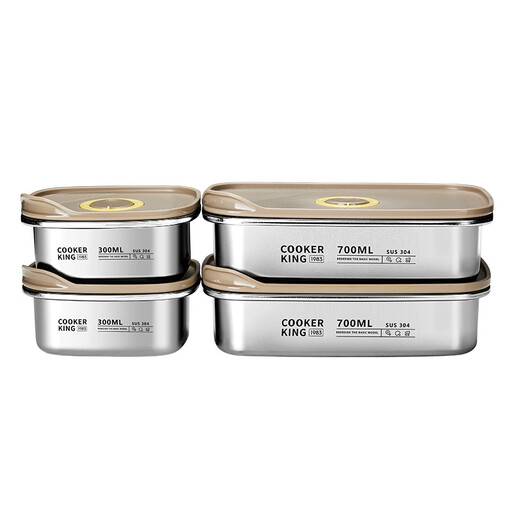
Why this product suits this profile: According to the product description, the set combines two 300 ml containers with two 700 ml containers. This makes it suitable for smaller portions, snacks and leftovers at home.
The two available sizes are clearly specified. Buyers therefore do not have to judge everyday practicality based solely on the number of containers in the set.
304 stainless steel, a four-piece set and, according to the product details, dishwasher-safe cleaning.
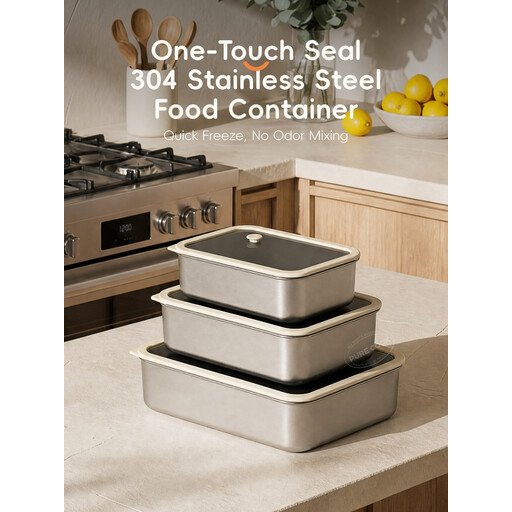
Why this product suits this profile: The combination of 304 stainless steel, borosilicate glass lids and silicone seals is aimed at users who compare material and closure details before buying.
The seal is described as a separate component and can be removed for cleaning. This makes it easier to check the rim and silicone ring.
Three sizes: 1,000, 1,800 and 3,000 ml; glass lids and stackable, nestable containers.

Why this product suits this profile: The 1,000, 1,800 and 3,000 ml sizes accommodate larger portions, salads and prepared meals. Rectangular containers make practical use of shelf compartments and fridge space.
The product details specify several locking clips, a silicone ring and a removable seal. Before transporting liquids, all clips must be closed.
Rectangular shape, three large capacities, 304 stainless steel and, according to the product description, dishwasher-safe cleaning.
We have put together a complete, regularly updated list of products that fully meet these strict selection criteria and the safety regulations applicable in the EU.
To keep dishwasher-safe food storage containers usable for as long as possible, the containers, lids and seals should be dried completely after washing. With plastic lids, it is also advisable to check for signs of warping. Abrasive cleaning products and hard objects can damage surfaces and seals.
When storing food in the freezer:
No, a stainless steel container should not be used in the microwave. Even if the lid is made from plastic or glass, the container itself is metal. To heat food, transfer it to a container that is explicitly labelled as microwave-safe.
For individual meals, 1,000 to 1,800 ml is often sufficient, depending on portion size and the type of food. Small containers between 300 and 700 ml are suitable for side dishes, fruit and snacks. Families or users preparing several portions can plan more flexibly with a set containing both small and large containers.
Their service life depends on the material, closure, seal and care. The stainless steel body is generally less susceptible to discolouration than many plastic surfaces. However, sealing rings and lids are wear parts. You should therefore check regularly that the seal is sitting properly and that the closure still closes securely.