
Lieferung heute & morgen

Qualitätsgarantie

Willkommens-Angebote freischalten: KOSTENLOSE Lieferung | Bis zu 80 % RABATT | Kostenlose 30-Tage-JoyPlus-Testphase
App herunterladen
A stainless steel frying pan can serve you well for many years, provided its construction, hob compatibility and care requirements suit the way you cook. But there are important differences between an uncoated stainless steel pan, a coated frying pan and a deep frying pan with a lid.
Many disappointing purchases aren’t down to the stainless steel itself, but to confusing product claims. Check these three common pitfalls before you buy:
A tri-ply frying pan usually has an aluminium core between two layers of stainless steel. Aluminium conducts heat quickly, while stainless steel forms the cooking surface and outer structure. This construction can distribute heat more evenly than a simple, single-layer stainless steel pan.
Look for clear details such as:
Multi-layer construction won’t prevent problems caused by incorrect use. Even a high-quality pan shouldn’t be left empty on the highest heat for a long time.
A coated frying pan makes it easier to cook delicate foods such as eggs, fish and pancakes. With PTFE-coated models, low to medium heat and suitable kitchen utensils are recommended. Sharp-edged metal utensils can damage the surface.
Some models are described as having a PFAS-, PFOA- and PTFE-free ceramic coating. This claim relates to the relevant supplier’s product description and shouldn’t be taken to imply any medical or health benefits.
An uncoated stainless steel pan needs more careful temperature control. A tried-and-tested approach is to preheat the pan, add the oil afterwards and avoid moving the food too soon. This can reduce sticking, although it can’t be ruled out completely with stainless steel.
The right size depends on your portions and hob:
A frying pan with a lid gives you more ways to cook. Check whether only the pan or the glass lid is oven-safe, as their maximum temperatures may differ.
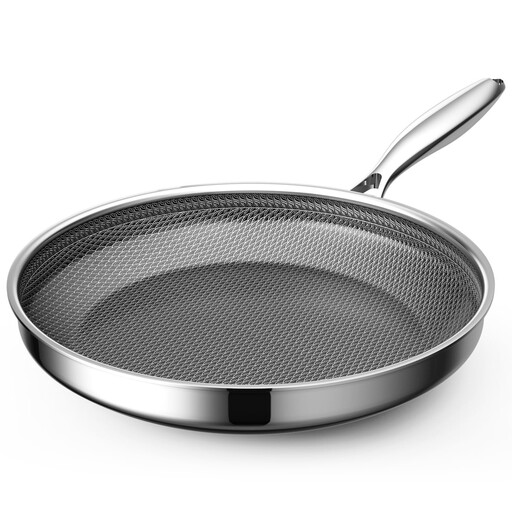
Why this product suits you: The 24 cm size is well suited to everyday portions. According to the product details, this model has a tri-ply construction with 304 stainless steel, an aluminium core and a 430 stainless steel induction base.
The product description explicitly states that it is suitable for induction and other hob types, and has a PFAS-, PFOA- and PTFE-free ceramic coating.
Suitable for induction, oven-safe up to 260 °C and dishwasher-safe according to the supplier.
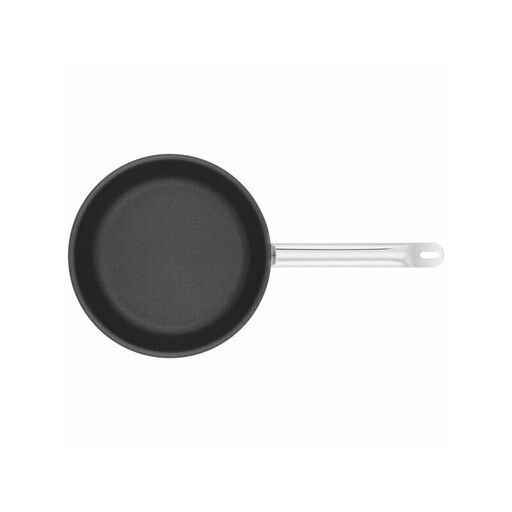
Why this product suits you: This 26 cm pan combines 18/10 stainless steel with a three-layer SIGMA-Clad construction and a Duraslide Ultra PTFE coating.
The coating is clearly specified, so you can distinguish this pan from an uncoated stainless steel pan and from PFAS-free ceramic models.
Suitable for induction and oven use up to 230 °C according to the product details; dishwasher-safe.
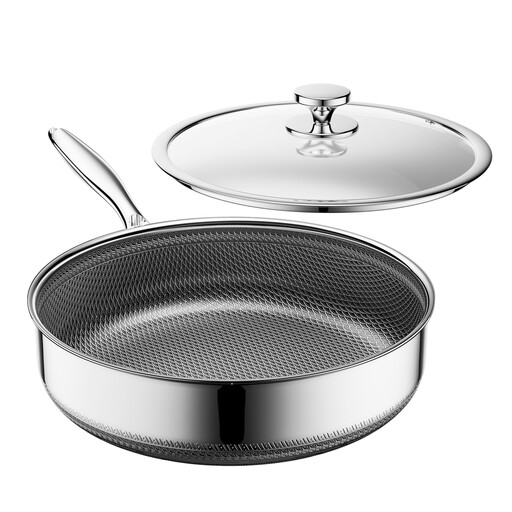
Why this product suits you: According to the product description, its deep shape and glass lid make it suitable for frying, braising and cooking dishes with sauce. The pan is designed for several hob types, including induction.
The product details give separate oven temperature limits for the pan and lid: up to 260 °C for the pan and up to 148 °C for the glass lid.
Deep design, lid, dishwasher-safe and free from PFAS, PTFE and PFOA according to the supplier.
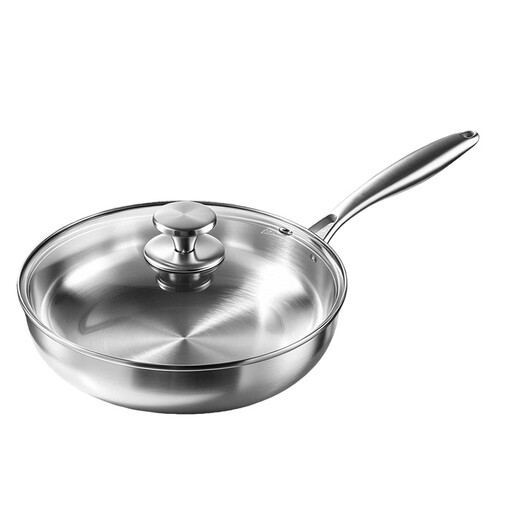
Why this product suits you: This uncoated 22 cm pan is for buyers who prefer a 304 stainless steel cooking surface without a chemical non-stick coating.
The surface is specified as uncoated, avoiding the common misconception that every stainless steel pan is automatically non-stick.
Tri-ply construction, suitable for induction and dishwasher-safe according to the product details; glass lid included.
We’ve put together a complete, regularly updated list of products that meet these strict selection criteria and fully comply with the safety regulations in force in the EU.
For a coated stainless steel pan, using low to medium heat and wooden, silicone or nylon utensils will help the coating last longer. Even if a model is described as dishwasher-safe, hand-washing it with mild washing-up liquid can help protect the coating.
Uncoated stainless steel pans can withstand more wear, but still need careful temperature control. Limescale or rainbow-coloured marks can often be removed with a little vinegar, followed by a thorough rinse. Don’t plunge a hot pan straight into cold water, as this can warp the base.
Look for the explicit wording “suitable for induction” and a magnetic base. A tri-ply construction with a 430 stainless steel base is commonly used for this purpose. The pan should sit flat on the hob.
A 20 cm frying pan is often enough for one person. A 24 or 26 cm pan usually gives two people plenty of flexibility. For several portions or family meals, a 28 cm frying pan offers more cooking space. The key is to choose a pan base that suits the size of your hob.
First, heat the pan over a medium setting, then add the oil and put the food in once the pan is hot enough. Leave the food to cook briefly before turning it. For delicate dishes, a coated frying pan is usually easier to use.