
Lieferung heute & morgen

Qualitätsgarantie

Willkommens-Angebote freischalten: KOSTENLOSE Lieferung | Bis zu 80 % RABATT | Kostenlose 30-Tage-JoyPlus-Testphase
App herunterladen
A stainless steel frying pan can handle frying, sautéing and everyday cooking reliably. But a shiny finish, terms such as ‘hybrid’ or claims of universal hob compatibility don’t automatically mean you’ve found the right pan. The key things to consider are its construction, care instructions and what you’ll use it for.
Many models have a stainless steel exterior but a ceramic or other non-stick coating on the inside. That’s not necessarily a drawback, but it does affect how you use the pan:
If you specifically want to cook without a chemical non-stick coating, check the full product description and material details. A stainless steel appearance alone isn’t proof.
An induction frying pan needs a magnetic base or a base designed for induction. On gas, electric and ceramic hobs, other factors such as a flat base and even heat distribution are important.
Even when a product is advertised as a pan for all hob types, check that the compatible hob types are listed individually. For infrared or halogen hobs, you may need to check with the manufacturer.
A 28 cm stainless steel frying pan offers plenty of room to cook several portions, but it needs a suitably sized hob and more storage space. Pans measuring 20 to 22 cm can be easier to handle if you’re cooking for one or two people. A 30 or 32 cm pan, on the other hand, makes sense if you regularly cook larger quantities or family-sized one-pan meals.
A 3-ply stainless steel frying pan typically consists of stainless steel, an aluminium core and another layer of stainless steel. Aluminium conducts heat relatively well, while stainless steel provides a durable cooking surface and exterior. Check whether the description refers to the whole pan or just the base.
A multi-layer construction can help distribute heat more evenly when sautéing or searing food. However, it doesn’t replace good temperature control. With uncoated pans in particular, it’s best to preheat over a medium heat and then add oil.
On coated hybrid models, a textured surface combines exposed areas of stainless steel with coated sections. This can support different cooking techniques, but you’ll need to follow the manufacturer’s care instructions.
With uncoated pans, food sticking or discolouration doesn’t automatically mean there’s a fault. The ‘hot pan, cold oil’ method, a moderate temperature and turning food at the right time can make cooking easier. You can usually remove residue with warm water, mild washing-up liquid and a soft sponge. Only use steel wool or abrasive cleaners if the manufacturer specifically says they’re suitable.
A stainless steel frying pan with a lid is also useful for braising, reducing sauces and keeping food warm. A glass lid lets you keep an eye on your food without lifting it. When choosing a pan, also consider its height, the diameter of its base and its weight.
For stir-frying and larger portions, a stainless steel wok pan with a diameter of 28 to 32 cm can be a good choice. However, a very wide pan may not heat evenly across a small induction hob. Make sure the size of the base matches your cooking zone.
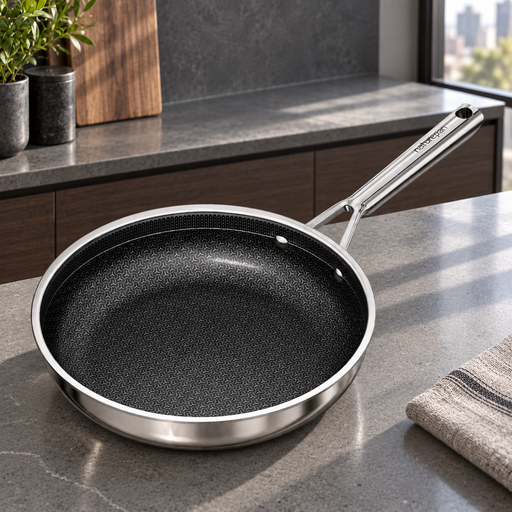
Why this product suits this profile: This 28 cm pan combines a multi-layer stainless steel body with an aluminium core and a textured ceramic surface. It’s listed as suitable for induction, gas, electric and ceramic hobs.
The product details clearly state that the pan is coated, rather than claiming it’s completely uncoated. It’s listed as oven-safe up to 230 °C without the lid.
28 cm diameter, a matching lid with the Deep-Sauté version and dishwasher-safe according to the product details. Hand washing is recommended to protect the coating.
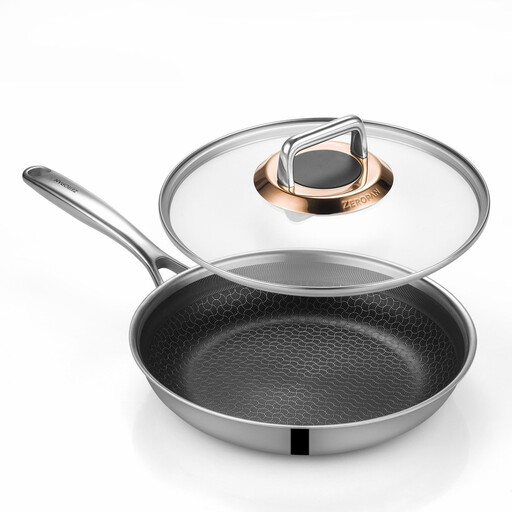
Why this product suits this profile: The product details specify a 3-ply construction made from 316 stainless steel, an aluminium core and a 430 induction base, along with a laser-cut honeycomb pattern.
The coating is explicitly described as ceramic and free from PFAS, PFOA and PTFE. This makes it easier to understand what the pan is made of before you buy.
30 cm diameter, glass lid, stay-cool hollow handle, and listed as suitable for gas, electric, ceramic, halogen and induction hobs.
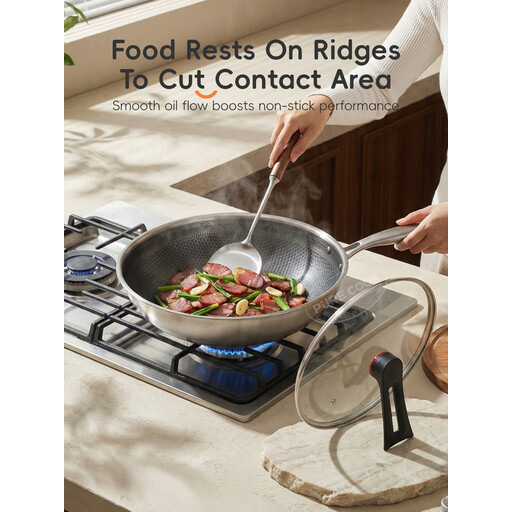
Why this product suits this profile: This 32 cm wok pan is designed for stir-frying, frying, braising and larger family portions. It’s listed as suitable for gas, induction and electric ceramic hobs.
The product details specify an uncoated honeycomb surface, and also recommend gentle cleaning and avoiding sudden temperature changes.
304 stainless steel in a 3-ply construction, a clear glass lid and listed as dishwasher-safe on a gentle cycle.
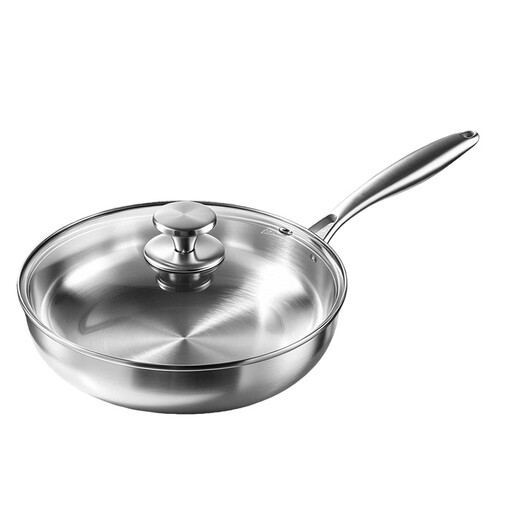
Why this product suits this profile: This compact pan is described as uncoated, 3-ply and suitable for induction, gas, electric, ceramic and halogen hobs. Its 22 cm size is ideal for smaller portions and limited storage space.
The product description explicitly states that there’s no non-stick coating. This clearly distinguishes the model from coated hybrid pans.
304 stainless steel with an aluminium core, a glass lid and listed as dishwasher-safe. For good results when frying, temperature control and enough oil are important.
We’ve put together a complete, regularly updated list of products that meet these strict selection criteria and the safety regulations in force in the EU.
Always follow the manufacturer’s instructions before using your pan for the first time. With a coated stainless steel frying pan, it’s important to use low to medium heat and suitable kitchen utensils. Uncoated models can also be preheated over a medium heat. Avoid leaving salt on dry, hot stainless steel for too long, as it can cause discolouration.
For cleaning:
Lids and handles can get hot while you’re cooking. Before using a pan in the oven, check the temperature limit, handle material and whether the lid needs to be removed. A stainless steel frying pan should never be put in the microwave.
Many models are listed as suitable for induction. What matters is the magnetic base or the induction base specified by the manufacturer. If you’re unsure, check the product description for the specific model.
It’s often due to the temperature being too low or too high, turning food too soon or not using enough fat. Preheating the pan, adding oil afterwards and letting the food cook until it releases more easily can help. Results also depend on the food, hob and quantity.
Its lifespan depends on the thickness of the material, heat treatment, care and how often you use it. With proper care, an uncoated surface can last a long time. For coated models, overheating, scratches and the utensils you use are the main factors that affect how long the pan lasts.