
Lieferung heute & morgen

Qualitätsgarantie

Willkommens-Angebote freischalten: KOSTENLOSE Lieferung | Bis zu 80 % RABATT | Kostenlose 30-Tage-JoyPlus-Testphase
App herunterladen
A stainless steel frying pan can be suitable for frying, sautéing, braising and everyday cooking. However, not every stainless steel frying pan delivers the same results. Differences in the base construction, coating, diameter and care requirements determine whether a pan is right for your household.
A single-layer stainless steel pan can heat up more quickly in certain areas than a model with an aluminium core. This can lead to unevenly browned food. The specific construction is more informative: in a tri-ply stainless steel frying pan, an aluminium core sits between layers of stainless steel. Aluminium conducts heat well, while stainless steel forms the inner and outer surfaces.
Important: a reinforced base is not automatically the same as a fully multi-layered pan body. Always check the product description before assuming that heat will be distributed evenly.
A coating-free stainless steel frying pan does not have a conventional non-stick coating. This may appeal to shoppers who prefer a robust metal surface. However, food can stick more readily if the pan is used when it is too cold, too hot or without enough fat.
For easier cooking:
By contrast, a non-stick stainless steel frying pan or hybrid pan is designed to release food more easily. It generally requires gentler handling of heat and cooking utensils.
An induction-compatible frying pan needs a magnetic base or a suitable induction disc. Most products described as suitable for all hob types list gas, electric, ceramic and induction hobs. For oven use, the maximum temperature is also crucial. The handle and any lid must be suitable for the stated temperature too.
304 stainless steel is specified as the food-contact material for several of the models considered here. The designation alone does not indicate the wall thickness, weight or heat distribution. Also look for:
On uncoated models, stainless steel can offer high scratch resistance compared with many coatings. Nevertheless, avoid abrasive sponges, wire wool and harsh cleaning products, as they can dull the surface.
The stated size usually refers to the upper diameter, not the actual usable cooking surface. A 20 cm stainless steel frying pan is better suited to smaller portions, side dishes, one or two eggs or compact cooking zones. A 26 cm stainless steel frying pan is a well-balanced everyday size for many households. A 28 cm stainless steel frying pan provides more room for vegetables, meat or several portions, but also requires a sufficiently large hob zone.
With induction hobs, the actual base diameter should match the cooking zone. A significantly smaller base can reduce the available power, while an overhanging pan rim will not automatically heat evenly.
A stainless steel frying pan with a lid is practical for braised vegetables, sauces and dishes that need to retain liquid. A glass lid lets you monitor the food without heat and steam escaping immediately. Check whether the lid can be used in the oven or needs to be removed before placing the pan inside.
A dishwasher-safe frying pan makes cleaning easier, but does not replace the manufacturer’s care instructions. With brushed or polished stainless steel, hand washing with a soft sponge can help keep the surface looking its best for longer. A ovenproof frying pan should only be used within the stated temperature limit. Handles can become hot independently of the pan body.
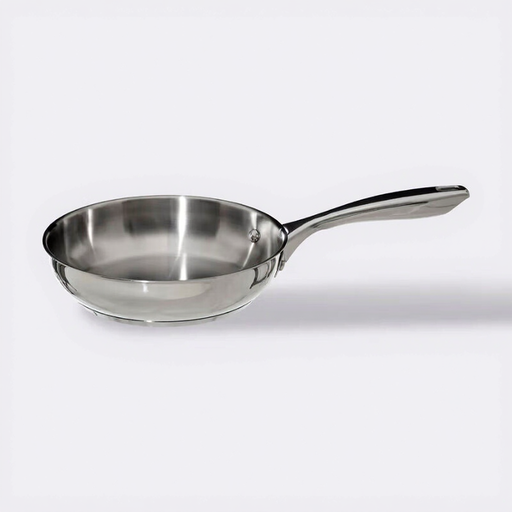
Why this product suits this profile: The 20 cm diameter is designed for smaller portions and compact cooking zones. It is specified as stainless steel with an aluminium disc, and is suitable for gas, electric, ceramic, halogen and induction hobs.
The product details clearly specify the diameter, hob types and dishwasher suitability instead of making only general claims about versatility.
20 cm diameter, 1.2 l usable capacity and compatibility with several hob types.
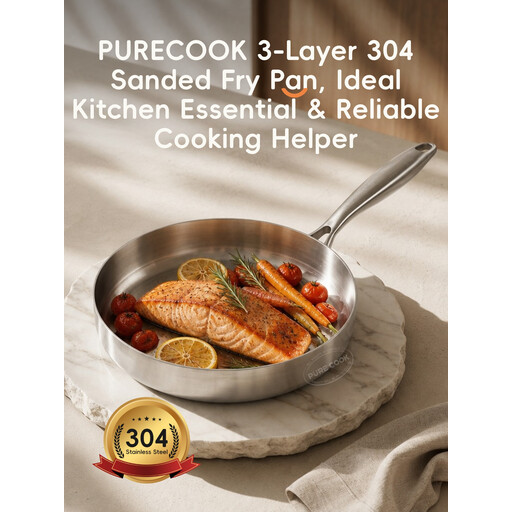
Why this product suits this profile: The specified tri-ply construction consists of 304 stainless steel and an aluminium core. The 26 cm diameter is suitable for everyday portions and various hob types.
The multi-layer construction is explicitly stated. The pan is also listed as dishwasher-safe and suitable for gas, induction, electric, ceramic and halogen hobs.
26 cm, tri-ply construction, 304 stainless steel and dishwasher-safe according to the product details.
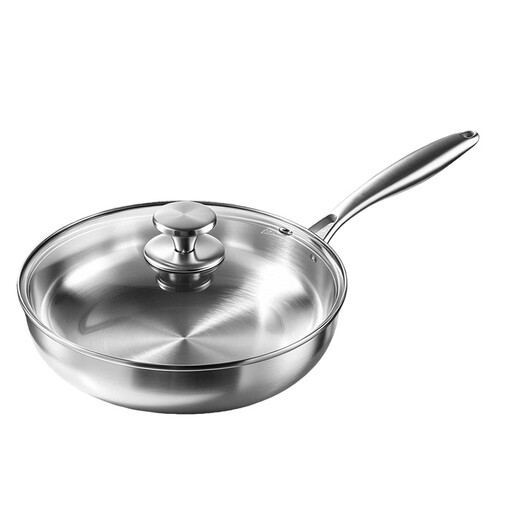
Why this product suits this profile: The uncoated tri-ply construction with an aluminium core is designed for users who want to fry without a chemical non-stick coating and also use a glass lid.
The product details explicitly highlight the uncoated surface. This makes it clear that suitable temperature control and enough fat are needed when frying.
22 cm diameter, 304 tri-ply stainless steel, glass lid and suitability for induction, gas, electric, ceramic and halogen hobs.
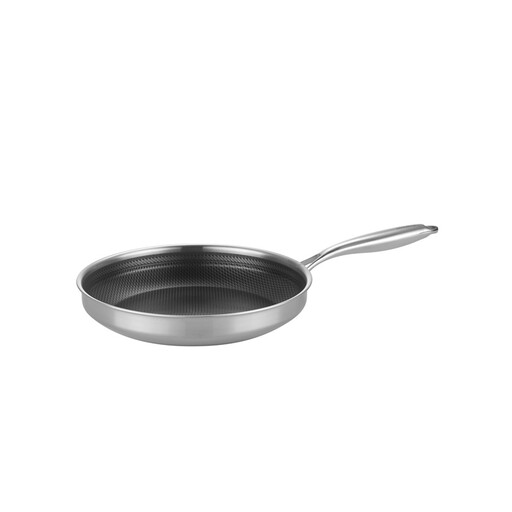
Why this product suits this profile: This model combines a stainless steel body with an aluminium core and ceramic non-stick coating. It is specified as suitable for several hob types and for oven use up to 260 °C.
The product description clearly states the ceramic coating, temperature limit and dishwasher suitability. This pan should therefore not be confused with an uncoated stainless steel frying pan.
24 cm, ceramic non-stick coating, aluminium core, induction compatibility and oven use up to 260 °C according to the product details.
We have put together a complete, regularly updated list of products that fully meet these strict selection criteria and the safety regulations applicable in the EU.
Daily use has a significant effect on the results you get from a stainless steel frying pan. Allow the pan to cool after cooking before rinsing it with cold water. Soak burnt-on residue in warm water. Use a soft sponge and a mild washing-up liquid. With coated hybrid models, wooden, nylon or silicone utensils are preferable.
On induction hobs and when the pan is empty, a medium heat setting is usually sufficient. Overheating can cause discolouration and, with coated models, place unnecessary strain on the coating. Also check regularly that the handle, lid knob and fixings are firmly attached.
A 26 cm stainless steel frying pan is a practical starting point for many everyday dishes. For larger portions or several ingredients, a 28 cm pan offers more cooking space. Sizes from 20 to 22 cm are better suited to smaller portions, side dishes or compact hobs.
The most common causes are a surface that has not been preheated sufficiently, turning the food too soon or using too high a temperature. Preheating, adding a little fat and cooking over a medium heat can improve food release. An uncoated pan will nevertheless behave differently from a ceramic or conventional non-stick model.
This depends on the model. Several of the pans mentioned are listed as dishwasher-safe. For the gentlest possible cleaning, however, hand washing with a soft sponge is still recommended, particularly for polished surfaces or ceramic coatings.