
Lieferung heute & morgen

Qualitätsgarantie

Willkommens-Angebote freischalten: KOSTENLOSE Lieferung | Bis zu 80 % RABATT | Kostenlose 30-Tage-JoyPlus-Testphase
App herunterladen
A stainless steel frying pan is a practical addition to many UK kitchens. It is suitable for frying, braising and searing, and is often designed for induction and other types of hob. However, models can differ considerably in terms of construction, heat distribution, cleaning and ease of use.
If you focus only on shiny stainless steel or bold claims such as “non-stick”, you may overlook important details. The following buying criteria will help you assess marketing terms and choose a suitable stainless steel frying pan for everyday use.
A single-layer stainless steel frying pan may warp more quickly or distribute heat unevenly. That is why the base construction is crucial for everyday use. A multi-layer construction with an aluminium core can distribute heat more effectively across the surface. In a Tri-Ply stainless steel frying pan, two stainless steel layers typically surround a heat-conducting aluminium core.
A coating-free stainless steel frying pan requires a different frying technique from a conventional pan with a plastic or ceramic coating. With uncoated surfaces, food can stick if the pan is too cold, too little fat is used or the temperature is set too high.
A structured honeycomb surface can reduce direct contact between food and the base of the pan. However, it does not replace proper temperature control. For coated pans, buyers should also check which utensils are permitted and whether using a dishwasher could affect the surface over time.
A pan advertised as suitable for all hob types should be explicitly approved for gas, induction, electric and ceramic hobs. Additional restrictions may apply to halogen or infrared hobs. For induction in particular, the base must be magnetically suitable and sufficiently flat to ensure reliable heat transfer.
304 stainless steel is listed as the material for several selected models. This designation describes a widely used grade of stainless steel for kitchenware. On its own, however, it says nothing about the weight, wall thickness or heat distribution.
The following details are relevant for more even heating:
A scratch-resistant pan can be robust enough for everyday use if it has a suitable surface. Nevertheless, abrasive sponges, wire wool and harsh scouring products should be avoided unless the manufacturer states otherwise.
A 28 cm stainless steel frying pan offers many households a balanced compromise between cooking surface and ease of handling. It is often suitable for several portions of vegetables, meat or one-pan meals. For one or two people, a 20 to 22 cm frying pan may be lighter and quicker to handle.
With a wok frying pan featuring a glass lid, height is just as important as diameter. A 30 or 32 cm model offers more capacity for stir-fries, braised dishes and larger portions, but requires sufficient space on the hob and in the sink.
A glass lid makes it easier to keep an eye on your food and is practical when braising. Check whether the lid and handle are heat-resistant and whether the pan can be used in the oven without the lid. Always observe the stated maximum temperature.
A dishwasher-safe pan is convenient for everyday use. With stainless steel, however, hand-washing with a soft sponge may still be advisable to protect the shine, handle connections and any coatings. The pan should be dried thoroughly after washing.
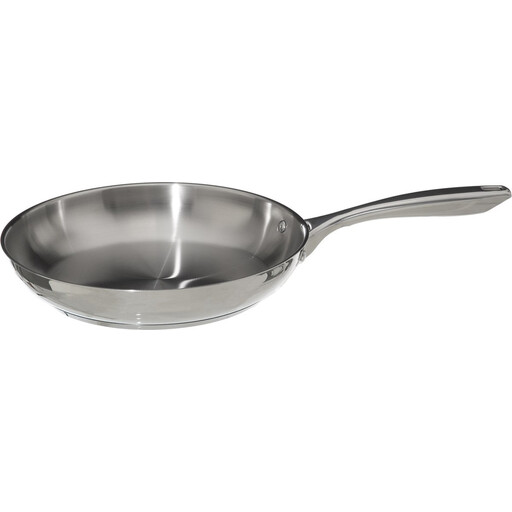
Why this product suits this profile: The 28 cm diameter is suitable for everyday family portions. According to the product information, the pan is suitable for gas, induction, ceramic and electric hobs, and is dishwasher-safe.
The details explicitly specify the compatible hob types, the material used for the pan body and the cleaning method. This means you do not have to infer key features from vague advertising language.
28 cm diameter, 2.2 l capacity, stainless steel body and compatibility with several hob types.
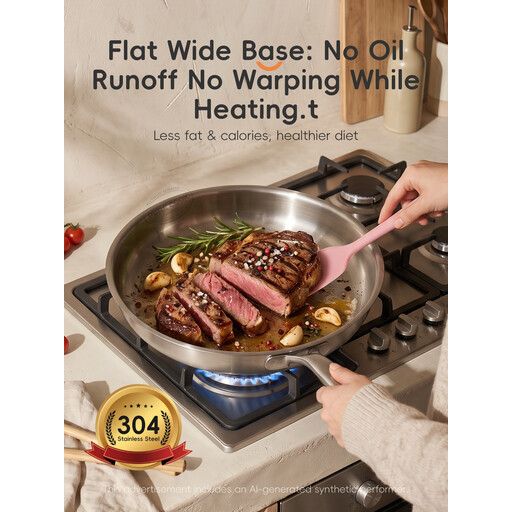
Why this product suits this profile: The three-layer construction with an aluminium core is designed to distribute heat more evenly. According to the product information, the stainless steel frying pan is suitable for gas, induction, ceramic and halogen hobs.
The construction is specifically described as stainless steel–aluminium–stainless steel. This makes it clear how heat conduction is intended to be supported, rather than relying on an unspecified “premium” material claim.
Tri-Ply construction, 28 cm diameter, scratch-resistant stainless steel surface and dishwasher-safe design.
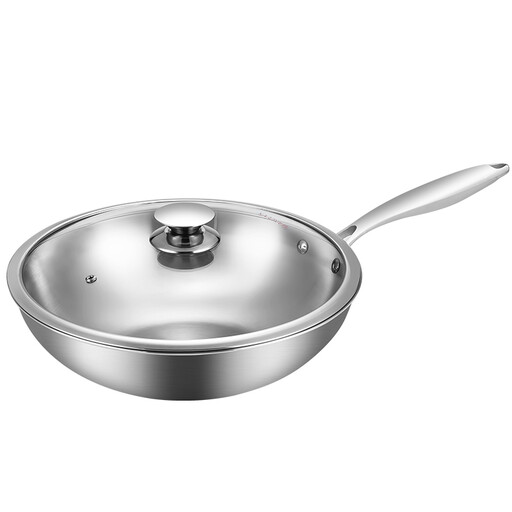
Why this product suits this profile: The wok shape is ideal for stirring, searing and braising. The glass lid is useful for dishes where you need to control the liquid and temperature.
The product information explicitly states that it has no chemical non-stick coating, and specifies the compatible hob types and dishwasher suitability. Nevertheless, hand-washing with a soft sponge is recommended to protect the surface.
304 stainless steel, Tri-Ply construction, 28 cm diameter, glass lid and suitability for induction, gas, electric and ceramic hobs.
We have put together a complete, regularly updated list of products that fully meet these strict selection criteria and the safety regulations applicable in the EU.
The following method is recommended for an uncoated frying pan:
Where possible, salt should only be added to liquid or after heating. White deposits or rainbow-coloured discolouration can be caused by minerals in the water, starch or high heat. Cleaning with a little vinegar followed by thorough rinsing can remove this residue. Do not overheat the pan empty on the highest setting, and do not place it directly into cold water while it is still hot.
A 28 cm pan is suitable for many family meals and several portions. For smaller households or individual side dishes, 20 to 24 cm is often sufficient. If you frequently prepare stir-fries or larger quantities, you can choose a model measuring 30 to 32 cm with a higher rim.
The most common causes are a starting temperature that is too low or too high, too little fat or turning the food too soon. Preheating, medium heat and allowing enough time for the food to cook undisturbed can reduce sticking. A coating-free stainless steel frying pan behaves differently from a conventional non-stick pan.
That depends on the construction of the base. Look for an explicit statement regarding induction compatibility and a base that sits flat on the hob. Models with a bonded base or aluminium core may be designed for induction, but the manufacturer’s own information remains decisive.