
Lieferung heute & morgen

Qualitätsgarantie

Willkommens-Angebote freischalten: KOSTENLOSE Lieferung | Bis zu 80 % RABATT | Kostenlose 30-Tage-JoyPlus-Testphase
App herunterladen
A stainless steel frying pan can last for many years if its construction, hob compatibility and care requirements are right for you. But some marketing claims can easily lead to the wrong choice. A shiny finish, for example, says little about how evenly a pan distributes heat, while “suitable for all hob types” is no substitute for checking the base or the manufacturer’s specifications.
This guide explains what households, keen home cooks and frequent users in the UK should look for. You’ll also find a selection of suitable models for different cooking habits.
Stainless steel is durable and doesn’t affect the flavour of food, but it conducts heat much less effectively than aluminium. In a basic, single-layer stainless steel frying pan, heat can therefore be concentrated more heavily around the base of the hob. This increases the risk of food browning unevenly.
A 3-ply stainless steel frying pan with an aluminium core distributes heat more widely thanks to its construction. The stainless steel and aluminium are arranged in several layers. The name “Tri-Ply” alone isn’t enough: check whether the manufacturer clearly explains the specific materials and construction.
An uncoated stainless steel frying pan has no additional non-stick layer. It’s suitable for high temperatures and for use with stainless steel, wooden or silicone utensils, but it does require the right cooking technique. Food can stick if the pan is filled while it’s too cold or heated too much.
A coated stainless steel frying pan, by contrast, combines a stainless steel body with a non-stick or ceramic coating. When choosing one, check which coating is actually used. According to the product information, ZEROPAN models have a ceramic coating that is stated to be free from PFAS, PFOA and PTFE. This describes a material property of the product and should not be taken as a medical claim.
“Oven-safe” doesn’t always apply to every part of a pan. For example, a pan may be suitable for use in the oven up to a certain temperature, while its glass lid has a lower maximum temperature. Check the specifications for the handle, silicone components and lid separately, too.
A dishwasher-safe pan can generally be cleaned in the dishwasher, but some manufacturers recommend hand-washing to help preserve the finish and shine for longer. Uncoated stainless steel is usually easier to care for than a delicate non-stick coating.
The following details are useful for everyday cooking:
A stainless steel frying pan should sit flat on the hob you use. For induction, choose models that are explicitly described as induction-compatible, for example those with a 430 stainless steel base or a suitable layered base.
Sizes from 20 to 22 cm are suitable for smaller portions, eggs, side dishes or single-person households. Sizes from 24 to 26 cm are a good all-round choice for many households. A 28 to 30 cm pan offers more room for several portions, but needs a hob ring large enough to accommodate it.
A stainless steel wok pan has higher sides and is useful for vegetables, noodles, braised dishes and stir-frying food in batches. A lid is handy when you want to cook food through, keep it warm or prepare it with very little liquid.
Look for:
With an uncoated stainless steel frying pan, the hot-pan, cold-oil method can help: warm the pan gently first, add the oil afterwards, then adjust the temperature to suit the food. This can reduce sticking, but it doesn’t replace the manufacturer’s instructions.
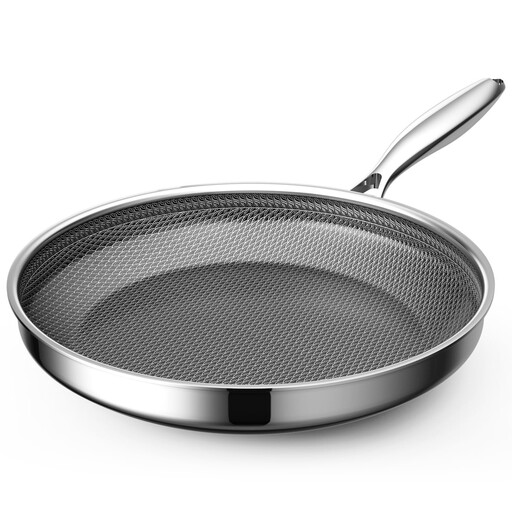
Why it suits this need: The 24 cm size is ideal for everyday portions. According to the product information, its construction of 304 stainless steel, an aluminium core and a 430 stainless steel base is suitable for gas, electric, ceramic, halogen and induction hobs.
The material layers and induction compatibility are clearly specified. The ceramic coating is stated to be free from PFAS, PFOA and PTFE.
24 cm diameter, a dishwasher-safe stainless steel handle and, according to the supplier, oven-safe up to 260 °C.
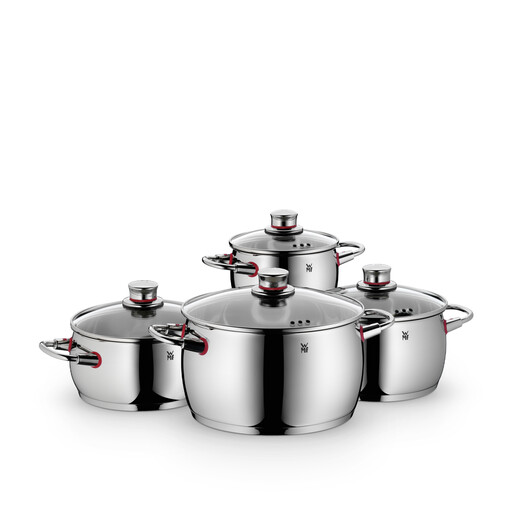
Why it suits this need: The set includes a frying pan with a lid and three saucepans with glass lids. It’s made from Cromargan 18/10 stainless steel and features a TransTherm base. It’s specified as suitable for induction, gas, electric and ceramic hobs.
The set contents, measurements and temperature specifications are all provided. There’s no need to assume that the characteristics of one pan apply to the whole set.
Uncoated stainless steel pieces, glass lids and, according to the supplier, dishwasher-safe components for a coordinated kitchen setup.

Why it suits this need: This 32 cm wok pan is designed for larger quantities and cooking techniques such as steaming, searing and braising. Its three-layer construction combines stainless steel, aluminium and stainless steel.
The pan is explicitly described as uncoated. That makes it clear that the stainless steel body doesn’t have an additional non-stick layer.
32 cm diameter, a metal lid with a steam vent, and suitability for induction, gas, electric and ceramic hobs.
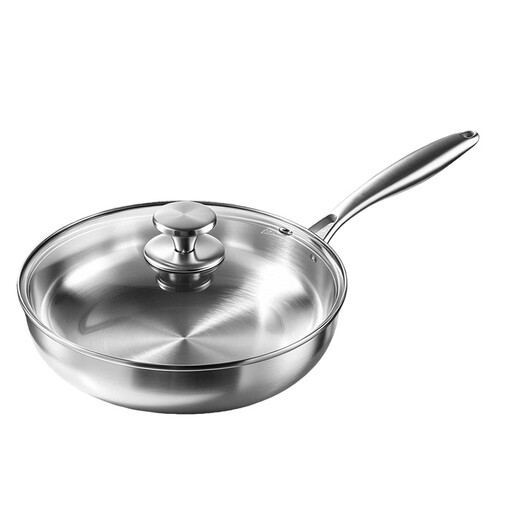
Why it suits this need: The 22 cm diameter takes up less hob space and is ideal for smaller portions. The pan is described as having 304 stainless steel, an aluminium core and a glass lid, and as suitable for several hob types.
The surface is specified as uncoated. The material layers and compatible hob types are also clearly listed, rather than relying on a vague general description of stainless steel.
22 cm size, glass lid, 3-ply construction and, according to the product information, dishwasher-safe.
We’ve put together a complete, regularly updated list of products that meet these strict selection criteria and fully comply with the safety regulations in force in the EU.
Before using a stainless steel frying pan for the first time, wash it with warm water and mild washing-up liquid. According to the manufacturer’s guidance, vinegar or citric acid can help remove white deposits or rainbow discolouration. Scouring powders and steel wool can alter the surface.
Uncoated pans can usually be heated to higher temperatures, but shouldn’t be left empty on a high heat for an extended period. Coated models generally need a low to medium heat and suitable kitchen utensils. Don’t plunge hot pans or lids straight into cold water: sudden temperature changes can cause them to warp.
Choose a model whose product information explicitly states that it’s suitable for induction. These pans often have a magnetic stainless steel base or a layered composite base. Look for specific manufacturer information as well as an induction symbol.
In most cases, the temperature, amount of oil or timing of turning the food isn’t quite right. Warm the pan gently first, then add the oil before putting the food in. Protein-rich foods may stick at first, but should release as they reach the right point in cooking.
Its lifespan depends on the material thickness, base construction, handle attachment and how well it’s cared for. An uncoated stainless steel frying pan has no non-stick layer that can wear away through scratching. On coated models, the coating is the more delicate part and should be cared for according to the instructions.