
Lieferung heute & morgen

Qualitätsgarantie

Willkommens-Angebote freischalten: KOSTENLOSE Lieferung | Bis zu 80 % RABATT | Kostenlose 30-Tage-JoyPlus-Testphase
App herunterladen
A stainless steel frying pan can last for years of everyday cooking if its construction, hob compatibility and care requirements suit your needs. But vague marketing claims can easily lead to the wrong purchase. A pan may be advertised as ‘non-stick’, even though its surface only performs well at the right temperature and with enough oil. Or the stated size may refer to the top rim, while the usable cooking surface is considerably smaller.
This buying guide explains what home cooks, families and quality-conscious shoppers in Germany should look out for.
A single-layer stainless steel pan can heat up quickly, but it may not distribute heat evenly. This can lead to hot and cool spots, especially on smaller hobs or at high heat. A tri-ply stainless steel pan with an aluminium core can spread heat more quickly across the base. The key is to check whether the layered construction is only in the base or extends throughout the pan.
A traditional stainless steel frying pan is usually uncoated. It can be prone to sticking if the temperature is wrong or there isn’t enough oil. A coated stainless steel pan, ceramic pan or hybrid pan, on the other hand, has a coated cooking surface but needs more careful handling.
Claims such as PFAS-free pan should refer explicitly to the specific coating. For products with a ceramic surface, check the manufacturer’s claims about PFAS, PTFE and PFOA separately. According to its product description, an uncoated pan has no chemical non-stick coating. However, that doesn’t automatically mean it has particular cleaning properties.
A lid is useful for sauces, slow-cooked dishes and family-sized portions. However, check whether it’s oven-safe and whether the handle gets hot in the oven. A stainless steel pan with lid may have different temperature limits for the pan and the glass lid. And ‘dishwasher-safe’ doesn’t necessarily mean frequent washing will leave the surface unchanged.
Look for specific details such as 18/10 stainless steel, 304 stainless steel or a construction combining stainless steel, an aluminium core and a stainless steel base. 18/10 refers to a type of stainless steel containing approximately 18 per cent chromium and 10 per cent nickel. 304 stainless steel is another common designation for corrosion-resistant stainless steel used in food-contact applications.
For even heating, look for these features:
A stainless steel induction pan should be explicitly approved for induction hobs. Most compatible models also work on gas, electric and ceramic hobs. For halogen or specialist infrared hobs, it’s worth checking the manufacturer’s information.
An uncoated stainless steel pan is less vulnerable to suitable metal utensils, but you’ll need to keep an eye on the temperature when frying. A good approach is to heat the pan gently first, use a drop of water to check the temperature, then add oil and avoid moving the food straight away.
Ceramic and hybrid coatings can make it easier to release food. Even so, you should:
A 28 cm pan is often a good size for vegetables, several eggs, meat or family-sized portions. Check the base diameter too, as this determines the actual contact area with the hob. A 20 to 22 cm pan is practical for smaller households and individual portions. A 30 to 32 cm pan offers more capacity, but needs enough space on the hob.
A deep sauté pan helps contain splashes and is suitable for slow-cooked dishes. However, its high sides can make it harder to turn food with a spatula. The right shape depends more on how you plan to use the pan than on its size alone.
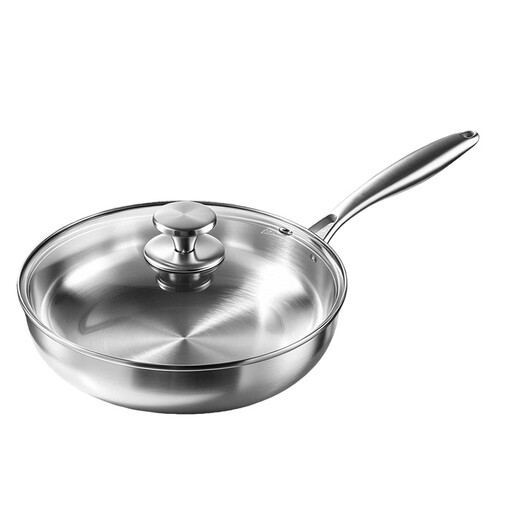
Why it suits this type of user: Its compact size is ideal for smaller portions, while the uncoated 304 stainless steel surface is designed for use on a range of hob types.
The product description explicitly states that the pan is uncoated, so it isn’t presented as having a traditional chemical non-stick coating.
Tri-ply construction with stainless steel, an aluminium core and stainless steel; according to the product details, suitable for induction, gas, electric and ceramic hobs.
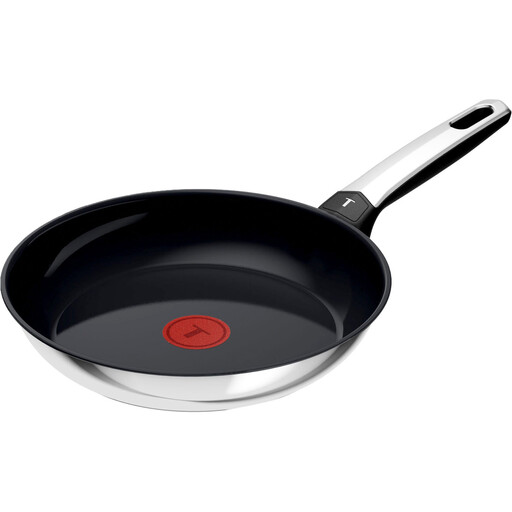
Why it suits this type of user: This 28 cm pan combines an 18/10 stainless steel body with a ceramic non-stick coating and a deep shape for larger portions.
The product details clearly distinguish between the stainless steel body and the ceramic coating. They also specify that it’s suitable for induction, gas, electric and ceramic hobs.
Ceramic coating, Thermo-Signal indicator, deep shape and, according to the product details, dishwasher-safe.
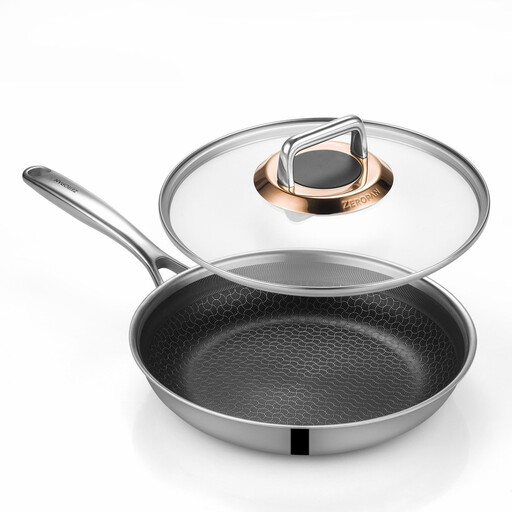
Why it suits this type of user: This deep 30 cm pan is designed for cooking larger quantities, with a lid and ceramic surface for those who prefer them.
The manufacturer specifies a construction combining 316 stainless steel, an aluminium core and a 430 induction base, as well as claiming the pan is free from PFAS, PFOA and PTFE.
Tri-ply construction, glass lid and, according to the product details, compatibility with all common hob types and oven-safe up to 260 °C.
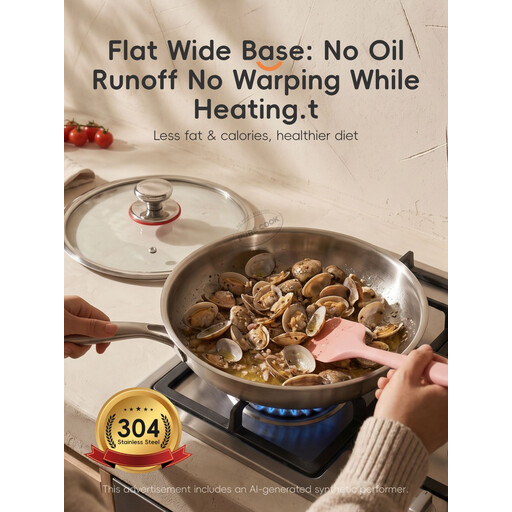
Why it suits this type of user: Its 28 cm diameter and glass lid make it well suited to larger portions and slow cooking, while allowing you to keep an eye on your food as it cooks.
The product description specifies a construction of 304 stainless steel, aluminium and stainless steel, and lists compatible hob types separately. The lid is included.
Layered construction, 28 cm diameter, glass lid and, according to the product details, dishwasher-safe.
We’ve put together a complete, regularly updated list of products that meet these strict selection criteria and fully comply with the safety regulations in force in the EU.
With an uncoated stainless steel pan, avoid keeping the heat at its highest setting for long periods. Soak stuck-on food in warm water first. White limescale or starch marks can often be removed with a little vinegar, followed by a thorough rinse. For coated pans, use soft sponges and mild cleaning products.
Before you buy, also check:
A stainless steel pan is suitable for induction if the manufacturer explicitly says so and it has a magnetic induction base. Layered models with an aluminium core usually need an additional magnetic stainless steel layer in the base.
Common causes include starting at too low or too high a temperature, turning food too soon or not using enough oil. Heat the pan gradually, add fat, then let the food sear before moving it.
Its lifespan depends on the material thickness, handle attachment, heat treatment and care. An uncoated stainless steel pan has no traditional non-stick coating to wear away. With coated ceramic or hybrid pans, however, heat, utensils and cleaning methods all affect how long the surface lasts.