
Lieferung heute & morgen

Qualitätsgarantie

Willkommens-Angebote freischalten: KOSTENLOSE Lieferung | Bis zu 80 % RABATT | Kostenlose 30-Tage-JoyPlus-Testphase
App herunterladen
A stainless steel frying pan can cook very differently depending on its construction, coating and the type of hob you use. Many buying decisions go wrong not because of the material itself, but because the product details are unclear. A pan might be advertised as ‘non-stick’, even though its coating is only suitable for certain temperatures. Or its diameter might match the product description, but not the usable cooking surface.
Before you buy, check for these three common pitfalls:
A basic stainless steel pan responds relatively quickly to changes in temperature, but may distribute heat less evenly. A 3-ply stainless steel pan often consists of stainless steel, an aluminium core and another layer of stainless steel. Aluminium conducts heat well, while stainless steel provides stability and a durable cooking surface.
Look for specific details such as:
The word ‘stainless steel’ alone doesn’t tell you how the pan is constructed. With an uncoated stainless steel pan, it’s also important to manage the temperature correctly: preheating the pan, adding a little oil and waiting before moving the food can help reduce sticking. A completely uncoated surface is not automatically non-stick.
A coated frying pan makes it easier to cook delicate foods such as eggs, fish and vegetables. PTFE coatings are used on many models, while a ceramic-coated pan has a ceramic non-stick layer. If you’re specifically looking for a PFAS-free frying pan or a PTFE-free pan, check that the manufacturer states this explicitly.
Pay close attention to the care instructions:
A claim such as ‘durable’ should not be taken as a guarantee of lasting performance unless it’s backed by technical details. The coating type, temperature limit and correct use are what matter.
A stainless steel pan for induction needs a magnetic base. The product description should specifically state that it’s suitable for induction. For a household of two to four, a 28 cm frying pan usually provides enough room for vegetables, meat or several portions. Sizes from 20 to 24 cm are better suited to smaller quantities or single meals.
Also check:
An oven-safe frying pan with a glass lid is especially versatile. However, the lid may have a lower temperature limit than the pan itself. Check these details separately before using it in the oven.
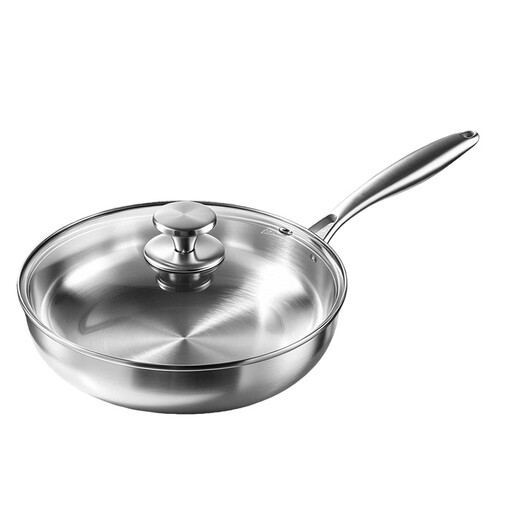
Why this product suits this profile: This 22 cm pan is ideal for smaller portions and has no chemical non-stick coating. It’s listed as suitable for induction, gas, electric and ceramic hobs.
The product details clearly specify uncoated 304 stainless steel and explain the need to control the temperature when frying.
304 stainless steel, 3-ply construction, 22 cm diameter and dishwasher-safe according to the product description.
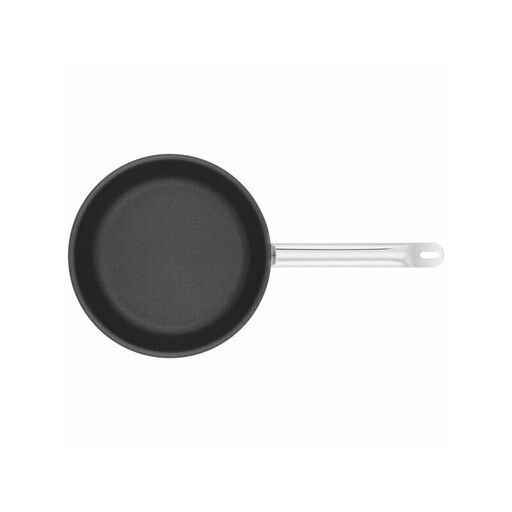
Why this product suits this profile: This pan combines 18/10 stainless steel with a Duraslide Ultra PTFE coating, making it suitable for delicate foods and everyday cooking.
The product details specify the 3-ply SIGMA Clad construction, coating type, care recommendation and oven limit of 230 °C.
Suitable for all hob types, including induction; dishwasher-safe and oven-safe up to 230 °C.
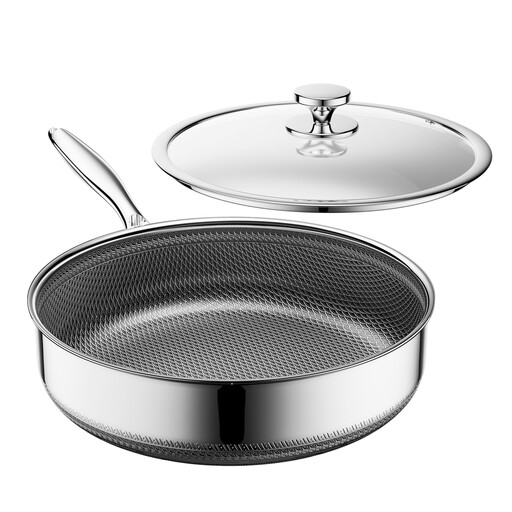
Why this product suits this profile: This deep hybrid frying pan is suitable for searing, braising and cooking dishes with sauce. The product description states that its ceramic coating is free from PFAS, PFOA and PTFE.
The temperature limits are listed separately: up to 260 °C for the pan and up to 148 °C for the glass lid.
Suitable for all the hob types listed, dishwasher-safe and supplied with a heat-resistant glass lid.
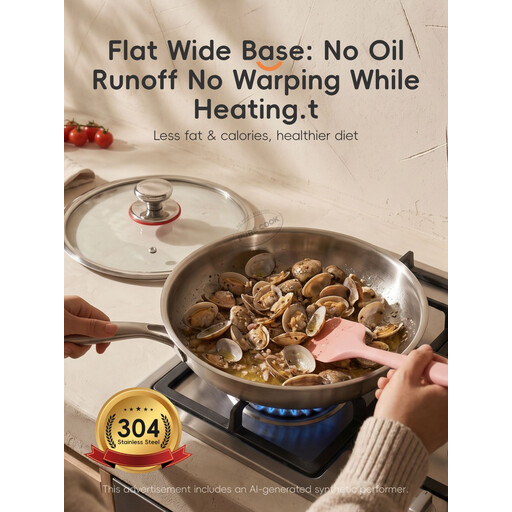
Why this product suits this profile: The 28 cm diameter gives you room to cook larger portions. The pan is listed as suitable for induction, gas, ceramic and halogen hobs, and comes with a glass lid.
The 3-ply construction and compatible hob types are clearly specified. The lid lets you cook covered and reduce sauces.
304 stainless steel, aluminium core, 28 cm diameter, glass lid and dishwasher-safe according to the product details.
We’ve put together a complete, regularly updated list of products that meet these strict selection criteria and comply fully with the safety regulations in force in the EU.
Choose a model that’s explicitly listed as having an induction-compatible base. A 3-ply construction with an aluminium core can improve heat distribution, but the manufacturer’s stated hob compatibility is what matters.
Stainless steel isn’t automatically non-stick. Preheating the pan, adding oil afterwards and waiting until a crust has formed before turning the food can help reduce sticking. For particularly delicate foods, a coated or ceramic-coated pan is usually easier to use.
It depends on the model. Many products are labelled dishwasher-safe, but manufacturers often recommend hand-washing pans with coated surfaces. Check the product details for the coating, handle and lid separately.