
Lieferung heute & morgen

Qualitätsgarantie

Willkommens-Angebote freischalten: KOSTENLOSE Lieferung | Bis zu 80 % RABATT | Kostenlose 30-Tage-JoyPlus-Testphase
App herunterladen
A stainless steel frying pan can be ideal for searing, sautéing and gentle cooking. However, not every stainless steel pan automatically makes for a good purchase. What really matters is the construction, diameter, coating, weight and whether it’s actually suitable for your hob.
A single-layer uncoated stainless steel pan can heat up faster in some spots than others. This increases the risk of delicate foods sticking or browning unevenly. A sandwich base or a tri-ply frying pan with an aluminium core distributes heat more widely by design.
It’s important to read the product description carefully: some models only have a bonded induction base, while others have a fully multi-layered pan body.
An uncoated stainless steel surface doesn’t need a traditional non-stick coating, but it isn’t completely immune to incorrect cleaning. Steel wool and harsh abrasives can dull the surface or leave visible marks.
With a coated frying pan, different rules apply: even if manufacturers claim a scratch-resistant frying pan or allow the use of metal utensils, using wooden, silicone or nylon turners will often extend the life of the coating in practice. Always follow the specific care instructions for your product.
A frying pan for all hob types should be explicitly approved for gas, induction, ceramic or electric, and halogen where applicable. You should also check the oven temperature, lid compatibility and handle construction. “Induction-compatible”, for example, doesn’t tell you whether the pan can go in the oven with its lid on.
For an induction frying pan, a magnetic stainless steel base is essential. Multi-layer constructions of stainless steel and aluminium can improve heat conduction. A tri-ply construction typically consists of stainless steel, an aluminium core and another layer of stainless steel.
The material specification “304 stainless steel” describes a particular grade of stainless steel. It’s a factual material note, but not a standalone guarantee of a specific cooking performance. Likewise, “food-safe” shouldn’t be equated with any medical or health benefit.
A 28 cm stainless steel pan offers plenty of space for several portions, but also needs a suitably large hob zone. For one or two portions, 20 to 22 cm can be more manageable. 26 cm is a good middle ground for many households.
Alongside the top diameter, the actual base area matters. On a small induction hob, a large pan can heat up more slowly or unevenly if the pan base is significantly bigger than the cooking zone.
An uncoated stainless steel pan suits those who prefer a robust cooking surface without a traditional non-stick coating and want to master temperature control. Preheating, a little oil and medium heat can help reduce sticking. However, it’s not always possible to prevent it entirely with certain foods.
A hybrid frying pan combines, depending on the model, exposed stainless steel areas with coated surfaces or a textured finish. This can change how it handles, but makes the care instructions especially important. A frying pan with a lid is practical for braising, sauces and keeping food warm. Glass lids shouldn’t be subjected to sudden temperature changes.
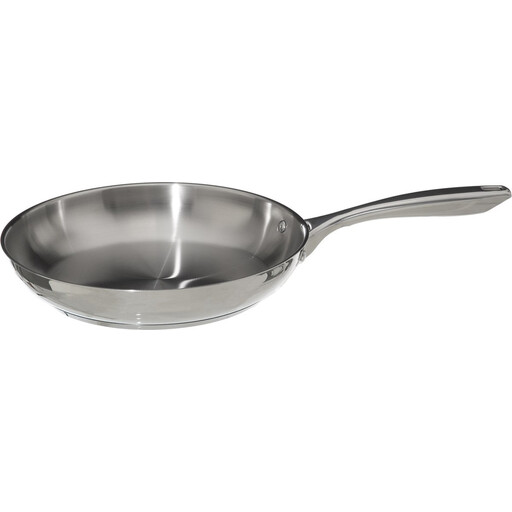
Why this product fits the profile: With a 28 cm diameter, 2.2 l capacity and suitability for gas, induction, ceramic and electric hobs, it covers typical household tasks.
The hob compatibility is clearly stated. It also describes a dishwasher-safe frying pan with a scratch-resistant finish.
28 cm diameter, 8.5 cm height, 1.03 kg weight and, according to the product information, a two-year guarantee.
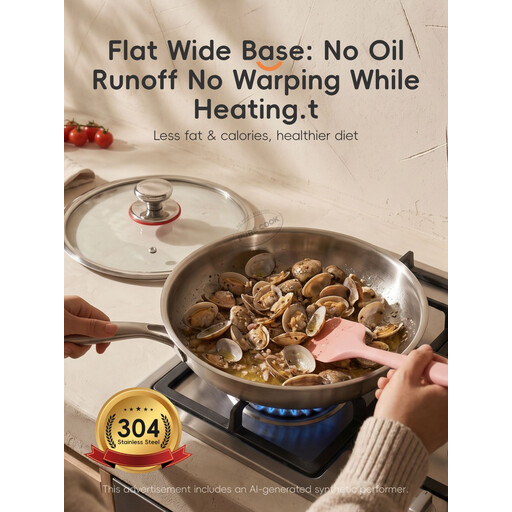
Why this product fits the profile: The three-layer construction with an aluminium core and the glass lid appeal to those who want to combine frying and braising in one piece of cookware.
The material construction, lid and hob types are listed separately in the product details. This means even heat distribution doesn’t have to be inferred from the term “stainless steel” alone.
304 stainless steel, aluminium core, glass lid, suitability for gas, induction, ceramic and halogen hobs, and dishwasher-safe according to the product description.
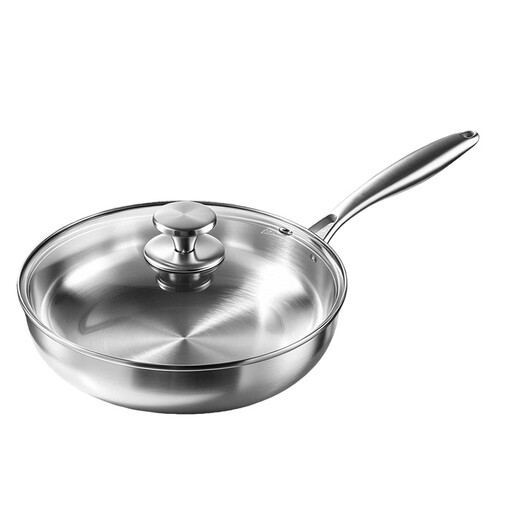
Why this product fits the profile: The compact size is ideal for smaller portions, while the uncoated tri-ply construction handles daily temperature changes well.
The product details explicitly state “uncoated” and explain that medium to low heat and preheating can help reduce sticking.
22 cm diameter, 304 stainless steel without coating, glass lid and suitability for induction, gas, electric, ceramic and halogen hobs.
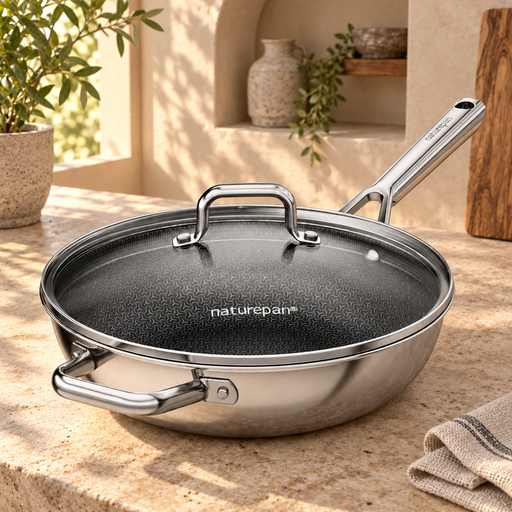
Why this product fits the profile: The deeper shape and included lid are ideal for sauces, stews and larger quantities.
The care instructions recommend low to medium heat, soft utensils and hand washing to protect the ceramic coating.
28 cm diameter, 7.8 cm body height, ceramic hybrid surface, glass lid and oven-safe up to 230 °C without the lid, according to the product data.
We’ve put together a full, regularly updated list of products that fully meet these strict selection criteria and the safety regulations in force in the EU.
A frying pan for induction needs a magnetic base. The product description should explicitly state that it’s suitable for induction hobs. For multi-layer pans, the size of the base area is also important, as it should match the induction zone.
That depends on your cooking style. An uncoated stainless steel pan allows for high temperature ranges and doesn’t need a non-stick coating, but it does require proper temperature and fat management. A coated or hybrid pan can make cooking delicate foods easier. However, the surface needs to be treated more gently.
Being dishwasher-safe makes cleaning easier, but it doesn’t automatically protect against discolouration or a shortened coating lifespan. For stainless steel, hand washing with mild washing-up liquid can be gentler on the surface; for coated models, the manufacturer’s instructions are especially important.