
Lieferung heute & morgen

Qualitätsgarantie

Willkommens-Angebote freischalten: KOSTENLOSE Lieferung | Bis zu 80 % RABATT | Kostenlose 30-Tage-JoyPlus-Testphase
App herunterladen
A stainless steel frying pan with lid can handle frying, braising, sautéing and gentle cooking. However, not every shiny pan is the right choice. Details such as the layer construction, the lid and actual hob compatibility often determine whether the cookware performs well in everyday use.
A single-layer stainless steel frying pan may distribute heat more slowly and unevenly. This makes local hot spots more likely. The construction is more informative: a tri-ply stainless steel frying pan typically consists of stainless steel, an aluminium core and another stainless steel layer. Aluminium conducts heat well, while stainless steel provides a robust cooking surface.
So, look for specific details about the layer construction, rather than relying solely on terms such as “premium” or “professional”.
An uncoated stainless steel frying pan does not have a conventional non-stick coating. This can appeal to buyers who prefer a durable, scratch-resistant cooking surface. At the same time, it requires careful temperature control: preheat the pan, add the oil afterwards and cook over medium to low heat.
If you start frying at a high temperature without preparing the pan, food may stick even in a high-quality stainless steel frying pan. A coated frying pan with lid is often easier to use for delicate foods such as omelettes or pancakes, but it requires more careful handling of utensils.
A glass lid makes it easier to monitor the food and reduces the need to lift the lid frequently during cooking. However, its heat resistance may differ from that of the pan body. Check the maximum temperature for the pan and lid separately. Plastic or silicone handles can also limit the permitted oven temperature.
The term 304 stainless steel is often used for a corrosion-resistant, food-grade type of stainless steel. What matters is whether this information is clearly stated in the product details. According to the product information, several of the models presented here are made from food-grade 304 stainless steel. However, this material specification does not replace checking the workmanship, base thickness and handle attachment.
For a versatile induction frying pan, the base should be magnetically suitable and sufficiently flat. If you switch between gas, electric, ceramic and induction hobs, look for the description suitable for all hob types. On gas hobs, a stable distance between the handle and the flame is also important.
A deep sauté pan is more practical if you regularly braise food, reduce sauces or prepare larger quantities. An stainless steel wok with a high rim, on the other hand, supports tossing and is ideal for quick stir-fries. On round hobs, the pan base should not be significantly larger than the heated zone.
“Dishwasher-safe” does not mean that the surface will remain unchanged after every cycle. Water marks, dull patches or rainbow discolouration can be caused by minerals, salt and heat. A dishwasher-safe frying pan is convenient to clean; nevertheless, hand-washing with a soft sponge is often recommended for keeping stainless steel looking even.
According to the product information, diluted vinegar or citric acid can help with white deposits or discolouration. Scouring pads and harsh cleaning products may damage the surface. A new pan should be cleaned thoroughly with warm water and washing-up liquid before first use.
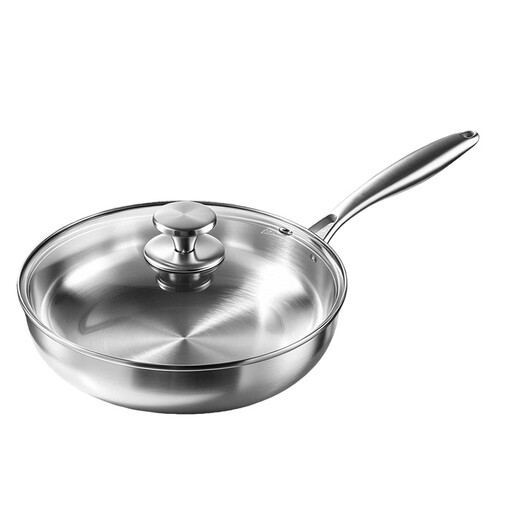
Why this product suits this profile: The compact 22 cm size is suitable for smaller households and everyday portions. According to the product information, the pan is suitable for induction, gas, electric, ceramic and halogen hobs, and comes with a glass lid.
The product details explicitly state that it has an uncoated 304 stainless steel surface and a three-layer construction. This makes it clearer what you are buying than a vague “non-stick” marketing claim.
Uncoated cooking surface, tri-ply construction, 22 cm diameter and, according to the product information, dishwasher-safe.

Why this product suits this profile: This set is aimed at households that want to use a stainless steel frying pan with lid alongside a matching saucepan, rather than buying one separately. According to the product information, the glass lids have silicone rims and integrated pouring openings.
Compatibility with different hob types, including induction, and oven use up to 180 °C are clearly specified. This makes it easier to check the details before buying.
18/10 stainless steel according to the product description, SIGMA Classic+ multi-layer base, measurement scale and, according to the supplier, dishwasher-safe.
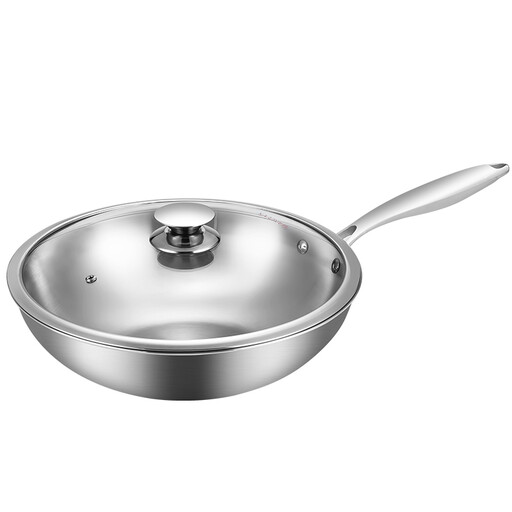
Why this product suits this profile: The 28 cm design is made for wok dishes, sautéing and larger portions. According to the product information, the wok comes with a glass lid and is suitable for gas, induction, electric and ceramic hobs.
The product description points out that there is no chemical non-stick coating. This sets clear expectations for use: preheat the wok, add the oil afterwards and avoid leaving it empty over high heat for prolonged periods.
Tri-ply construction, 304 stainless steel according to the product information, glass lid and compatibility with several hob types.
We have put together a complete, regularly updated list of products that fully meet these strict selection criteria and the safety regulations applicable in the EU.
Look for the descriptions induction-compatible or suitable for all hob types. The pan base must be magnetic and sit flat on the hob. For multi-layer models, the manufacturer should provide clear information about the construction of the base or the pan as a whole.
First, heat the pan over a medium setting without oil. A few drops of water can show whether the surface is hot enough: if they bead and roll across the base, you can add the oil. Then add the food and do not move it straight away. Low to medium heat reduces the risk of sticking and helps prevent overheating.
Its service life depends on the material thickness, base construction, handles and care. An uncoated stainless steel surface is less affected by the typical wear associated with coatings. However, warping, loose handles, cracks in the glass lid or a base that is coming away can make further use unsafe. Check the pan regularly and follow the manufacturer’s safety instructions.