
Lieferung heute & morgen

Qualitätsgarantie

Willkommens-Angebote freischalten: KOSTENLOSE Lieferung | Bis zu 80 % RABATT | Kostenlose 30-Tage-JoyPlus-Testphase
App herunterladen
A stainless steel frying pan can last for many years in the home, depending on how it is made. But a shiny finish, terms such as ‘hybrid’ or general claims about even heat distribution don’t automatically mean it’s the right choice for you. Look for clear information about the materials, diameter, hob compatibility and cleaning.
An uncoated stainless steel frying pan has no traditional non-stick coating. This usually makes it more resistant to high temperatures and metal utensils, but it does require the right cooking technique: preheat the pan, add the oil afterwards and generally keep the heat at a medium level. Food may stick if you try to move it too soon.
A coated stainless steel frying pan or hybrid pan behaves differently. Its surface combines stainless steel with a ceramic or other non-stick coating. These models can be easier to clean, but you should follow the manufacturer’s care instructions. With coated surfaces, wooden, silicone or nylon utensils are often the gentler choice.
For a stainless steel induction frying pan, the base needs to be magnetic and sufficiently flat. An induction-compatible pan may also work on gas, electric and ceramic hobs. It’s still worth checking the product description, especially if you have a halogen or infrared hob.
For stainless steel models with an aluminium core, it’s also important that the heat-conducting layer is properly integrated into the construction. A multi-layer design can improve heat distribution, but you should still check that the pan is compatible with your hob.
The stated size usually refers to the top rim, not the usable cooking surface. A 28 cm frying pan gives you more room to cook several portions, but it needs a sufficiently large hob and can be heavy when full. A 20 cm frying pan is handy for small quantities, single portions or breakfast. The versatile sizes in between are 24 cm and 26 cm.
For a 304 stainless steel frying pan, the designation refers to the grade of stainless steel used. According to the manufacturer’s product information, several PURECOOK models are made from 304 stainless steel. A Tri-Ply frying pan typically has an aluminium core between two layers of stainless steel. Aluminium conducts heat well, while stainless steel provides stability and a durable cooking surface.
Important: the term ‘Tri-Ply’ alone tells you nothing about the pan’s weight, wall thickness or build quality. Also check:
A hybrid pan may be a good choice if delicate foods such as fish, vegetables or eggs are regulars on your menu. According to the product information, the Zeropan-FD series has a ceramic coating and is free from PFAS, PTFE and PFOA. This statement is based on the manufacturer’s information and should not be taken as a general claim about all ceramic-coated frying pans.
According to its product information, the Naturepan hybrid frying pan combines a ceramic coating with a textured stainless steel surface. This model is listed as suitable for induction, gas, electric and ceramic hobs, and for oven use up to 230 °C without the lid. The care instructions recommend hand-washing, even though the product is listed as dishwasher-safe. This shows that dishwasher-safe frying pan doesn’t necessarily mean the dishwasher is the gentlest option for every surface.
An oven-safe frying pan is only practical if its temperature limit and handle design are compatible. Stainless steel handles can get hot in the oven. Models with glass lids also come with guidance on temperature changes and the lid’s maximum temperature.
A glass lid is useful for braising, reducing or keeping food warm. With a stainless steel frying pan with a glass lid, you can keep an eye on your food without regularly lifting the lid. Still, check whether the lid itself is oven-safe.
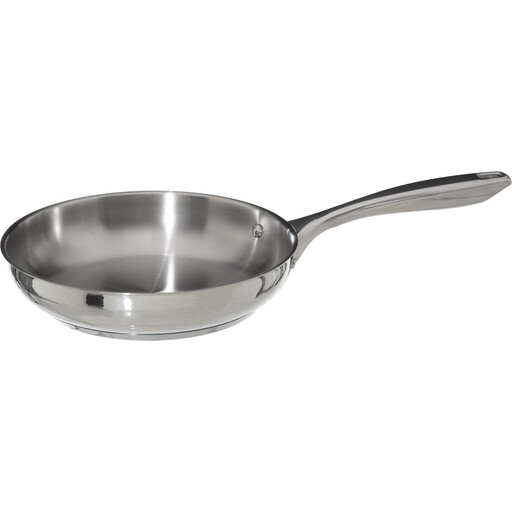
Why this product suits this profile: Its diameter is ideal for everyday portions without taking up as much space as a large 28 cm pan. According to the product information, it is suitable for gas, electric, ceramic, halogen and induction hobs.
Hob compatibility and dishwasher suitability are specified clearly, rather than described using vague marketing terms.
24 cm diameter, stainless steel body, aluminium induction disc and stated compatibility with several hob types.
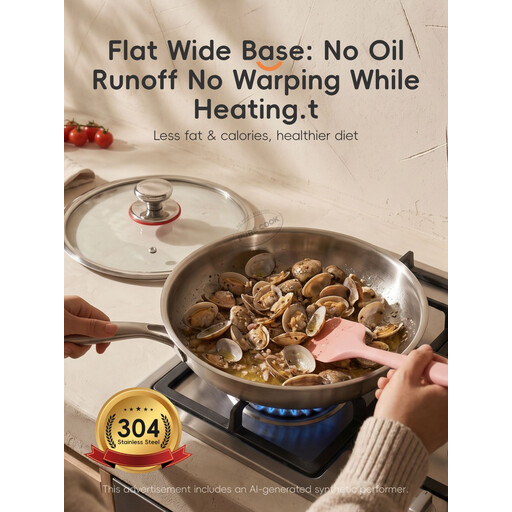
Why this product suits this profile: The 28 cm pan is designed for households that cook larger quantities or want to braise food with the lid on. According to the product information, it is made from stainless steel, an aluminium core and stainless steel.
The multi-layer construction is clearly described. The product features also include a glass lid, induction compatibility and dishwasher use.
Tri-Ply construction, 304 stainless steel, 28 cm diameter, glass lid and suitability for gas, induction, ceramic and halogen hobs.
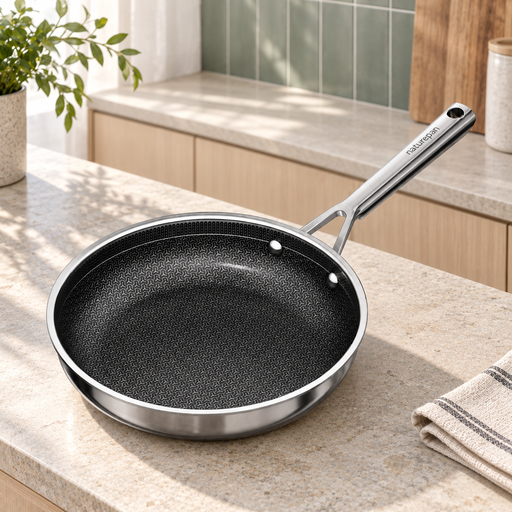
Why this product suits this profile: According to the product information, this hybrid pan combines a multi-layer stainless steel body with an aluminium core and ceramic coating. It’s a good option if you want to combine frying with easier cleaning.
The care requirements are clearly stated: use low to medium heat and soft utensils, don’t use it in a microwave, and remove the lid before putting it in the oven.
24 cm diameter, induction compatibility, ceramic coating, textured cooking surface and oven-safe up to 230 °C without the lid.
With an uncoated stainless steel frying pan, the so-called ‘hot pan’ method can help: heat the empty pan over a medium setting, use a drop of water to get a rough idea of the temperature, then add the oil and food. Overheating can cause discolouration and burnt-on residue.
For cleaning:
The pan’s lifespan depends greatly on temperature, care, storage and how often it is used. So a blanket claim about how many years it will last isn’t reliable. The coating on hybrid pans is a wear part. Uncoated models have no traditional non-stick layer on the cooking surface, but improper cleaning or sudden temperature changes can still cause damage.
We’ve put together a complete, regularly updated list of products that meet these strict selection criteria and fully comply with the safety regulations in force in the EU.
Look for an explicit statement that the pan is induction-compatible, with a magnetic base that sits flat on the hob. Models with a stainless steel–aluminium–stainless steel construction may be suitable for induction, provided this is confirmed in the technical specifications.
A 20 cm frying pan is often enough for one person or small portions. A 24 or 26 cm pan is a versatile choice for many households. A 28 cm frying pan offers more cooking space for several portions, but needs a suitable hob and more storage space.
It’s generally durable and doesn’t need special care for a coating. However, food can stick more easily if the pan is too cold, too hot or used without enough fat. Using medium heat, preheating the pan and cleaning it with a soft sponge can help keep everyday care simple.