
Lieferung heute & morgen

Qualitätsgarantie

Willkommens-Angebote freischalten: KOSTENLOSE Lieferung | Bis zu 80 % RABATT | Kostenlose 30-Tage-JoyPlus-Testphase
App herunterladen
A stainless steel frying pan can serve you reliably for many years—provided its size, material construction and care routine suit the way you cook. Focusing solely on terms such as “premium”, “scratch-resistant” or “non-stick” often means overlooking crucial details. As a Joybuy Product Recommendation Officer, I filter the relevant product information and explain what households in Germany should consider before buying.
A single-layer stainless steel frying pan may distribute heat more slowly or unevenly than a model with an aluminium core. The difference can be particularly noticeable on induction hobs, when searing at high heat or when preparing delicate ingredients.
It is therefore worth looking for specifications such as three-ply stainless steel frying pan, “Tri-Ply” or a stainless-steel-and-aluminium sandwich base. This construction can improve heat conduction. However, actual performance also depends on the hob, the pan diameter and the surface area in contact with the cooking zone.
An uncoated stainless steel frying pan has no conventional non-stick layer. This makes it suitable for high-temperature cooking and for use with appropriate kitchen utensils, but it does require the right technique: preheat the pan, add the oil afterwards and control the temperature carefully.
Hybrid models, by contrast, often feature a ceramic coating. According to the manufacturer, the Zeropan FD Hybrid uses a natural ceramic coating that is described as free from PFAS, PTFE and PFOA. This should not be confused with an uncoated stainless steel frying pan. Before buying, make sure you know whether you want a coated or uncoated model.
Many models are marketed as a dishwasher-safe frying pan. Even so, harsh detergents, salt residue or abrasive sponges can affect the appearance of the surface. Stainless steel can also develop rainbow discolouration or water spots without this necessarily indicating material damage.
For a long service life, the recommended approach is generally to clean the pan after it has cooled using warm water and mild washing-up liquid, use soft sponges and dry it thoroughly afterwards.
The following specifications are particularly relevant for everyday use:
A frying pan for all hob types should be explicitly listed as suitable for induction, gas, ceramic or electric hobs and, where applicable, halogen hobs. Induction cooking requires a magnetic or induction-compatible base.
If you also want to use the stainless steel frying pan in the oven, check the permitted temperature as well as any restrictions relating to the lid, handle and coating. Specifications such as “up to 260°C” or “up to 250°C without lid” apply only to the respective product and should not be generalised.
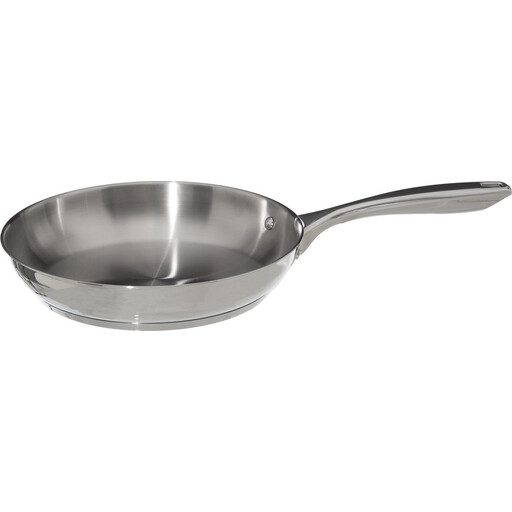
Why it is a good fit: An everyday size for households looking for an uncomplicated stainless steel frying pan suitable for gas, electric, ceramic and induction hobs.
The product specifications state compatibility with all common hob types and a scratch-resistant design. A non-stick coating is not assumed.
26 cm diameter, 1.7-litre usable capacity and dishwasher-safe according to the product specifications.
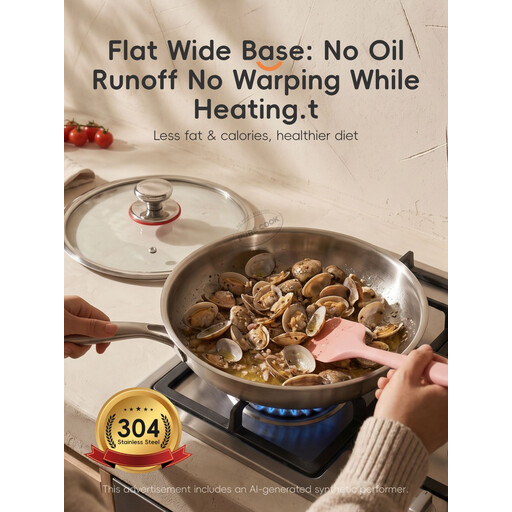
Why it is a good fit: The three-layer construction with aluminium core and glass lid is well suited to frying, braising and preparing sauces in larger quantities.
The material construction, hob compatibility and dishwasher suitability are clearly stated in the product data. The pan is uncoated.
304 stainless steel, aluminium core, glass lid and compatibility with gas, induction, ceramic and halogen hobs.
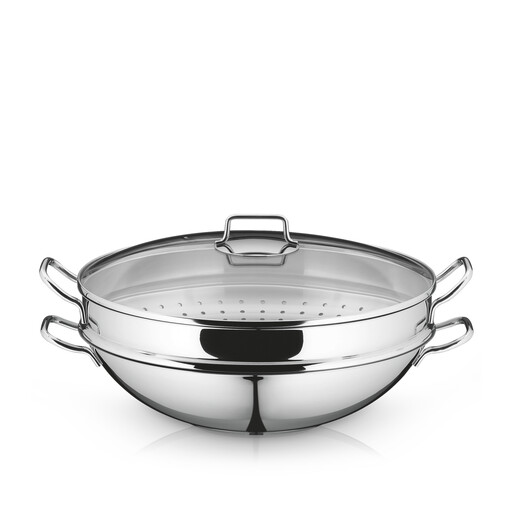
Why it is a good fit: Designed for large quantities and versatile cooking, with a wok, steamer insert, rack and glass lid.
The set lists the material, 4.5-litre capacity, compatible hob types and temperature limits for the wok and lid separately.
18/10 stainless steel, TransTherm base, 36 cm diameter and dishwasher-safe components.
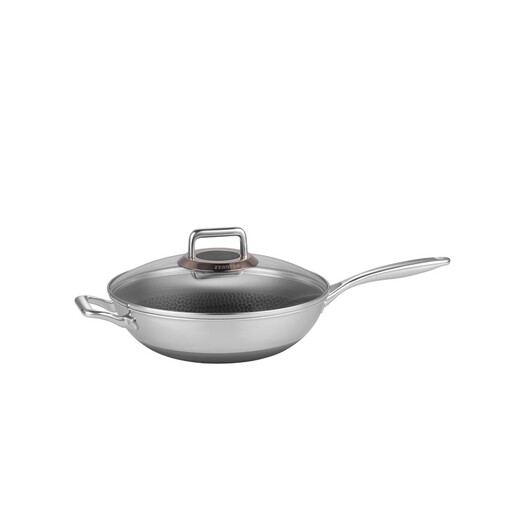
Why it is a good fit: The combination of stainless steel, honeycomb structure and ceramic coating is aimed at users who prefer a different cooking experience from that of a completely uncoated pan.
The product description explicitly states that it has a ceramic coating free from PFAS, PTFE and PFOA. This keeps the material type transparent.
30 cm diameter, three-layer construction, compatibility with all stated hob types and oven use up to 260°C according to the product specifications.
Our selection includes additional stainless steel frying pans, uncoated models and suitable options for different hob types and cooking styles.
An uncoated stainless steel frying pan does not need to be seasoned like cast iron. However, a controlled approach can help reduce sticking:
On induction hobs, a lower setting than expected is often sufficient. Empty pans should not be heated unnecessarily for extended periods at high temperatures.
For many everyday dishes, 26 cm is a versatile starting point. Sizes from 20 to 22 cm are better suited to smaller portions, while 28 cm provides more room for vegetables, meat or several portions.
That depends on the base. An induction frying pan explicitly marked as induction-compatible can be used on induction hobs. For older models or products with unclear specifications, check the manufacturer’s information.
An uncoated stainless steel frying pan has no non-stick layer that can peel away through scratching. Its actual lifespan nevertheless depends on the material thickness, base, handle, temperature changes and care. The product specifications cannot guarantee a specific service life.