
Lieferung heute & morgen

Qualitätsgarantie

Willkommens-Angebote freischalten: KOSTENLOSE Lieferung | Bis zu 80 % RABATT | Kostenlose 30-Tage-JoyPlus-Testphase
App herunterladen
The search for the right stainless steel pot for induction can quickly become overwhelming. The market is filled with promises, but not every pot lives up to them. As a Joybuy Product Recommendation Officer, I see daily which features truly matter and where the most common pitfalls lie. Before you make a decision, you should be aware of the three typical problems that often only become apparent after the purchase.
This guide will help you bypass these issues and find a pot that performs its function reliably and safely.
To avoid a bad buy, you should focus on objective and verifiable criteria. Three features are crucial for the durability, safety, and functionality of a stainless steel induction pot.
The term "stainless steel" alone is not a sufficient quality indicator. Look for the 304 stainless steel specification (also known as 18/8 or 18/10). This alloy contains 18% chromium and 8–10% nickel.
A pot made of 304 stainless steel is food-safe, robust, and will not alter the taste of your dishes. It is the foundation for durable and safe cookware.
A pot for an induction cooktop requires a special base. The induction field generates an alternating magnetic field that only produces heat in ferromagnetic material. A pot made purely of 304 stainless steel would not work.
Therefore, a multi-layered composite base (sandwich base) is necessary. This typically consists of:
Such a flat composite base not only ensures induction compatibility but also makes the pot a universal pot for all types of stovetops, including gas, electric, and ceramic.
For daily use, practical details are essential. A 4L stock pot or a 22cm stainless steel pot offers a flexible size for family portions, soups, or stews.
Here are some product recommendations tailored to specific user profiles and the quality criteria mentioned above.
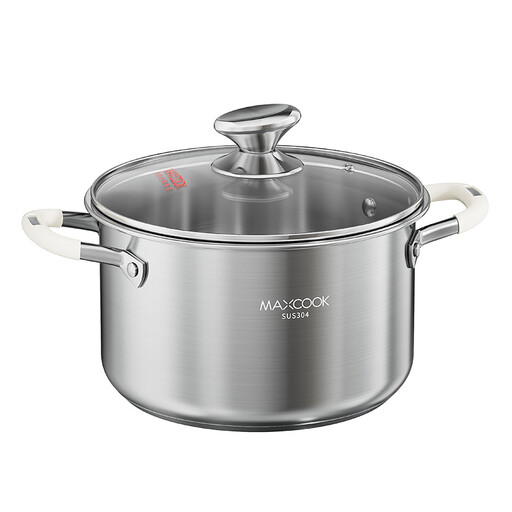
Why it's a great fit: Ideal for daily use in a family kitchen. The 4.3-litre capacity is perfect for soups, stews, or pasta. The silicone handles provide safety when the kitchen gets hectic and children are around.
This pot is made of food-safe 304 stainless steel, features a flat composite base for all stovetops, and has insulated silicone handles to minimise the risk of burns.
Combines all essential safety and functional features in one versatile, all-purpose pot for everyday use.

Why it's a great fit: For cooks who value precise results. The three-layer (Tri-Ply) construction ensures exceptionally fast and even heat distribution from the base to the rim.
The Tri-Ply construction with an aluminum core is the direct technical solution to the "hotspot" trap. It guarantees homogeneous temperature distribution and prevents localised burning.
Superior heat conductivity for precise searing and cooking. The construction is designed for maximum performance and durability.

Why it's a great fit: For those who extend the principle of high-quality materials to their entire kitchen. This organizer brings order to the sink area and is made from the same durable material as good cookware.
Instead of cutting corners on accessories, this product consistently uses rust-proof 304 stainless steel. This prevents rust stains on the sink rim that can be caused by low-quality metal caddies.
Creates a tidy and hygienic environment at the sink and complements high-end kitchen equipment with a uniform, durable material.
We have compiled a complete, up-to-date list of products that fully meet these strict selection criteria and safety standards.
The easiest way to check is with the magnet test. Hold a standard magnet to the bottom of the pot. If the magnet sticks firmly, the pot's base is ferromagnetic and therefore suitable for induction. If it doesn't stick, or only very weakly, the pot will not work on an induction stove.
This is usually not a material defect.
Yes. Due to its composition, 304 stainless steel is very stable and non-reactive. It does not release harmful substances into food under normal cooking conditions and is used worldwide as a standard for high-quality cookware, cutlery, and in the food processing industry.