
Lieferung heute & morgen

Qualitätsgarantie

Willkommens-Angebote freischalten: KOSTENLOSE Lieferung | Bis zu 80 % RABATT | Kostenlose 30-Tage-JoyPlus-Testphase
App herunterladen
A stainless steel kitchen bin with a pedal should be hygienic, sturdy and easy to clean in everyday use. In practice, however, it is not just the material or capacity that can lead to a poor purchase. Details such as the lid mechanism, inner bin and floor space often determine whether a kitchen bin remains convenient to use over time.
This buying guide from the Joybuy Product Recommendation Officer provides an objective overview of the key selection criteria and presents models for different households and areas of use.
A nominal capacity of 30 or 60 litres does not automatically describe the amount of space that can be used in practice. The inner bin, lid mechanism and shape of the outer casing can all take up room. For a small kitchen, a slim 30-litre bin may be more practical than a wider model with a similar capacity.
A large 60-litre bin, on the other hand, is more suitable for households with several people or rooms that generate larger amounts of waste. Before buying, compare the external dimensions with the available space beneath the worktop or next to a cupboard.
A bin with a soft-close lid closes gently and quietly. This can reduce noise, but it does not replace a robust mechanism. Important details include whether the lid can be held open at 90 degrees, how the pedal operates and whether the lid remains unrestricted when the bin is full.
Product details such as “100,000 uses” or “200,000 cycles” should be understood as manufacturer or product claims. They are not a general guarantee of durability for every usage situation.
A stainless steel bin with a coating can reduce fingerprints and visible marks. Nevertheless, the surface should be cleaned with a soft, damp cloth. Abrasive cleaners, wire wool and harsh cleaning products can damage the coating or affect the appearance.
Even a container described as an odour-proof bin cannot prevent every unpleasant smell from developing. A lid that closes as tightly as possible, regular emptying and the correct bin-bag size are the decisive factors.
Stainless steel casings with wipe-clean surfaces are practical. Check whether the plastic inner bin can be removed and whether it has handles or a bag-retaining system. A bin with a removable inner container makes emptying and cleaning easier, particularly when dealing with damp kitchen waste.
You should also look for:
Hands-free operation of a kitchen pedal bin is useful when cooking, as you do not need to touch the lid. The pedal should move smoothly, and the casing should not tip forwards when the lid is opened.
A 90-degree lid hold-open function can be useful when preparing larger quantities. In small kitchens, however, it is important that the lid does not hit wall cupboards or shelving when opened.
A recycling bin with two separate compartments supports the separation of general waste and recyclables right where the waste is produced. However, two 30-litre containers require more floor space than a single 30-litre kitchen bin.
With a waste-separating bin, check the lid and pedal construction as well as how the individual inner containers are removed. Separate handles and bag-retaining systems make it easier to assign waste types and change the bin bags.
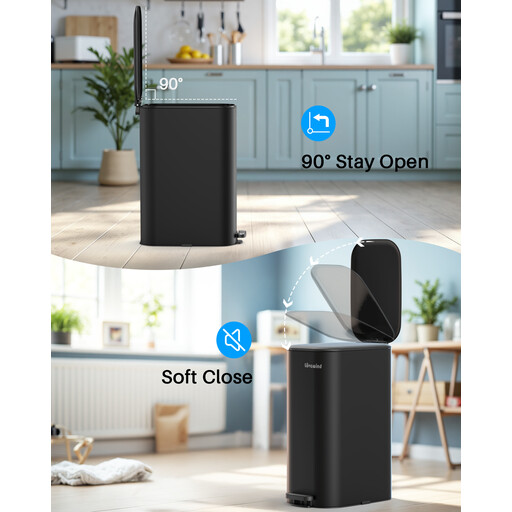
Why this product suits this profile: The 30-litre capacity and slim design are suitable for smaller kitchens, single-person households or a home office. The black, coated stainless steel surface is designed to be cleaned with a damp cloth.
The removable inner bin, with two handles and bag-retaining systems, makes changing the bag easier. The soft-close lid and 90-degree hold-open function are explicitly specified.
30-litre capacity, pedal operation, removable inner container and coated stainless steel casing.
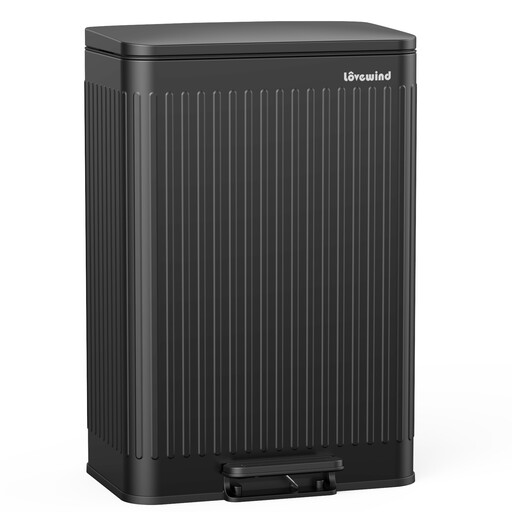
Why this product suits this profile: This model is aimed at families and kitchens that generate larger amounts of waste. Two removable inner containers, a soft-close lid and a black casing with a textured surface combine generous capacity with straightforward operation.
The product description specifies two inner containers with handles and bag-retaining systems. This means you do not have to carry the entire outer container to the bin area.
60-litre total capacity, soft-close and hold-open functions, plus removable inner containers.
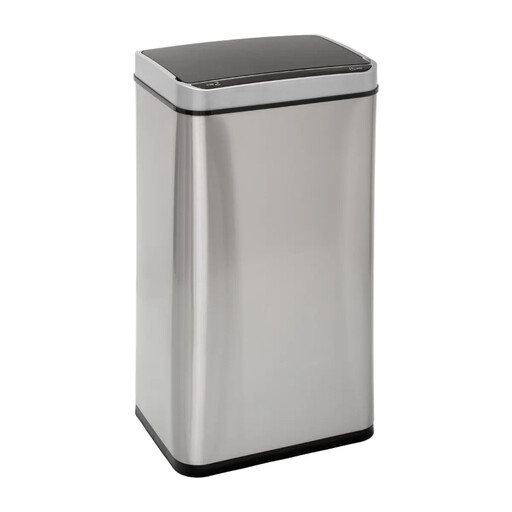
Why this product suits this profile: The 40-litre sensor bin is designed for users who prefer hands-free opening. According to the product description, it is suitable for kitchens, offices and commercial indoor areas.
It is operated by a motion sensor rather than a pedal. Before buying, consider battery availability, the sensor range and the space required in front of the lid.
40-litre capacity, stainless steel casing, automatic lid opening and rectangular design.
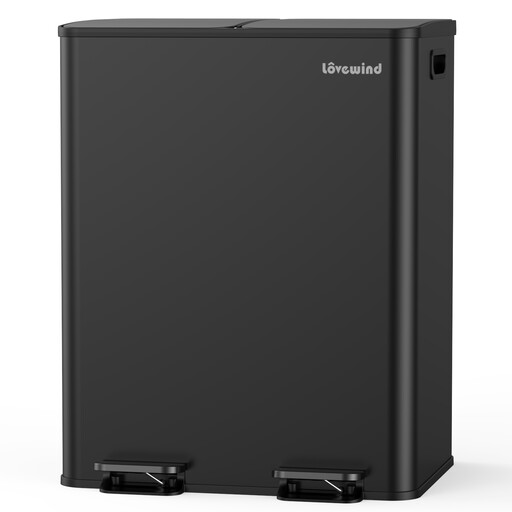
Why this product suits this profile: The separate 30-litre compartments make it easier to sort two types of waste. This model is suitable for larger kitchens, offices or living rooms with sufficient floor space.
Two pedals and separate inner containers mean you do not have to move the entire lid or a single container when sorting waste.
2 × 30 litres, two pedals, separate handles, bag-retaining systems and soft-close lids.
We have put together a complete, regularly updated list of products that fully meet these strict selection criteria and the safety regulations applicable in the EU.
A pedal bin does not incur battery costs during normal operation. However, hinges, the pedal and the damping mechanism should be protected from moisture and objects that could block them. A sensor bin requires batteries; actual battery life depends on the battery type, number of openings and sensor usage.
The following applies to all models:
For individuals or smaller kitchens, 20 to 30 litres is often sufficient. Families and households that cook frequently may prefer 40 to 60 litres. When separating waste, consider the capacity of each compartment rather than just the total capacity.
Yes, if reducing noise and ensuring a slow-closing lid are important in everyday use. Also check whether a hold-open function is available and whether the lid moves smoothly with regular use.
Both options allow you to operate the bin without touching the lid. A pedal does not require batteries and can be operated directly. A sensor bin opens automatically, but requires batteries and should be positioned so that the detection range is not constantly triggered accidentally.