
Lieferung heute & morgen

Qualitätsgarantie

Willkommens-Angebote freischalten: KOSTENLOSE Lieferung | Bis zu 80 % RABATT | Kostenlose 30-Tage-JoyPlus-Testphase
App herunterladen
A stainless steel kitchen sieve is one of the most versatile kitchen essentials: it can be used as a pasta strainer, draining sieve, fine-mesh sieve or rice-washing sieve. However, not every model is the right choice for every purchase. Small openings, an unstable base or a handle that becomes uncomfortably hot when handling hot food can significantly limit everyday usability.
This buying guide explains what keen home cooks, families and baking enthusiasts should look for in a stainless steel sieve. The product selection is based on clear specifications such as diameter, material, mesh width, handle design and cleaning requirements.
The term stainless steel does not automatically describe the exact alloy or manufacturing quality. For kitchen use, specifications such as 304 stainless steel, 18/8 or 18/10 are more helpful when provided by the seller. The construction also matters: a sieve may be made entirely from stainless steel or feature a plastic frame with stainless steel mesh.
A plastic frame can reduce the weight, but depending on its design, it may be less heat-resistant. When buying, you should therefore check whether the model is suitable for boiling liquids.
A fine-mesh sieve holds back small particles and is suitable for sifting flour, icing sugar and cocoa, or for filtering juices. For pasta or larger quantities of vegetables, however, a very fine mesh may drain more slowly and become clogged more quickly.
For a vegetable-washing sieve or a pasta colander, evenly distributed, sufficiently large openings are generally more practical. If you want to cover several tasks, consider a set with different diameters or an additional food mill.
A large draining sieve holds more food, but it also requires enough space over the sink. In smaller kitchens, a model with a stand or side handles may be a better fit. A compact kitchen colander, on the other hand, is more suitable for individual portions, berries or small quantities of rice.
Also pay attention to the distance between the sieve surface and the worktop. A raised base prevents drained water from coming back into contact with the food.
Care instructions are also important. A dishwasher-safe kitchen sieve can make cleaning easier. With plastic frames, observe the stated temperature limit. Abrasive sponges, wire wool and harsh cleaning products can damage surfaces or fine mesh.
The following sizes can serve as a guide when choosing:
A flat base makes the sieve stable. A hanging loop is useful if you want to store kitchen utensils on a rail or hooks.
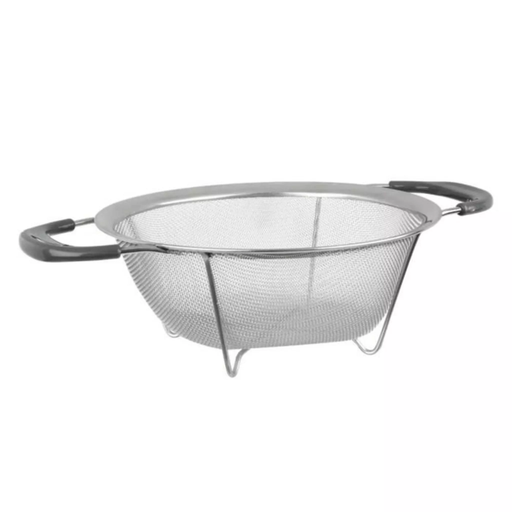
Why this product suits this profile: With a diameter of 22 cm, it covers several everyday tasks: draining pasta, rinsing fruit and vegetables, and sifting dry ingredients. The plastic frame keeps the weight comparatively low at 250 grams.
The product details specify 316 stainless steel mesh, food-safe materials and dishwasher compatibility. The plastic frame’s stated temperature limit of 70 °C should be observed before draining hot liquids.
22 cm diameter, fine stainless steel mesh, plastic frame and dishwasher-safe according to the product description.
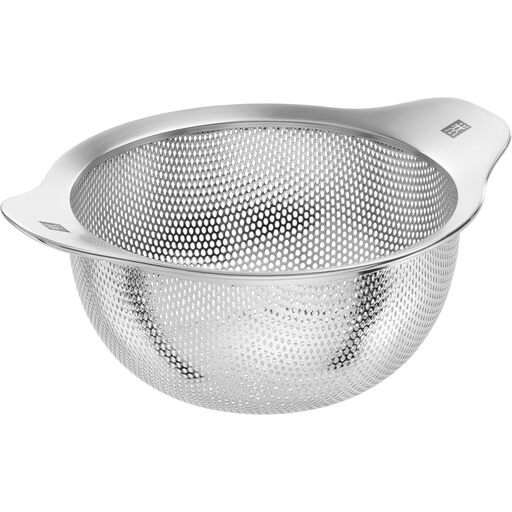
Why this product suits this profile: The 16 cm design combines a sieve, colander and bowl. The flattened base allows it to stand on the worktop, while the stackable range of sizes supports space-saving storage.
According to the product details, the construction is made from 18/10 stainless steel and is dishwasher-safe. Hand washing is recommended to preserve the satin finish; it is not designed for use over an open flame.
18/10 stainless steel, flattened stand, two handles and stackable sizes of 16, 20 and 24 cm.
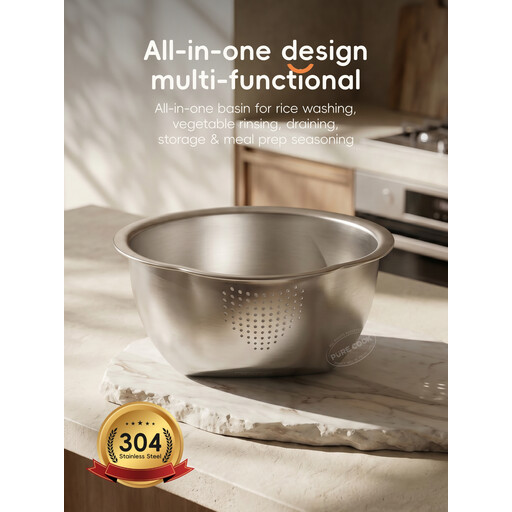
Why this product suits this profile: With a diameter of 27 cm and side handles, this bowl is designed for larger quantities. It is suitable for rinsing rice, washing vegetables, draining food and preparing fruit or beans.
The evenly distributed drainage openings and side drainers are documented as suitable for rinsing and draining. Acidic or salty foods should not be stored in it for extended periods.
304 stainless steel, 27 cm diameter, side handles, closely spaced openings and dishwasher-safe according to the product description.
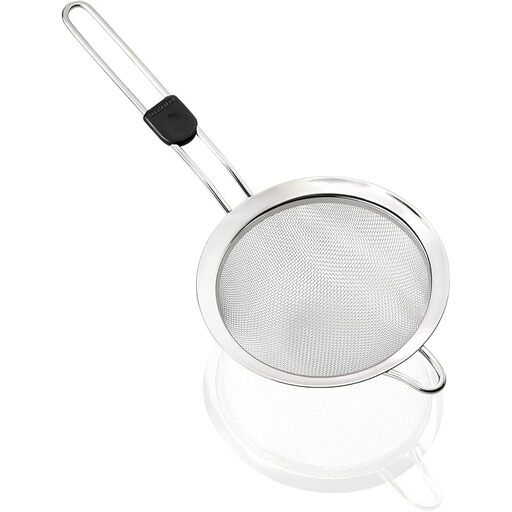
Why this product suits this profile: The stated mesh opening of 1.5 mm is suitable for flour, icing sugar and fine dry ingredients. A thumb rest and hanging loop make everyday use more convenient.
The specified mesh width makes it easier to assess the intended use. According to the product details, the model is dishwasher-safe, but it should not be used with very hot liquids or oil.
1.5 mm mesh opening, 16 cm diameter, stainless steel construction, thumb rest and hanging loop.
We have put together a complete, regularly updated list of products that fully meet these strict selection criteria and the safety regulations applicable in the EU.
Wash a new stainless steel kitchen sieve with warm water and mild washing-up liquid before using it for the first time. After use, remove any salt, acid, oil or starch residue promptly. Dry the sieve thoroughly before storing it in a cupboard or on a hanging loop.
Follow the manufacturer’s instructions when handling hot liquids. A heat-insulating handle does not necessarily protect every component from heat. Plastic frames can warp, while metal handles may become hot after prolonged exposure to heat. Check the mesh regularly for tears and stop using the sieve if the handle becomes loose or the mesh is deformed.
A diameter of 16 to 20 cm is often sufficient for individual portions. Families that regularly prepare larger quantities of pasta or vegetables will generally benefit from 22 to 27 cm. The important thing is that the sieve rests securely in the sink or over a bowl.
Stainless steel retains its shape and does not absorb odours when cleaned properly. Plastic may be lighter and, in some models, gentler on delicate surfaces. With a fine-mesh sieve, however, the key factors are the mesh width, the stability of the frame and the quality of the edges.
There is no universal lifespan. It depends on the alloy, welds, level of use and care. A sieve can be used for longer if it is not subjected to sharp objects, is dried after cleaning and is used in accordance with the manufacturer’s instructions.