
Lieferung heute & morgen

Qualitätsgarantie

Willkommens-Angebote freischalten: KOSTENLOSE Lieferung | Bis zu 80 % RABATT | Kostenlose 30-Tage-JoyPlus-Testphase
App herunterladen
A stainless steel kitchen sieve is a staple in many British households – for draining pasta, washing vegetables, sifting flour and filtering homemade soya milk. Even so, small differences in design can quickly lead to the wrong purchase. A fine-mesh sieve is not automatically suitable for every task, and a large capacity does not always mean easy handling.
This buying guide explains which features really matter when choosing a stainless steel sieve and which design is best suited to your household, baking project or catering business.
“Stainless steel” initially describes only the material group. For everyday use, the construction, wall thickness and surface quality are also important. Specifications such as 304 stainless steel or 316 stainless steel are more precise than a general material description. The product information should also explicitly state whether the item is suitable for contact with food.
For coated models, it is worth checking the care instructions. A damaged coating can make cleaning more difficult. By contrast, an uncoated stainless steel sieve can usually be cleaned with warm water, mild washing-up liquid and a soft brush.
A coarse draining sieve is practical for pasta, potatoes and larger pieces of vegetables. Flour, icing sugar and fine liquids, however, require a fine kitchen sieve. Very small mesh openings may drain more slowly when used with puréed ingredients or become blocked more quickly.
If you are looking for a sieve for soya milk, choose one with an evenly distributed, tightly woven filter surface. Depending on the product, nylon filters with a stated mesh count may also be suitable for particularly fine residue. A traditional household sieve is not always sufficient for this purpose.
A small kitchen sieve is easy to store and is suitable for individual portions or baking ingredients. For pasta, salad or larger quantities of vegetables, a stainless steel draining basket with a base or side supports is more practical.
Before buying, also check:
For many kitchen applications, 304 stainless steel is a clear and useful material specification. A product intended for direct contact with food should also include care and safety instructions. Smooth, neatly folded edges make cleaning easier and reduce the risk of catching yourself on a sharp edge.
A 316 stainless steel sieve may also be available. The key consideration is whether the rest of the construction – such as a plastic frame or riveted handle – is suitable for the intended use. Check the temperature limits for any plastic components.
The openings determine what is retained and how quickly liquid drains:
A tightly woven mesh should be evenly tensioned. With wire sieves, it is advisable to inspect the mesh before every use. Damaged or misshapen sections can retain food and make cleaning more difficult.
For normal household use, compact models with a diameter of around 15 to 22 cm are often sufficient. An extendable draining basket offers greater flexibility if it can rest across sinks of different widths. Make sure you observe the maximum permitted weight, particularly when handling wet potatoes or large quantities of vegetables.
For restaurants and catering businesses, several sizes or a set can be a sensible choice. This allows you to select a strainer suited to the portion size, without losing small ingredients in an oversized basket.
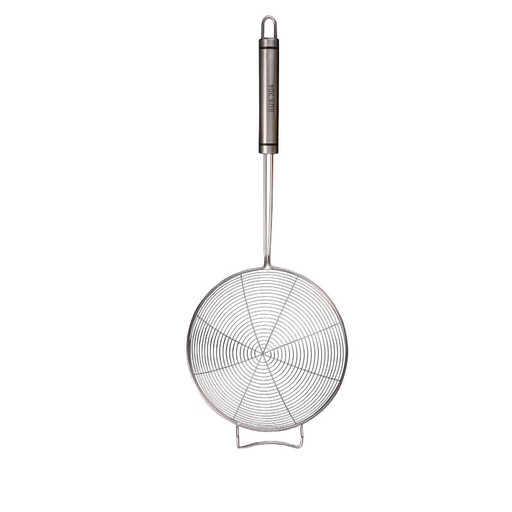
Why this product suits this profile: The compact 15 cm handheld sieve is suitable for smaller portions, flour, liquids and everyday kitchen tasks, while taking up very little storage space.
The product description specifies 304 stainless steel and a precise size, rather than making only general claims about the material or possible uses.
Compact diameter and stainless steel mesh for a wide range of household tasks.
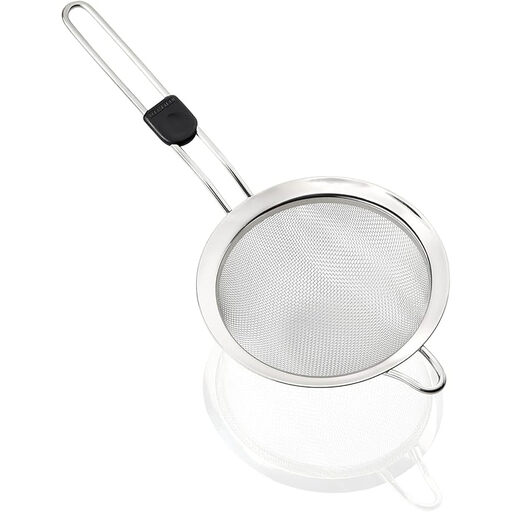
Why this product suits this profile: With a 16 cm diameter and a stated mesh opening of 1.5 mm, this sieve is ideal for keen bakers and users who prefer precise measurements for flour and icing sugar.
The mesh opening, diameter and dishwasher suitability are clearly specified in the technical details.
1.5 mm mesh opening, 16 cm diameter, thumb rest and hanging loop.
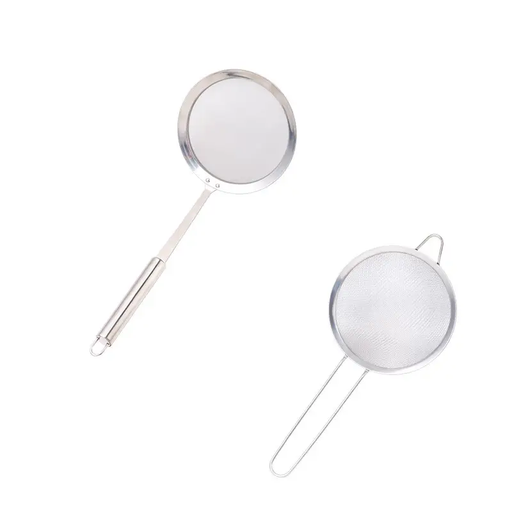
Why this product suits this profile: This set is designed for fine filtering tasks and is suitable for users who process drinks or liquids as well as flour.
The product name specifies the fine filter function, 304 stainless steel and the two-piece set contents.
Fine sieve for flour and soya milk, plus a complementary skimmer in the two-piece set.
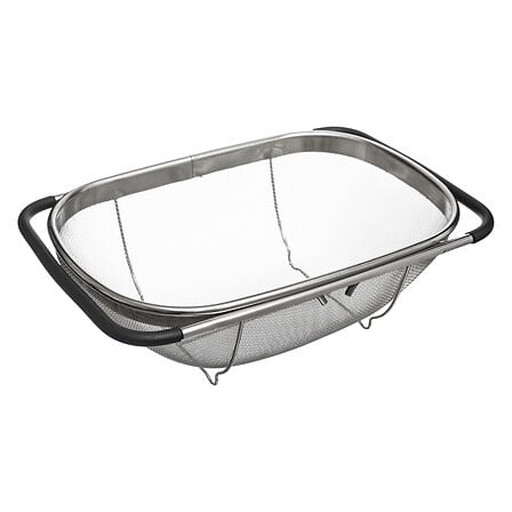
Why this product suits this profile: With a capacity of 3.6 litres, this extendable draining basket is designed for sinks, pasta, vegetables and larger quantities.
The dimensions of 53.5 × 24.7 × 10.5 cm and the extendable design make it possible to check the fit before buying.
3.6-litre capacity, extendable supports and ergonomic handle.
We have put together a complete, regularly updated list of products that fully meet these strict selection criteria and the safety regulations applicable in the EU.
Rinse a new stainless steel kitchen sieve thoroughly before using it for the first time. After use, food residue should not be left to dry on the mesh. A soft brush can reach between the openings without unnecessarily deforming the mesh.
When handling hot liquids or oil, always follow the relevant safety instructions. Plastic frames may have limited temperature resistance. A heat-insulating handle does not automatically mean that the entire sieve is heat-resistant. Damaged mesh, loose handles or sharp edges are all reasons to stop using the product.
For flour and icing sugar, a fine kitchen sieve with an even mesh structure is a sensible choice. A clearly stated mesh opening, such as 1.5 mm, makes it easier to choose the right product. For larger quantities, a sieve with a wide support that rests over a bowl may be more comfortable to use.
A sieve separates smaller particles or liquids using mesh or openings. A strainer and pasta colander are generally larger and designed for draining cooked food. A stainless steel draining basket often has side supports or handles and can be used directly in the sink.
Its lifespan depends on the material thickness, construction, level of use and care. Do not use knives or hard objects on the mesh, avoid abrasive cleaners and dry the sieve after washing. Regular checks make it easier to spot deformation or damaged areas at an early stage.