
Lieferung heute & morgen

Qualitätsgarantie

Willkommens-Angebote freischalten: KOSTENLOSE Lieferung | Bis zu 80 % RABATT | Kostenlose 30-Tage-JoyPlus-Testphase
App herunterladen
A stainless steel kitchen sieve is one of the most versatile kitchen tools: it can sift flour, drain pasta, wash rice, and rinse fruit and vegetables. However, not every model makes a good purchase. Small details such as mesh size, rim finishing and the support surface often determine whether a kitchen sieve remains practical for everyday use.
“Stainless steel” does not automatically describe the overall quality of a product. It is important to know whether only the sieve mesh, or also the frame, handles and base, are made of metal. A plastic frame can reduce weight, but it should be suitable for the intended use. With a stainless steel kitchen sieve, smooth edges and neat finishing are also important, as fine wire ends can injure your hands or become misshapen during cleaning.
A fine-mesh kitchen sieve is suitable for sifting flour, icing sugar or cocoa. However, it may drain more slowly when used for pasta, salad and larger pieces of vegetables. A coarse-holed colander drains water quickly, but may not reliably retain small grains of rice or fine residue. The mesh size should therefore match the main purpose.
Product images can make it difficult to judge dimensions. You should therefore check the diameter, height, capacity and handle length. A large pasta colander needs enough space over the sink or saucepan. A small strainer, on the other hand, saves space but only holds smaller portions. It is also important that information such as “dishwasher-safe kitchen sieve” is stated explicitly in the product details, rather than being inferred from the photograph alone.
For regular use, rust-resistant stainless steel variants with confirmed suitability for food contact are a sensible choice. Details such as 304 stainless steel or 316 stainless steel refer to the grade of stainless steel used. However, they do not replace checking the specific product, particularly its handles, plastic parts and coatings.
Uncoated surfaces can be easy to clean. After washing, you should dry the sieve thoroughly, especially if it will be stored for a longer period. Abrasive cleaners, steel wool and hard brushes can damage metal surfaces or fine mesh.
A sieve for sifting flour requires a finer mesh than a traditional colander for potatoes or pasta. For rice, quinoa and small berries, evenly distributed, smaller openings are helpful. With a rice-washing sieve, the water should drain quickly without the grains falling through the openings.
Also check whether the manufacturer specifies an exact mesh size. For example, the Leifheit sieve from the ProLine series is listed with a 1.5-millimetre mesh opening and a diameter of 16 centimetres.
A long handle makes it easier to work over bowls or saucepans. Side handles are more suitable for larger quantities and allow you to carry the sieve safely. Models with extendable supports can be used over sinks of different widths, but require different amounts of storage space when folded and extended.
For small kitchens, compact dimensions, a hanging loop or a stackable design are important. A stainless steel strainer with handle is practical if you often drain individual portions. For family-sized portions, a larger diameter is generally more suitable.
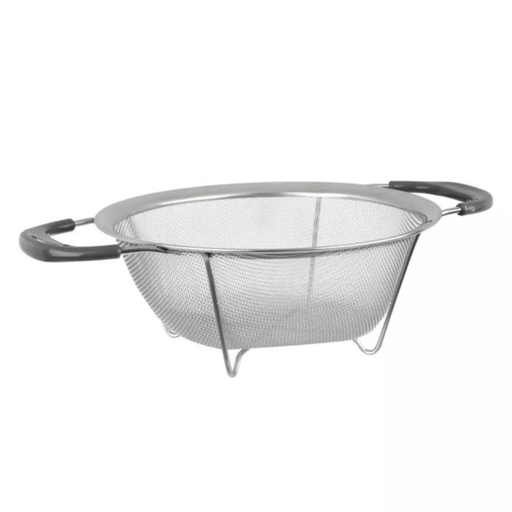
Why this product suits this profile: The 22-centimetre sieve handles everyday tasks such as sifting flour, draining pasta and washing vegetables, without being limited to one specialist use.
The product details clearly specify the diameter, material and dishwasher suitability. This makes it easier to match your choice to your actual kitchen needs.
316 stainless steel mesh, plastic frame, 22-centimetre diameter and confirmed dishwasher suitability.
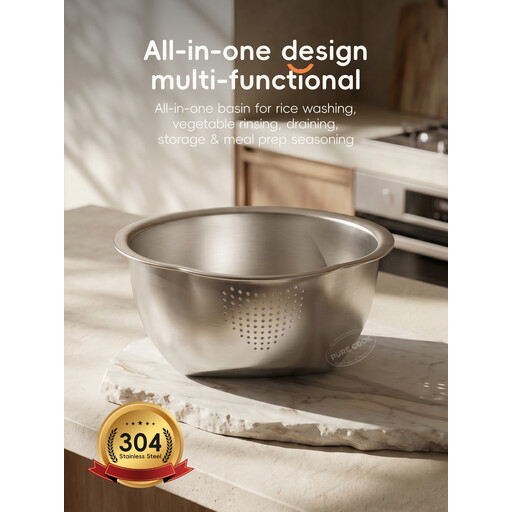
Why this product suits this profile: This rice-washing sieve is designed for frequent washing, draining and preparing ingredients, and can also be used as a basket for fruit or vegetables.
The specifications state 304 stainless steel, evenly distributed openings, polished edges and two side handles. This provides clear information about key buying criteria.
304 stainless steel, 27-centimetre diameter, side handles and confirmed dishwasher suitability.

Why this product suits this profile: The extendable design is ideal for households that drain larger quantities and want to use the strainer flexibly over sinks of different widths.
Rather than giving an unclear universal size, the product specifies its capacity, dimensions and extendable design. Before buying, you should check the width of your own sink.
3.6-litre capacity, stainless steel construction, extendable dimensions and ergonomic handle.
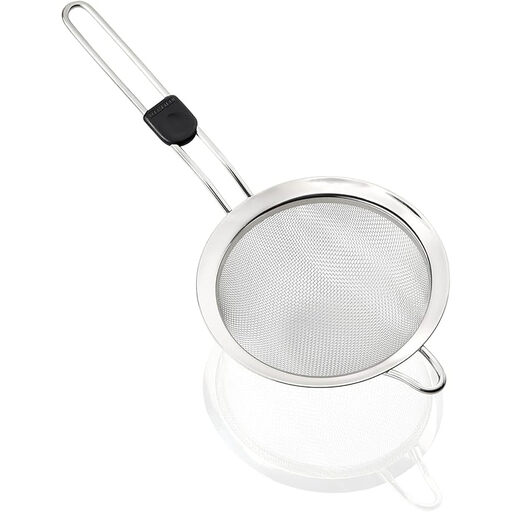
Why this product suits this profile: The diameter and fine mesh opening are suitable for flour, icing sugar and smaller baking ingredients. The hanging loop supports space-saving storage.
The product description specifies a 1.5-millimetre mesh opening, a 16-centimetre diameter and dishwasher suitability. This makes its intended use clearer than vague “fine mesh” claims alone.
Stainless steel, 1.5-millimetre mesh opening, thumb rest, hanging loop and confirmed dishwasher suitability.
We have put together a complete, regularly updated list of products that fully meet these strict selection criteria and the safety regulations applicable in the EU.
For flour, icing sugar and cocoa, a fine-mesh kitchen sieve with a clearly specified mesh size is a sensible choice. A diameter of around 16 to 22 centimetres is sufficient for many households. A wider model can speed up the process when baking larger quantities.
That depends on the individual product. Some models explicitly state that they are dishwasher-safe, while plastic frames or handles may require gentler cleaning. Always check the manufacturer’s instructions and dry the sieve completely after the wash cycle.
A small strainer is sufficient for individual portions. For family-sized portions or larger quantities, a diameter of around 22 centimetres or more, or a capacity of several litres, is more practical. The key is to ensure that the sieve rests securely on the sink or bowl and that the drainage openings are not blocked.