
Lieferung heute & morgen

Qualitätsgarantie

Willkommens-Angebote freischalten: KOSTENLOSE Lieferung | Bis zu 80 % RABATT | Kostenlose 30-Tage-JoyPlus-Testphase
App herunterladen
A stainless steel kitchen sieve can be used to drain pasta, rinse rice and vegetables, or sift flour. In practice, though, the differences often only become clear after a few uses: the sieve may not sit securely, small ingredients may fall through, or the frame may warp when exposed to heat. So if you focus only on a shiny finish or a large capacity, you may not end up with a sieve that suits your everyday cooking.
“Stainless steel” describes a broad group of materials. For food contact, details such as 304 stainless steel, 18/8, 18/10 or 316 stainless steel are more useful. They indicate the composition, but you should still check the specific product information.
A sieve with a stainless steel surface may also have a plastic frame, wooden handle or coated components. These parts often determine whether a household sieve is dishwasher-safe and how it can be used with hot liquids.
A coarsely perforated pasta strainer is suitable for draining pasta and larger pieces of vegetable. Rice, quinoa, berries and flour need smaller holes or a finer mesh. A fine-mesh sieve catches smaller particles, but liquids and thicker foods may drain more slowly through it.
So compare claims such as “fine” with the actual product dimensions and intended use. A stated mesh size of, for example, 1.5 mm is more informative than a general marketing claim.
Calling a kitchen sieve dishwasher-safe means it is designed to be cleaned in a dishwasher. However, frequent hot cycles can put extra strain on the plastic frames, wooden lids or handles of products made from several materials. After cleaning, let the sieve dry completely. Steel wool, abrasive scouring pads and harsh cleaning products can damage the surface or fine mesh.
For many households, 304 stainless steel or 18/8 stainless steel are practical material specifications. Products made from 18/10 stainless steel contain a higher proportion of nickel. Construction, edges and the way the handles are attached to the sieve body matter too.
316 stainless steel is specified for some fine-mesh sieves. The product description for the Stainless Steel and Plastic Mesh Sieve Diam 22 cm says that its mesh is made from 316 stainless steel, while the frame is plastic. According to the supplier, the plastic frame should not be exposed to temperatures above 70 °C. So avoid pouring boiling water directly into the sieve while holding it.
Look for:
A diameter of around 16 to 24 cm covers many everyday household uses. A smaller sieve is easy to store and handy for flour, icing sugar or small quantities of fruit. For family-sized portions of pasta or larger quantities of vegetables, a deeper body, side handles and a stable base are more useful.
An extendable model may fit sinks of different widths. According to the product information, the 3.6-litre Expandable Stainless Steel Sieve is 53.5 cm long and designed for draining, rinsing and straining larger quantities. Before you buy, check that it will fit the width of your sink.
A sieve for draining needs large enough openings for water to flow through and a stable base. A sieve for washing rice and vegetables should hold back small ingredients and have no hard-to-reach gaps. For baking ingredients, an even, fine mesh and a comfortable handle are important.
A stainless steel sieve for pasta and baking only combines both uses well if the hole size and capacity suit the recipe. A small flour sieve is no substitute for a large colander when cooking several portions of pasta.
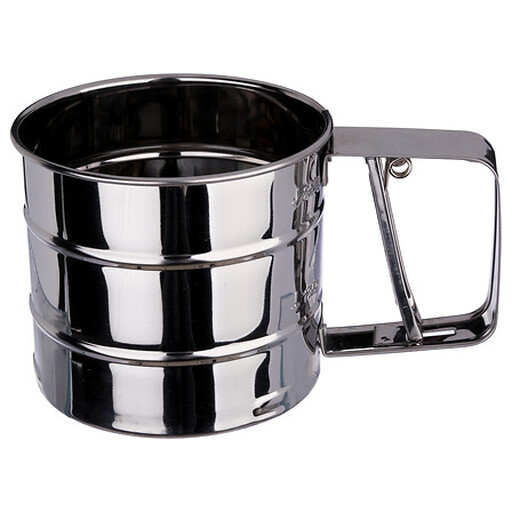
Why it suits this profile: Measuring 10.3 × 9.3 × 15.5 cm, this compact sieve is ideal for smaller households, baking ingredients and everyday straining tasks.
The product details give the exact dimensions and specify stainless steel as the material, rather than relying on a vague size description.
Compact dimensions, a light weight of 120 g and versatile use for sifting, straining and rinsing small quantities.
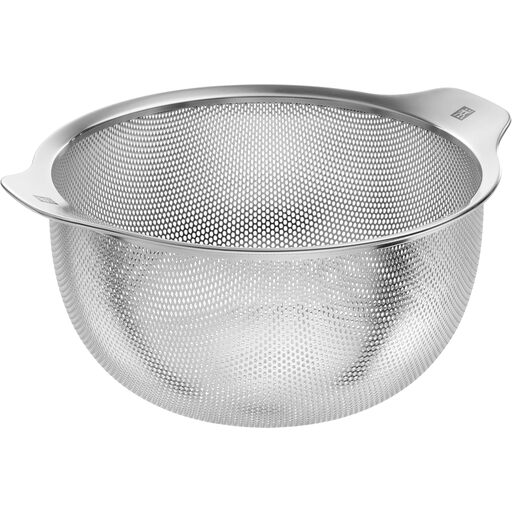
Why it suits this profile: This 24 cm colander is designed for larger quantities of pasta and vegetables. The product description says it has integrated side handles and a raised base.
The product details clearly specify the material, diameter, handles, perforated base and dishwasher suitability.
18/10 stainless steel according to the product description, a 24 cm diameter and side handles for larger portions.
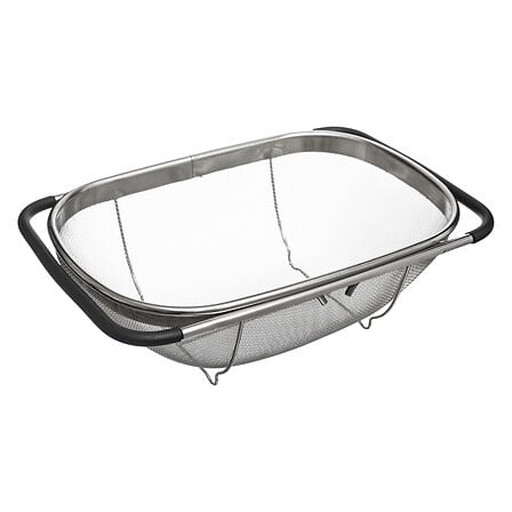
Why it suits this profile: This extendable strainer is designed for people who regularly prepare large quantities of pasta, vegetables or fried food.
The adjustable length helps avoid a mismatch between the size of the sieve and the width of your sink. Check the dimensions before buying.
3.6-litre capacity, an extendable design and a handle for use across sinks of different widths.
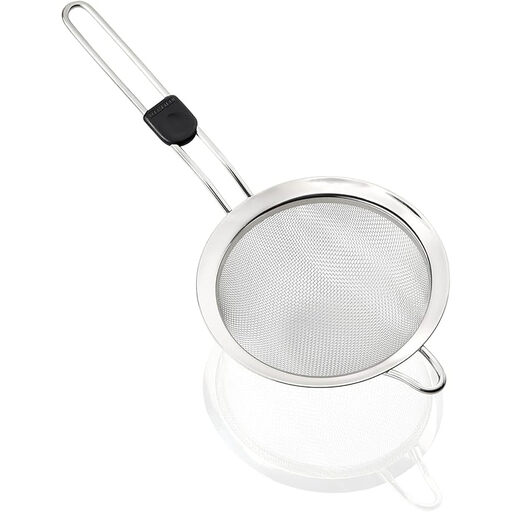
Why it suits this profile: With a diameter of 16 cm and a stated mesh size of 1.5 mm, this sieve is suitable for flour, icing sugar and smaller straining tasks.
The stated mesh size makes it easier to choose than vague descriptions such as “extra fine”. According to the product guidance, it is not designed for very hot liquids.
16 cm diameter, 1.5 mm mesh, thumb rest, hanging loop and dishwasher-safe according to the product details.
We’ve put together a complete, regularly updated list of products that meet these strict selection criteria and fully comply with the safety regulations in force in the EU.
A fine-mesh sieve or a model with closely spaced small holes is a good choice for rice. The mesh should hold the grains while allowing water to drain quickly. A large colander with coarse holes is less suitable.
No. This should be clearly stated in the product details. A dishwasher may shorten the lifespan of individual components in sieves with a plastic frame or wooden handle. Always follow the manufacturer’s instructions.
Its lifespan depends on the material, construction, how heavily it is used and how well it is cared for. A sieve made entirely from stainless steel has fewer different components than one made from several materials. Excessive heat, knocks, steel wool and salt or acidic residue left on the surface for long periods can affect its finish and shape.