
Lieferung heute & morgen

Qualitätsgarantie

Willkommens-Angebote freischalten: KOSTENLOSE Lieferung | Bis zu 80 % RABATT | Kostenlose 30-Tage-JoyPlus-Testphase
App herunterladen
A stainless steel kitchen sieve is a staple in many British kitchens – for draining pasta, washing vegetables, sifting flour and filtering liquids. Yet it is often only after buying one that you discover whether a model really suits everyday use. Holes that are too large let small ingredients through, an unstable rim makes tasks more difficult, and a plastic handle may not cope well with hot water.
This buying guide helps you assess marketing claims and choose a stainless steel sieve based on clear, practical criteria.
“Stainless steel” is initially only a general material description. For kitchen use, more specific information is helpful, such as 304 stainless steel, 18/8, 18/10 or 316 stainless steel. These designations describe the composition of the steel and make it easier to assess corrosion resistance and care requirements.
For products with plastic components, you should also check whether the frame or handle is suitable for the intended temperature range. A dishwasher-safe sieve is not automatically designed to handle boiling liquids in every situation.
A coarse-perforated colander is suitable for draining pasta and washing fruit or vegetables. Flour, icing sugar, cocoa, soya milk and fruit pulp, on the other hand, require a fine-mesh sieve.
The mesh size should therefore match the intended use:
A versatile model can be used for many tasks, but it cannot replace every specialist sieve design.
A small kitchen sieve is easy to store, but it can quickly become overcrowded when handling larger portions. For family-sized portions of pasta or washing larger quantities of vegetables, diameters of around 22 to 27 cm are more practical. A stable base, easy-to-reach handles and a rim that sits securely on a bowl or saucepan are also important.
For direct contact with food, the product should be explicitly intended for this purpose. Information such as food contact safe, 304 stainless steel or 18/10 stainless steel provides more guidance than vague claims such as “rust-proof”. The workmanship also matters: smooth edges make cleaning easier, while damaged or misshapen mesh should be replaced.
When using acidic or salty foods, it is advisable to rinse away any residue promptly and dry the sieve thoroughly. This helps reduce discolouration and build-up.
Wire mesh retains fine particles and is suitable for a sieve for sifting flour or filtering liquids. Evenly distributed punched holes usually allow water to drain more quickly, making them a good choice for a sieve for draining food or a sieve for washing vegetables.
Before buying, it is worth checking the product images and technical specifications. The key factor is not simply whether the product is described as “fine”, but the actual mesh or hole structure.
A dishwasher-safe sieve saves time in everyday use. Nevertheless, high temperatures and long dishwasher programmes can put prolonged strain on plastic frames, coatings and surfaces. Washing by hand with warm water, mild washing-up liquid and a soft sponge is often gentler on the material.
Abrasive cleaners, wire wool and hard brushes can scratch stainless steel or deform fine mesh. For all models, follow the manufacturer’s safety instructions.
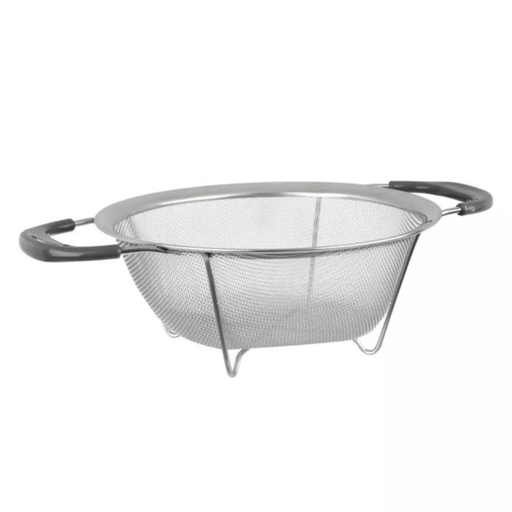
Why this product suits this profile: With a diameter of 22 cm, it handles typical household tasks, from draining cooked pasta to washing smaller food items.
The product specifies a 316 stainless steel mesh, food-safe construction and dishwasher suitability. However, the plastic frame is not designed for temperatures above 70 °C.
Fine stainless steel mesh, a 22 cm diameter and stated dishwasher suitability.
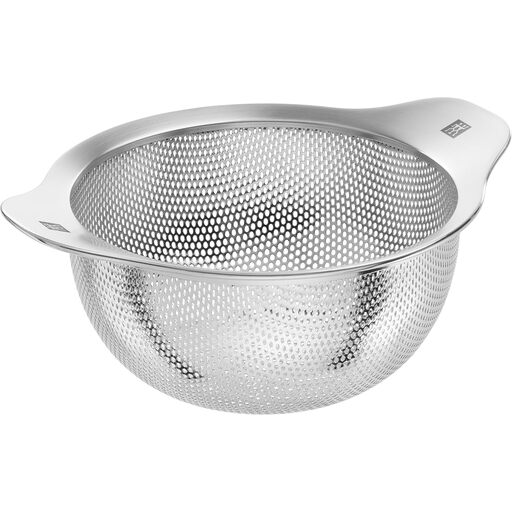
Why this product suits this profile: Its compact design, two stainless steel handles and flat base make it suitable for kitchens where stability and space-saving storage are important.
The construction is made from 18/10 stainless steel and has no plastic frame that imposes a temperature limit. However, its perforated design is less specialised for fine flour than a close-knit mesh.
3-in-1 use as a sieve, colander and bowl; dishwasher-safe and stackable in different sizes.

Why this product suits this profile: The extendable design is intended for sinks of different widths. With a 3.6-litre capacity, it provides plenty of room for larger quantities of pasta, vegetables or fried food.
The dimensions of 53.5 × 24.7 × 10.5 cm and the extendable design make it clear how the strainer fits the sink. Check the width of your own sink before buying.
Large capacity, stainless steel construction and an adjustable rest for different sink sizes.
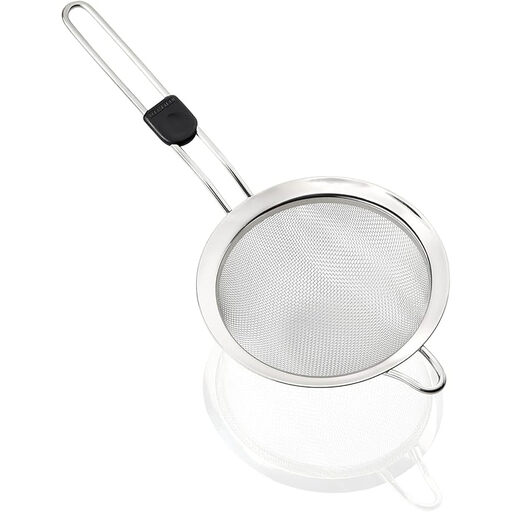
Why this product suits this profile: The stated mesh opening of 1.5 mm is suitable for tasks such as sifting flour, dusting icing sugar and other smaller baking jobs.
The mesh opening is specified precisely, avoiding an imprecise marketing claim such as “extra fine”. According to the product information, this model is not intended for very hot liquids or oils.
1.5 mm mesh opening, thumb rest, hanging loop and stated dishwasher suitability.
We have put together a complete, regularly updated list of products that fully meet these strict selection criteria and the safety regulations applicable in the EU.
A fine-mesh sieve is ideal for flour, icing sugar and cocoa. As a specific guide, a mesh opening of 1.5 mm, for example, may be suitable. For particularly fine filtering tasks, such as soya milk or fruit pulp, an even denser structure may be required.
Many models are described as dishwasher-safe. These include, for example, some stainless steel colanders and fine-mesh kitchen sieves from the selection. For plastic frames or special surfaces, hand washing may extend the product’s service life. The relevant manufacturer’s instructions should always take precedence.
For small portions, a diameter of around 16 cm is often sufficient. Households with several people will often choose 22 to 27 cm or a model with a larger capacity. Alongside the diameter, the height, base and handles are important to ensure that a full colander can be moved safely.