
Lieferung heute & morgen

Qualitätsgarantie

Willkommens-Angebote freischalten: KOSTENLOSE Lieferung | Bis zu 80 % RABATT | Kostenlose 30-Tage-JoyPlus-Testphase
App herunterladen
A stainless steel kitchen sieve can be used to drain pasta, rinse rice, drain vegetables or sift flour. In practice, though, differences often only become apparent after several uses. Some models become misshapen, others don’t sit securely over the sink, and some let small ingredients fall through the holes.
Whether you’re cooking at home, enjoy baking or work in a professional kitchen, it’s worth looking beyond general marketing claims and checking the product’s practical features. Material, design, size, mesh and ease of cleaning all matter.
The term ‘stainless steel’ alone tells you little about the exact composition. A stainless steel sieve might, for example, be made with 304 stainless steel, 18/8 stainless steel, 18/10 stainless steel or a mesh made from 316 stainless steel. These details describe the material’s composition and help you assess its corrosion resistance and care requirements.
If the product has a plastic frame, check whether only the mesh is made from stainless steel. A plastic handle or frame may have a different temperature limit from the metal.
A pasta strainer needs a different mesh from a flour sieve. Evenly spaced, smaller holes are useful for rice, quinoa or small berries. However, a very fine mesh can slow down the draining of pasta.
If you want to use a kitchen sieve for a range of tasks, decide what you’ll use it for most:
A model described as dishwasher-safe can be cleaned in the dishwasher. However, harsh detergents, high temperatures or contact with other metal items can affect the surface over time. For plastic parts, always check the manufacturer’s care instructions.
Dry the sieve thoroughly after washing. Scouring pads, wire wool and highly abrasive cleaners can scratch polished surfaces or distort a fine mesh.
For regular use, details such as 304 stainless steel (18/8) or 18/10 stainless steel are more useful than a general description. Uncoated stainless steel has no coating that could peel away. Smooth, deburred edges help reduce the risk of scratches to your hands or cookware.
For wire mesh, check that it’s evenly tensioned and securely attached to the frame. A lightweight plastic frame may be fine for light ingredients, but may not be suitable for very hot liquids.
A diameter of around 16 cm is suitable for smaller portions, baking ingredients and use over a bowl. Models measuring 22 to 24 cm offer more room for vegetables or pasta. For family-sized portions or larger quantities, an extendable colander with a stated capacity of 3,6 litres may be a good choice.
A flat or raised base keeps the sieve clear of water as it drains. Side handles make it easier to move from the sink to the worktop. If you’re choosing a colander with handles, check that they’re securely attached and set far enough away from hot pans.
Clear care instructions are a useful sign of quality. Dishwashing and hand-washing are often suitable for an all-stainless steel model, provided the manufacturer says so explicitly. For products made from both stainless steel and plastic, check the frame’s heat resistance. For example, the 22 cm stainless steel and plastic sieve is listed as dishwasher-safe, but the plastic frame has a stated limit of 70 °C.
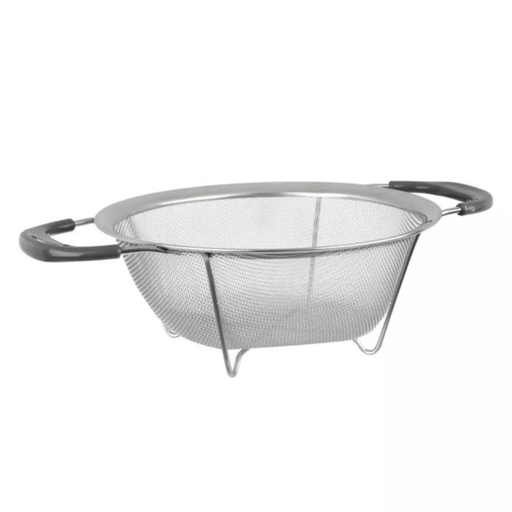
Why this product suits you: The 22 cm diameter gives you plenty of room for pasta, vegetables and fresh berries. It combines a 316 stainless steel mesh with a plastic frame, making it suitable for a range of everyday tasks.
The stated mesh structure keeps smaller ingredients in the sieve. The plastic frame’s temperature limit also makes it clear that boiling liquids shouldn’t be poured in without care.
22 cm diameter, 316 stainless steel mesh and stated dishwasher suitability.
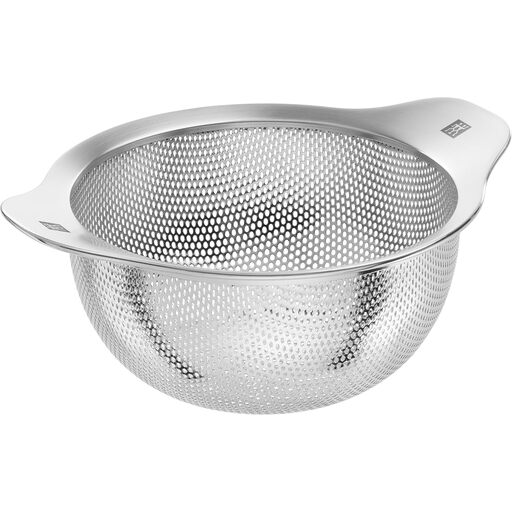
Why this product suits you: This 16 cm design combines a sieve, colander and bowl. The flat base keeps it stable, while two stainless steel handles make it easy to move.
The stable base helps prevent it from slipping over bowls or on the worktop. The stated 18/10 stainless steel construction also gives you more detail than a vague reference to stainless steel.
18/10 stainless steel, flat base, two integrated handles and nestable sizes within the range.
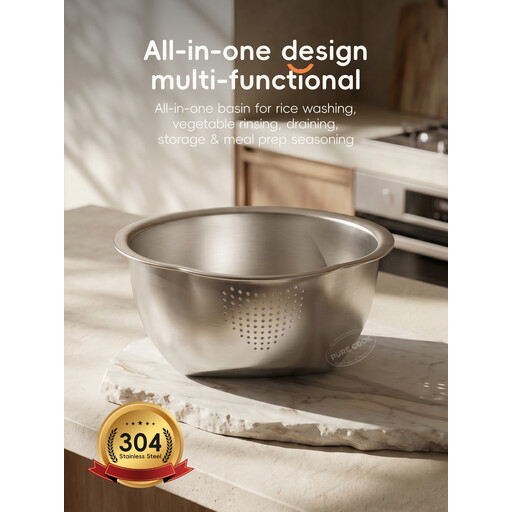
Why this product suits you: With a 27 cm diameter, sloped base and drainage holes at the sides, this rice sieve is designed for washing and draining rice, vegetables, fruit and pulses.
The product details specify 304 stainless steel (18/8), evenly spaced drainage holes and polished edges. This gives you a clearer picture of the material and construction than a general stainless steel description.
27 cm diameter, two side handles, sloped base and stated dishwasher suitability.
If you enjoy baking, a flour sieve with a fine mesh and easy-to-hold handle is a good choice. According to the product details, the Leifheit ProLine kitchen sieve has a 16 cm diameter, a mesh opening of 1.5 mm, a thumb rest and a hanging loop.
If you regularly drain large portions, you could choose a 24 cm pasta strainer or an extendable model with a 3,6-litre capacity. An extendable colander can be positioned across sinks of different widths. Before buying, though, compare its dimensions with your sink and check that the supports can bear the weight.
A classic vegetable sieve with holes at the sides isn’t necessarily the right choice for sifting flour. For each task, the combination of hole shape, sieve depth and stability is what matters.
We’ve put together a complete, regularly updated list of products that meet these strict selection criteria and fully comply with the safety regulations in force in the EU.
It depends on the product. All-stainless steel models are often labelled as dishwasher-safe. If the sieve has a plastic frame, you’ll also need to follow the temperature and care instructions. Always refer to the specific manufacturer’s guidance.
A diameter of around 16 cm may be enough for individual portions and smaller households. Models measuring 22 to 24 cm are usually more practical for family-sized portions. The depth of the sieve also matters, as does whether the handles rest securely over the sink.
A rice sieve with fine, evenly spaced holes is better at keeping small grains in and makes rinsing easier. A pasta strainer with large holes may not be suitable for rice, as the grains could fall through. If you cook rice regularly, it’s worth choosing a kitchen sieve designed specifically for the job.