
Lieferung heute & morgen

Qualitätsgarantie

Willkommens-Angebote freischalten: KOSTENLOSE Lieferung | Bis zu 80 % RABATT | Kostenlose 30-Tage-JoyPlus-Testphase
App herunterladen
A stainless steel kitchen sieve is a staple in many UK households, but it is often chosen for its appearance rather than its intended use. A fine-mesh sieve for flour requires different features from a colander for draining large quantities of pasta. An expandable sink strainer or stainless steel coffee filter is not automatically suitable for every application either.
If you only look for terms such as “robust”, “rust-resistant” or “extra fine”, you can easily overlook important details. Three common purchasing pitfalls are:
Mesh size determines which particles are retained. A finer structure is useful for a flour sieve or a sieve for flour and soya milk. The Leifheit kitchen sieve, for example, has a diameter of 16 cm and a stated mesh opening of 1.5 mm. This is a specific technical detail that makes it easier to assess the sieve for dry ingredients.
A pasta colander or vegetable sieve can have larger openings so that water drains quickly. Coffee, on the other hand, requires a considerably finer filter structure: the BJ coffee filter on offer is described as having 800 mesh and being made from grade 304 stainless steel. Mesh specifications should not automatically be equated with other mesh-size details, as manufacturers may use different reference measurements.
When choosing a stainless steel sieve, buyers should check whether the item is explicitly intended for contact with food. This intended use is stated in the product details for the expandable 3.6-litre sieve. According to the specifications, the model is made from stainless steel and designed for draining, rinsing and straining.
A black enamel surface can change the appearance, but on its own says nothing about suitability for every heat source. The Premier Housewares sieve is listed as being made from stainless steel and iron. At the same time, its care and usage information states that it is not suitable for the oven, microwave, freezer or hob. Such restrictions are more important when buying a kitchen sieve than a decorative finish.
Dimensions and support surfaces are crucial when straining food over the sink. The expandable model measures 53.5 × 24.7 × 10.5 cm, has a capacity of 3.6 litres and can be positioned over sinks of different widths. Even so, you should check before buying that the handles will rest securely on the rim of your own sink.
With smaller sieves, ease of use and storage are more important. A thumb rest, hanging hole or sturdy rim may be more practical in everyday use than an especially large capacity. For air fryers and barbecues, you should also check that the dimensions, material and temperature rating are compatible with the appliance in question. An air fryer rack or grill basket must not be used if the manufacturer has not approved it for that purpose.
The products below cover a range of applications. What matters is not a general judgement of quality, but whether the material, size, mesh structure and intended use match your needs.
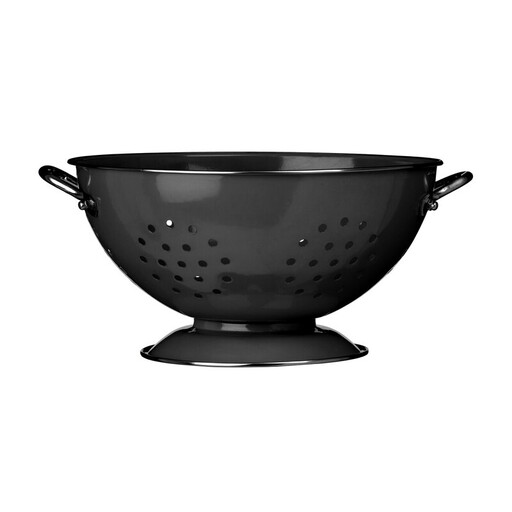
Why this product suits this profile: This colander is designed for draining pasta, potatoes and vegetables and has two side handles. Its stated capacity is 1,700 ml.
The product details clearly state its limitations: it is not suitable for use in the oven, microwave or on the hob. This makes it easier to avoid using it incorrectly.
Two handles, 1,700 ml capacity and, according to the specifications, dishwasher-safe.
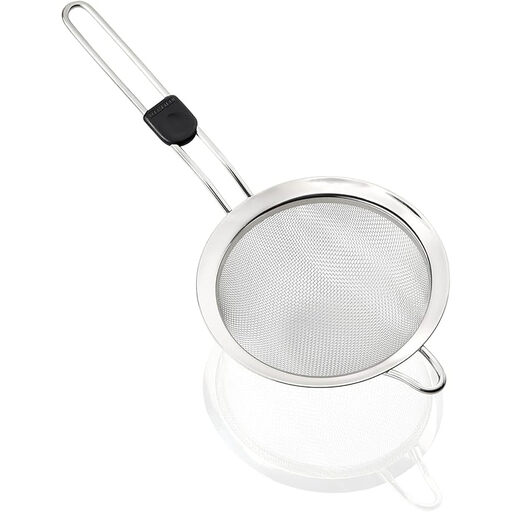
Why this product suits this profile: According to the product details, this 16 cm stainless steel sieve is intended for flour, icing sugar, baking ingredients and other foods. Its stated 1.5 mm mesh opening makes it a suitable choice for fine applications.
The mesh opening is specified precisely. The cleaning instructions also describe washing by hand or in the dishwasher, rather than making a vague claim about easy care.
Stainless steel construction, 1.5 mm mesh opening, thumb rest and hanging hole.
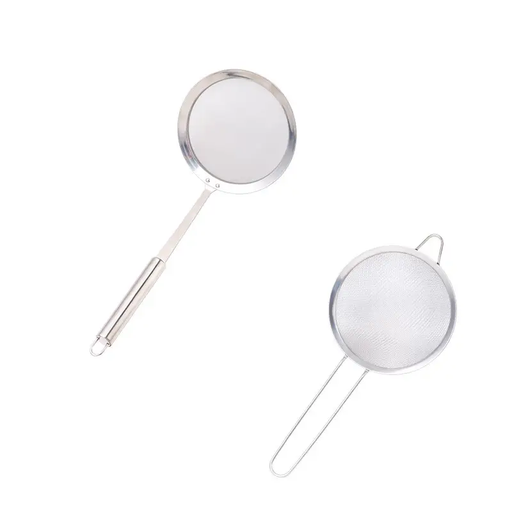
Why this product suits this profile: According to the product description, this two-piece set is designed for fine applications such as soya milk and flour, and also includes a skimming spoon.
Its intended use is more clearly defined than that of a universal sieve. This reduces the risk of using a coarse-mesh pasta colander for fine liquids.
Grade 304 stainless steel according to the product description, plus a two-piece set with a skimming spoon.

Why this product suits this profile: This expandable sink strainer has a 3.6-litre capacity and is designed for pasta, vegetables, rinsing and draining larger quantities.
The expandable design addresses the common problem of an insufficient support surface. Before buying, compare the width of your sink with the stated dimensions.
3.6-litre capacity, expandable design, stainless steel construction and ergonomic handle.
We have put together a complete, regularly updated list of products that fully meet these strict selection criteria and the safety regulations applicable in the EU.
A durable metal sieve depends more on proper care than product advertising often suggests. Flour residue and soya milk should not be allowed to dry, as they can clog fine mesh. After use:
A stainless steel sieve is not automatically suitable for hot oils, the oven or an air fryer. For an air fryer rack, check the dimensions and the relevant product’s approval for use. The same applies to a grill basket or grill mat. If there are sharp edges, bent mesh or damaged coatings, the kitchen utensil should be replaced.
A fine-mesh sieve is practical for flour, icing sugar and other fine dry ingredients. A specific measurement such as 1.5 mm makes comparison easier. Mesh specifications can be used for particularly fine filtering tasks, but they should be interpreted based on the manufacturer’s description.
That depends on the particular model and its surface. The Leifheit sieve is stated to be dishwasher-safe. When buying, you should also consider the handles, enamel, coatings and connection points. If there is no clear information, hand washing is the safer option.
A smaller sieve is often sufficient for individual portions. If you regularly drain pasta, potatoes or vegetables for several people, compare the capacity and support surface. An expandable sink strainer with a capacity of 3.6 litres may be suitable for larger quantities, provided it fits securely on your sink.