
Lieferung heute & morgen

Qualitätsgarantie

Willkommens-Angebote freischalten: KOSTENLOSE Lieferung | Bis zu 80 % RABATT | Kostenlose 30-Tage-JoyPlus-Testphase
App herunterladen
A stainless steel kitchen sieve can be used to drain pasta, wash vegetables, sift flour or filter liquids. In practice, however, it is often only after purchase that you discover whether a sieve really suits your kitchen routine. Small openings can slow draining, an unstable handle can make it difficult to use, and an unsuitable size can make storage or placing it over bowls unnecessarily awkward.
The product name alone therefore provides only some of the relevant information. The key considerations are the material, mesh or hole size, capacity and specific design.
Not every listing specifies the type of steel used. Details such as 304 stainless steel, 18/8 or a specific material description make it easier to assess the product. Other products simply state “metal” or “stainless steel”. This reveals little about the wall thickness, workmanship or the connection between the sieve and handle.
A rust-resistant surface does not replace careful maintenance. After washing, a stainless steel sieve should be dried completely, particularly around folded edges and connection points.
A fine-mesh sieve is suitable for flour, icing sugar, fruit pulp or small suspended particles. For pasta or larger pieces of vegetables, however, it may drain more slowly. A coarse draining colander lets water run off quickly, but does not reliably retain small grains or fine particles.
If you are looking for a pasta colander, rice sieve and flour sieve in one product, you should consider your own priorities. A single model can be versatile, but it will not automatically replace every specialised filter size.
A colander with a large diameter needs enough space in the sink or on a bowl. A small kitchen sieve is easier to store, but holds less food. With extendable models, you should also check whether the span fits your sink and whether the handles rest securely.
For direct contact with food, clear material details are important. The PURECOOK 304 Stainless Steel Rice Sieve, for example, is described as being made from uncoated, electropolished 304 stainless steel with smooth, polished edges. It has a diameter of 27 cm; side handles make washing and draining easier.
For coated or framed sieves, it is worth checking the care instructions. Plastic frames can be more sensitive to temperature than the metal mesh itself. For the model with 316 stainless steel mesh and a plastic frame, for example, the instructions point out that boiling liquids should not be poured directly through the sieve if this exposes the frame to high temperatures.
The mesh size affects what is retained and how quickly liquid drains. For baking ingredients, a fine-mesh sieve with an even structure is a sensible choice. According to the product description, the Leifheit Kitchen Sieve ProLine Ø 16 cm has a mesh opening of 1.5 mm and is intended for flour, icing sugar and other dry ingredients.
For rice, quinoa, berries and small pieces of vegetables, evenly distributed, smaller drainage openings are practical. A classic sieve for draining pasta, on the other hand, primarily needs sufficient surface area and a stable base.
A capacity of 1.7 to 3.6 litres covers many uses in the average household. The extendable 3.6-litre stainless steel draining sieve measures 53.5 × 24.7 × 10.5 cm and is designed for use over sinks of different sizes. Before buying, compare the maximum width with the dimensions of your sink.
Other useful details include:
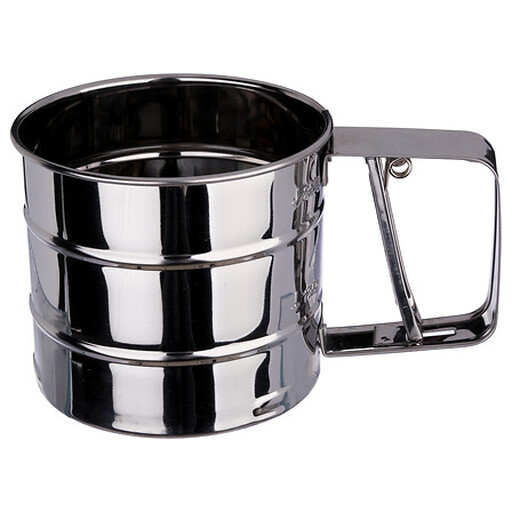
Why this product suits this profile: This compact sieve is designed for smaller kitchens and occasional tasks such as sifting flour, draining and washing small ingredients. Its stated dimensions are 10.3 × 9.3 × 15.5 cm.
The specific dimensions make it easier to assess how much space it requires. According to the description, the stainless steel construction is rust-resistant and can be cleaned with warm soapy water.
Compact design, stainless steel construction and suitable for sifting, draining and rinsing small ingredients.
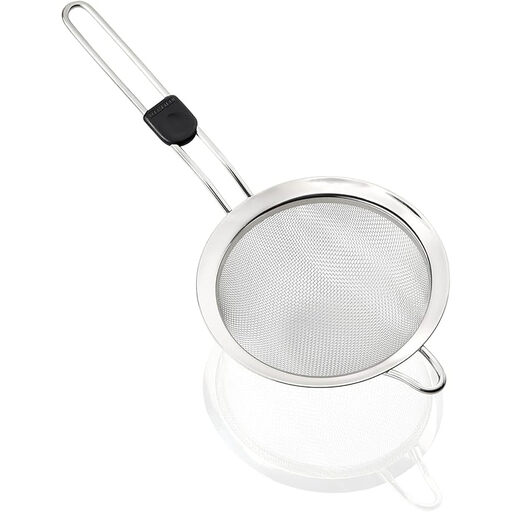
Why this product suits this profile: This 16 cm sieve combines a stated mesh opening of 1.5 mm with a thumb rest, hanging loop and dishwasher suitability. It is aimed at keen bakers and households that use a sieve regularly.
The mesh opening is clearly specified. This makes it easier to assess before buying whether the model is suitable for sifting flour or other fine dry ingredients.
1.5 mm mesh opening, thumb rest, hanging loop and stated dishwasher suitability.

Why this product suits this profile: With a capacity of 3.6 litres, this extendable draining sieve is designed for pasta, vegetables and larger quantities. Its adjustable span allows it to be used over sinks of different sizes.
The stated length of 53.5 cm and width of 24.7 cm make it possible to compare the sieve with your own sink. This helps prevent buying a model with unsuitable support surfaces.
3.6-litre capacity, extendable design, stainless steel construction and ergonomic handle.
For specialist filtering tasks, you could also consider a stainless steel coffee filter with 300- or 800-mesh, a tea strainer with an integrated metal filter or a stainless steel filter spoon for juices and soya milk. These designs are not automatically suitable as pasta colanders, but they can be a better solution for fine liquids.
We have put together a complete, regularly updated list of products that fully meet these strict selection criteria and the safety regulations applicable in the EU.
For pasta, a larger colander with sturdy handles and sufficient drainage openings is the practical choice. An extendable model can rest over the sink. A very fine-mesh sieve is more suited to flour, icing sugar or fine liquids and may drain more slowly.
Its service life depends on the material thickness, connection points, workload and care. Stainless steel is corrosion-resistant, but it can still become deformed by heavy foods, rough cleaning or improper exposure to heat. Drying it completely and avoiding abrasive cleaning products can help extend its useful life.
For washing rice, choose a sieve with an even pattern of sufficiently small holes that the grains cannot pass through. A fine-mesh sieve is more suitable for very fine particles or liquids. The decisive factors are the actual hole or mesh size and the diameter of the container.