
Lieferung heute & morgen

Qualitätsgarantie

Willkommens-Angebote freischalten: KOSTENLOSE Lieferung | Bis zu 80 % RABATT | Kostenlose 30-Tage-JoyPlus-Testphase
App herunterladen
A stainless steel kitchen sieve is a staple in many households, but it is often chosen based solely on its diameter or appearance. Yet it is the design that determines whether the sieve stays stable when draining pasta, keeps small grains of rice contained when washing them, or sifts fine ingredients evenly when baking.
Home cooks, families and keen bakers should pay particular attention to three common pitfalls before buying:
For contact with food, a smooth, uncoated stainless steel surface is practical because it is less likely to absorb odours and residue than porous materials. Some products specify the exact grade of stainless steel. 304 stainless steel corresponds to the common 18/8 designation; according to the product specification, 18/10 stainless steel contains 18 per cent chromium and 10 per cent nickel. A product with 316 stainless steel mesh can also offer a clear material specification.
The construction is important too:
It is not possible to make a blanket statement about service life. This depends on the material thickness, use, cleaning and storage.
The shape and size of the openings determine what an draining sieve is suitable for:
For example, the Leifheit sieve from the ProLine series is described as having a diameter of 16 cm and a mesh opening of 1.5 mm. This makes it particularly suitable for fine dry ingredients and smaller quantities. A classic pasta colander with a large diameter, on the other hand, offers more capacity and faster drainage.
A diameter of 22 to 24 cm is suitable for many family-sized portions. Small models measuring around 12 to 16 cm are easier to store and practical for individual portions, baking ingredients or smaller quantities of vegetables. For large sinks, an adjustable sink colander can be useful, as it can rest securely across the sink.
Before placing your order, check the following:
If the sieve has a plastic frame, pay particular attention to the temperature guidance. For example, the 22 cm sieve with a plastic frame is described as having a maximum frame temperature of 70 °C. In this case, boiling water should not be poured directly through the sieve while holding it in your hand.
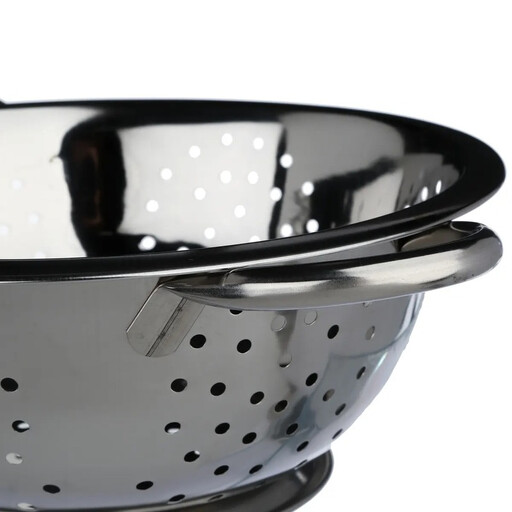
Why this product suits this profile: With a 2.2-litre capacity and a diameter of 24 cm, this model is suitable for everyday kitchen tasks such as draining pasta, washing vegetables and fruit, and handling dry ingredients.
The clearly stated dimensions make it easier to compare the sieve with bowls and saucepans. The stainless steel construction avoids a delicate coated interior.
24 cm diameter, 12 cm height and versatile use for straining and washing.
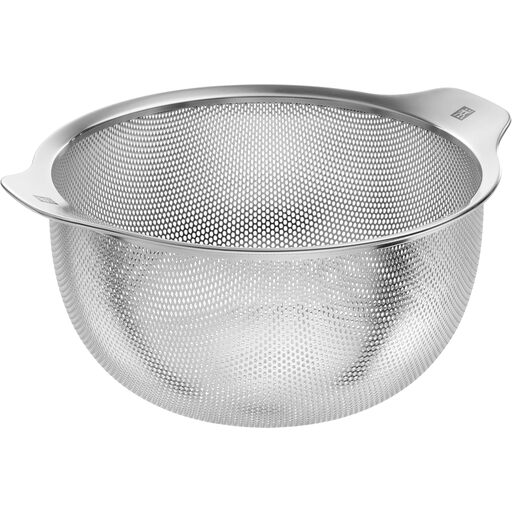
Why this product suits this profile: This model has a 24 cm diameter, integrated side handles and a raised base for larger quantities of pasta, salad or vegetables.
The integrated handles and wide base reduce the risk of a full sieve slipping while being carried or emptied.
Made from 18/10 stainless steel according to the product specification, with a perforated base and dishwasher-safe design.
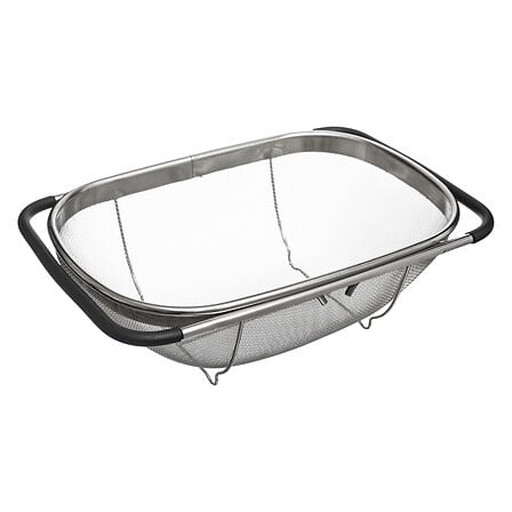
Why this product suits this profile: The extendable design is intended for different sink sizes and offers a 3.6-litre capacity for pasta, vegetables or fried food.
The adjustable length prevents the problem of a fixed sieve not fitting across the sink. Nevertheless, check that it is securely positioned before filling it.
3.6-litre capacity, extendable dimensions and an ergonomic handle for use across the sink.
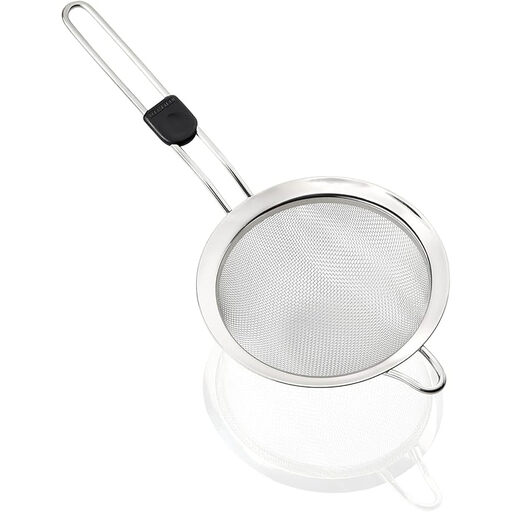
Why this product suits this profile: The stated 1.5 mm mesh opening is suitable for flour, icing sugar and cocoa. Its compact size is also practical in smaller kitchens.
The specific mesh size prevents buyers from confusing a coarse draining sieve with a baking or flour sieve. The handle has a thumb rest.
16 cm diameter, stainless steel construction, hanging loop and dishwasher-safe design according to the product specification.
We have put together a complete, regularly updated list of products that fully meet these strict selection criteria and the safety regulations applicable in the EU.
A dishwasher-safe sieve saves time, but you should still follow the manufacturer's instructions. Plastic frames may be exposed to greater wear through repeated hot dishwasher cycles. With stainless steel models, thorough rinsing and drying help preserve their well-maintained appearance.
Keep the following points in mind:
A tea strainer or filter for fruit pulp should be rinsed immediately after use so that fine particles do not dry onto the mesh. Depending on the handle and frame material, separate safety guidance may apply to very hot liquids.
For family-sized portions, around 22 to 24 cm is often practical. Small sieves measuring 12 to 16 cm are suitable for individual portions, baking ingredients or berries. The key point is that the sieve must rest securely on the saucepan, bowl or sink.
No. Many stainless steel models are suitable for the dishwasher according to the product specification, but combinations with wood or plastic may come with restrictions. Before buying, check the material, temperature guidance and cleaning recommendations for the specific product.
That depends on the hole or mesh size. A rice sieve needs dense, small openings so that the grains do not fall through. For rice, quinoa, berries and small pieces of vegetables, finer drainage openings are more suitable than a coarsely perforated pasta colander.