
Lieferung heute & morgen

Qualitätsgarantie

Willkommens-Angebote freischalten: KOSTENLOSE Lieferung | Bis zu 80 % RABATT | Kostenlose 30-Tage-JoyPlus-Testphase
App herunterladen
By: Joybuy Product Recommendation Officer
A stainless steel kitchen strainer is one of those kitchen utensils you regularly need for draining, washing and baking. Even so, models can differ considerably in mesh size, capacity, stability and ease of cleaning. A bargain purchase can prove impractical if small grains of rice fall through, the handle tips when the colander is full of pasta, or the material is not dishwasher-safe.
This buying guide explains which details really matter before you buy and which model best suits different usage profiles.
“Stainless steel” alone does not always describe the precise material quality. More informative specifications include 304 stainless steel or 18/8 and 18/10 stainless steel. These designations indicate which alloy has been used. However, they do not replace checking the workmanship, edges and care instructions.
Even a stainless steel strainer can develop marks if it is exposed to moisture, salt or acidic residue over a long period. Thorough drying after washing and avoiding wire wool help protect the surface.
A colander with large holes is suitable for pasta, potatoes and larger pieces of vegetables. For flour, icing sugar, soya milk or fruit pulp, however, you need a fine-mesh kitchen strainer. A flour sieve with a mesh opening of, for example, 1.5 mm, is considerably more suitable for dry ingredients than a coarsely perforated colander.
If you are looking for a single strainer for every task, check carefully whether the mesh structure allows both fine sieving and quick draining. A very fine-mesh model may drain more slowly when handling large quantities.
The diameter alone says little about practical capacity. Height, base shape and internal volume all affect whether the strainer is suitable for a portion of berries or a large pot of pasta. A kitchen strainer with a handle is easy to hold over a bowl, while a model with two side handles can offer greater stability when handling larger quantities.
An elevated base is also important. It prevents the colander from standing directly in the drained liquid, stopping the food from coming into contact with the water again.
The following specifications are particularly useful for frequent use:
The material specification should always be checked against the specific manufacturer information for the item in question.
A colander or traditional strainer usually has larger openings so that water can drain quickly. A fine-mesh sieve is more suitable for:
For rice and vegetables, evenly distributed, sufficiently small drainage openings are practical. With very small grains, the opening size should be checked particularly carefully.
A diameter of around 16 cm is easy to handle for smaller quantities and baking ingredients. Models measuring 24 to 27 cm are more suitable for family portions, vegetables or pasta. For large sinks, extendable versions may be worth considering; one of the models described has a length of 53.5 cm and a capacity of 3.6 litres.
When it comes to handles, length, position and stability all matter. Side handles make it easier to pour large quantities, while a long single handle is practical for small portions and for working over a bowl.
A dishwasher-safe sieve saves time every day. However, this suitability must be stated explicitly in the product description. The Leifheit sieve and several of the stainless steel strainers described are stated to be dishwasher-safe. Bamboo lids, such as those supplied with a PURECOOK set, have separate care instructions: they should be cleaned by hand and dried completely.
Regardless of whether the item is dishwasher-safe, we recommend that you:
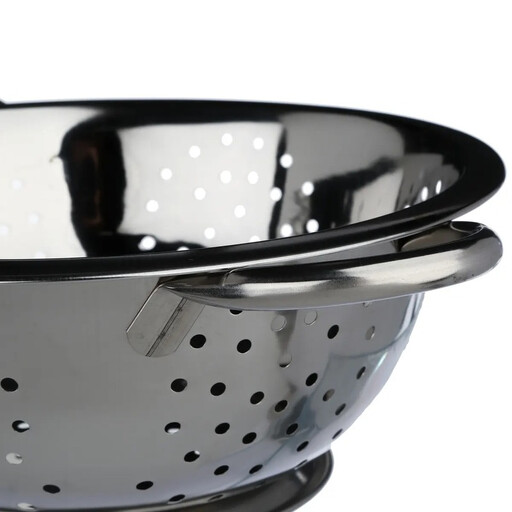
Why this product suits this profile: With a capacity of 2.2 litres and a diameter of 24 cm, this model is designed for typical household tasks such as draining pasta and washing fruit and vegetables.
The stated size gives a clearer idea of the practical capacity than a diameter specification alone.
Practical everyday capacity, stainless steel construction, and suitable for draining and washing.
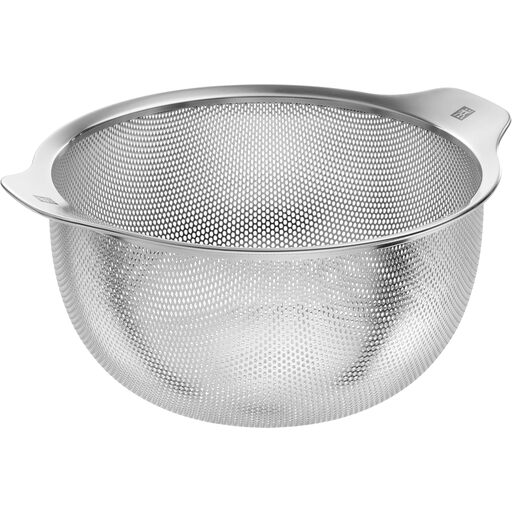
Why this product suits this profile: The model described is made from 18/10 stainless steel and features side handles and an elevated base for larger portions.
The material, diameter, side handles and dishwasher suitability are all clearly specified.
24 cm diameter, integrated side handles, elevated base and stated dishwasher suitability.
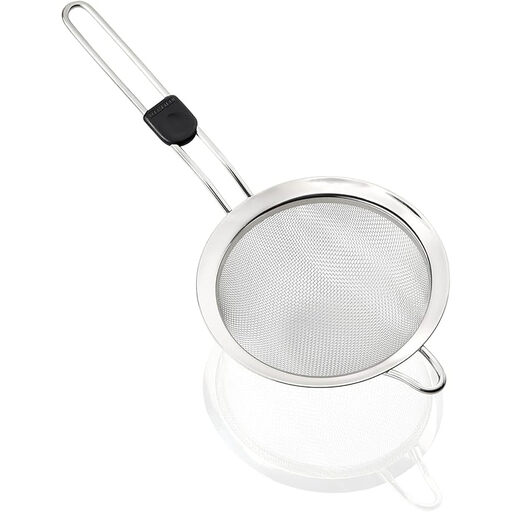
Why this product suits this profile: This 16 cm sieve, with a stated 1.5 mm mesh opening, is designed for flour, icing sugar and other dry ingredients.
The specific mesh opening helps prevent buyers from confusing a coarse colander with a flour sieve.
1.5 mm mesh opening, thumb rest, hanging loop and dishwasher suitability according to the product description.
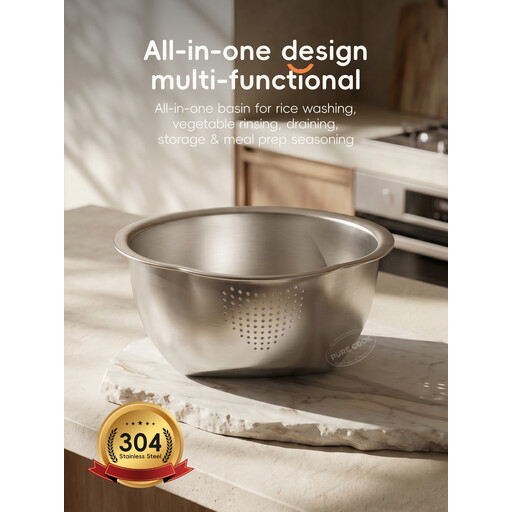
Why this product suits this profile: This 27 cm bowl with side drainage openings is designed for rice, quinoa, fruit, vegetables and larger preparation quantities.
The stated 304 alloy, evenly distributed drainage openings and smooth edges are clearly described.
304 stainless steel, side handles, electropolished surface and dishwasher suitability according to the product description.
We have put together a complete, regularly updated list of products that fully meet these strict selection criteria and the safety regulations applicable in the EU.
A stainless steel kitchen strainer should not be left permanently in water or highly salty liquids. Rinse off acidic and salty residue promptly after use. With fine-mesh models, it is advisable to rinse the sieve under running water first before placing it in the dishwasher.
Models with a hanging loop are suitable for storage. Stackable bowl strainers save space in small kitchens. A sieve must not be used over an open flame, on a hot hob or in a microwave unless the manufacturer expressly permits it.
For flour, icing sugar and starch, a fine-mesh kitchen strainer with a defined mesh opening is a sensible choice. A specification such as 1.5 mm provides better guidance than simply describing the mesh as “fine”. Pasta and vegetables, on the other hand, require larger drainage openings.
No. Dishwasher suitability must be stated in the relevant product description or care instructions. Even with a dishwasher-safe sieve, abrasive cleaners, wire wool or prolonged exposure to moisture can damage the surface.
For larger portions of pasta, vegetables or fruit, models measuring around 24 cm in diameter or more and with sufficient height are generally more practical. Small sieves measuring around 16 cm are better suited to baking ingredients, berries or individual portions. The key factors are not just diameter, but also the stated capacity and the size of the base.