
Lieferung heute & morgen

Qualitätsgarantie

Willkommens-Angebote freischalten: KOSTENLOSE Lieferung | Bis zu 80 % RABATT | Kostenlose 30-Tage-JoyPlus-Testphase
App herunterladen
A stainless steel kitchen strainer is a staple in many households, yet it is often chosen based on appearance alone. In practice, mesh size, capacity, stability and ease of cleaning determine whether a strainer is genuinely useful in everyday cooking. A small model can overflow when draining pasta, while a very fine-mesh kitchen strainer may work unnecessarily slowly with vegetables.
“Stainless steel” is useful information, but it does not always tell you everything. If the manufacturer specifies a particular grade, it is easier to assess the product. The models featured here include 304 stainless steel and 18/10 stainless steel, for example. These details refer to the material composition and should not be taken as a blanket guarantee of unlimited durability.
The finish is also important. Sharp edges, poorly deburred openings or difficult-to-reach joins can make cleaning more challenging. Smooth, polished surfaces and rounded edges are easier to care for in everyday use.
A colander should be suitable for the saucepan you use and the portion sizes you typically prepare. A diameter of 16 cm may be rather small for family portions. However, a larger draining colander requires more storage space and may be awkward to use in a small sink.
Before buying, check:
Not every kitchen strainer is designed for boiling water or hot oil. A stainless steel colander may be suitable for pasta and vegetables, while a fine-mesh kitchen strainer is more likely to be intended for sifting flour and icing sugar. With a skimming spoon or frying strainer, you should also consider the handle, as it may become hot during prolonged exposure to heat.
The manufacturer’s instructions should therefore always take priority. If you are unsure, drain hot liquids slowly, hold the strainer securely and never place models with plastic or wooden components directly on a hot hob.
304 stainless steel is specified as the material for several kitchen utensils. The ZWILLING models use 18/10 stainless steel. The finish may be polished or satin. A smooth surface makes cleaning easier, while satin finishes can be scratched by metal brushes or abrasive cleaners if cared for incorrectly.
Also look for specific information about dishwasher suitability. A dishwasher-safe kitchen strainer is convenient to clean, but it should be allowed to dry completely after the cycle. Products with wooden handles or handles made from unspecified materials may require hand washing.
For flour, starch or icing sugar, a fine-mesh kitchen strainer with small openings is a sensible choice. The Leifheit ProLine strainer specifies a mesh opening of 1.5 mm, making it suitable for dry ingredients and finer sifting tasks.
For pasta, potatoes or larger pieces of vegetables, larger perforated surfaces are generally more suitable. They allow water to drain more quickly and are less likely to become blocked. A classic colander with a handle, or a strainer for vegetables and pasta, should also stand securely or rest safely over the sink.
An ergonomic handle, thumb rest or hook for resting on the rim of a saucepan can make a strainer easier to use. Extendable models fit different sink widths, but when folded they do not always take up less space from side to side. Stackable strainers are worth considering for small kitchens, provided matching sizes are available.

Why this product suits this profile: This extendable stainless steel strainer offers a capacity of 3.6 litres and can be positioned over sinks of different widths. It is suitable for draining, rinsing and straining pasta or vegetables.
The adjustable length reduces the risk of the strainer slipping in the sink or being too small for larger quantities. Before buying, compare the dimensions of 53.5 × 24.7 × 10.5 cm with your sink.
3.6-litre capacity, extendable design and ergonomic handle. According to the product details, it weighs 0.600 kg.
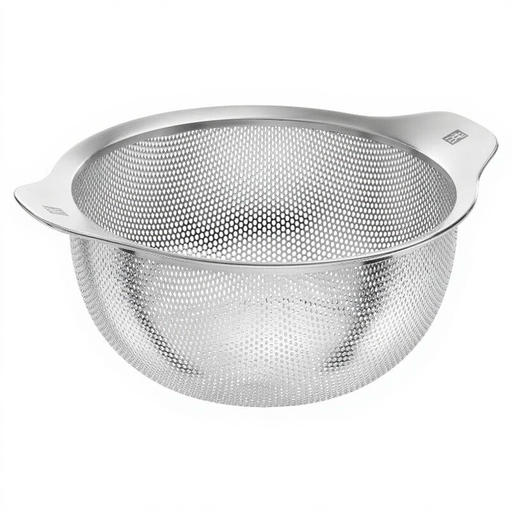
Why this product suits this profile: This model is made from 18/10 stainless steel, has a flat stable base and, according to the product details, can be used as a strainer, serving bowl or colander.
The sturdy base addresses the common problem of slipping when draining. Its stated dishwasher suitability makes cleaning easier; abrasive cleaners are not recommended for the satin finish.
20 cm diameter, 18/10 stainless steel, flat stable base and stackable sizes within the range.
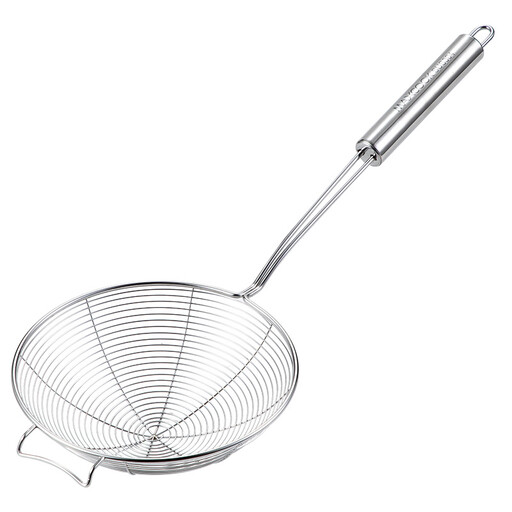
Why this product suits this profile: Made from 304 stainless steel, this skimming spoon has a widened spoon head and a hook for resting on the rim of a saucepan. It is designed for lifting out pasta, dumplings and vegetables, as well as filtering residue from liquids.
The secure hook stops the spoon from slipping into the saucepan when set down temporarily. The handle may become hot during prolonged exposure to heat, so keep it away from naked flames and handle it with care.
304 stainless steel, hollow handle, saucepan-rim hook and hanging hole. According to the product description, the smooth surface is easy to clean.
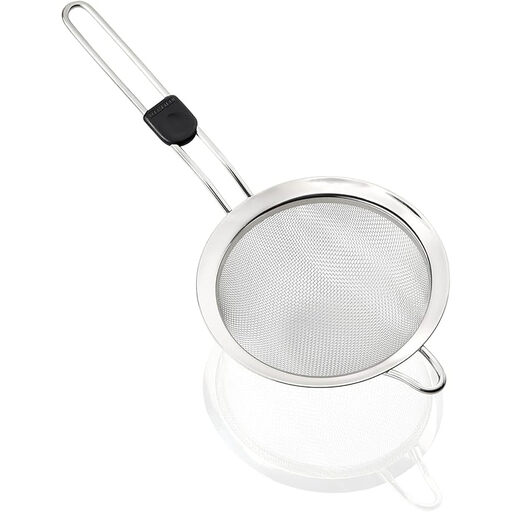
Why this product suits this profile: This 16 cm stainless steel strainer has a specified mesh opening of 1.5 mm, making it suitable for flour, icing sugar and other dry ingredients. A thumb rest helps with handling while sifting.
The specified mesh size ensures that “fine mesh” is not left as an imprecise marketing claim. According to the product details, this model is not intended for very hot liquids or oil.
1.5 mm mesh opening, 16 cm diameter, thumb rest, hanging loop and dishwasher suitability according to the product description.
We have put together a complete, regularly updated list of products that fully meet these strict selection criteria and the safety regulations applicable in the EU.
To keep a stainless steel strainer usable for as long as possible, remove salt, acidic substances and food residue promptly. Warm water, a soft sponge and mild washing-up liquid are recommended. Steel wool, hard brushes and harsh cleaners can damage the surface. After washing, the strainer should be allowed to dry completely, particularly around welded joints, handle connections and hooks.
With a frying strainer or skimming spoon, the handle must not be left in hot oil or over a naked flame for extended periods. Before each use, it is worth checking for bent edges, loose connections or damage.
For individual portions or small sinks, a diameter of around 16 cm may be sufficient. For family portions and larger quantities of pasta, models from around 20 cm are more practical. As well as the diameter, consider the size of your saucepan, your sink and the storage space available.
That depends on the individual product. Some models, including certain ZWILLING and Leifheit strainers, are stated to be dishwasher-safe. Even so, satin finishes should be cleaned gently without abrasive cleaners. For handles made from wood or unspecified materials, check the manufacturer’s information.
A colander usually has larger openings and a spacious strainer body for quickly draining pasta and vegetables. A fine-mesh kitchen strainer holds back smaller particles and is more suitable for flour, icing sugar, sauces or filtering liquids. For versatile kitchens, having both types can be useful.