
Lieferung heute & morgen

Qualitätsgarantie

Willkommens-Angebote freischalten: KOSTENLOSE Lieferung | Bis zu 80 % RABATT | Kostenlose 30-Tage-JoyPlus-Testphase
App herunterladen
A stainless steel kitchen strainer can handle many tasks, from draining and washing to filtering. However, shape, mesh size, capacity and handle design can vary considerably. If you only look for the term “stainless steel strainer” or focus on glossy product images, you may end up buying a strainer that is not suitable for its intended purpose.
The material specification alone says nothing about how easy the product is to clean. A draining strainer made entirely from stainless steel is often straightforward to care for. However, models with plastic frames or coated handles may have limited dishwasher suitability. Look for an explicit statement such as “dishwasher-safe strainer”.
A fine-mesh kitchen strainer holds back flour, pulp and small suspended particles. However, very fine mesh can drain more slowly and become blocked more easily when used for pasta or larger pieces of vegetables. A coarsely perforated colander is generally more suitable for pasta, rice and larger quantities of vegetables.
A 24 or 27-centimetre strainer offers more space, but it also needs sufficient storage room and a stable place to rest. In small sinks or narrow kitchen cupboards, a compact kitchen colander with a hanging loop may be the better choice. Also check whether the handles, base or extending mechanism can rest securely across the sink or bowl.
For stainless steel, specific details such as 304 stainless steel, 316 stainless steel, 18/8 or 18/10 are more helpful than general descriptions. They indicate the material’s composition and provide a useful guide to its intended use. Even so, stainless steel should be rinsed and dried after contact with salt, acid or fruit juice, as residue can encourage staining or discolouration.
When choosing a sieve for sifting flour, look for smooth joins between the frame and mesh. Sharp edges, loose mesh or poorly secured handles are practical defects. With a colander for hot food, it is also important to know whether the handle is merely heat-insulated or whether the manufacturer specifies particular temperature limits.
Mesh size determines which particles are retained:
A soya milk strainer or juice strainer with a dense mesh can hold back foam and suspended particles. The mesh should not be handled with knives or hard objects. When pressing out solid ingredients, apply only as much pressure as the construction can withstand without deforming.
For individual baking ingredients, a strainer with a diameter of around 16 centimetres is often sufficient. Households with several people are more likely to benefit from a diameter of 22 to 27 centimetres. For pasta or larger quantities of vegetables, side handles and a raised base are useful, allowing water to drain away without leaving the food standing in liquid.
An expandable model can adapt to different sinks, but it contains moving parts that need to be kept clean. With a straining spoon or skimmer, on the other hand, handle length is crucial, particularly when working in tall pans or hot oil.
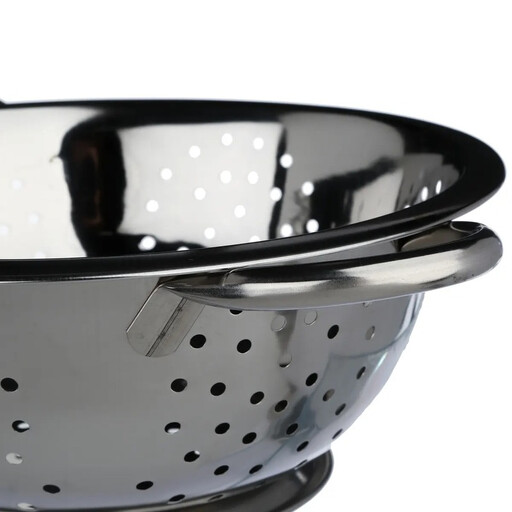
Why this product suits the profile: With a diameter of 24 cm and a height of 12 cm, it covers everyday tasks such as draining pasta, washing vegetables and sifting dry ingredients.
The product description gives specific dimensions and several possible uses rather than making only general claims about durability.
Stainless steel construction; a suitable size for everyday kitchen tasks.
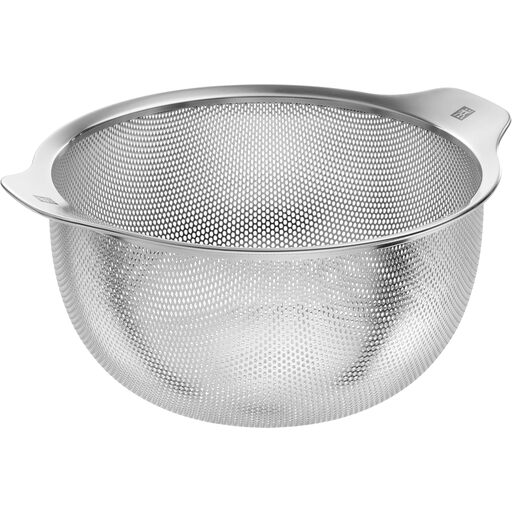
Why this product suits the profile: The model is designed for larger portions and, according to the product description, features 18/10 stainless steel, side handles and a stable base.
The material, diameter, handles and cleaning method are all specified clearly, making it easier to check whether the product meets your needs.
24-cm format; dishwasher-safe according to the supplier; side handles and raised base.

Why this product suits the profile: The expandable design is intended for sinks of different widths and offers a 3.6-litre capacity for larger quantities.
The adjustable width reduces the risk of the strainer not resting securely on your sink.
3.6-litre capacity; expandable design with a total length of 53.5 cm according to the product data.
We have put together a complete, regularly updated list of products that fully meet these strict selection criteria and the safety regulations applicable in the EU.
Before using a new stainless steel kitchen strainer for the first time, wash it with warm water and mild washing-up liquid. Fine mesh should not be cleaned with steel wool or abrasive cleaners. After use, it is best to remove food residue promptly and dry the strainer thoroughly.
With models that contain plastic parts, only add hot liquids in accordance with the manufacturer’s instructions. A heat-insulated handle does not automatically make the entire strainer heat-resistant. Check the mesh regularly for tears and the handle for looseness. Damaged mesh can create sharp edges and should no longer be used.
For flour, icing sugar and cocoa, a fine-mesh kitchen strainer with a manageable diameter is a sensible choice. A model such as the Leifheit ProLine with a diameter of 16 cm and a stated mesh opening of 1.5 mm is designed for dry ingredients. According to the product description, it is dishwasher-safe.
That depends on the construction as a whole. Pure stainless steel is generally more heat-resistant than plastic, but handles, frames and joints may have different limits. With a plastic frame, follow the manufacturer’s instructions and do not pour in very hot liquids directly unless the product is specifically stated to be suitable.
It is not possible to give a reliable fixed lifespan. This depends on the material, how the mesh is attached, the level of use, cleaning and storage. Dry storage, gentle cleaning and avoiding hard objects can all help extend its life. What matters is less a marketing promise than clear material and size specifications that match the intended use.