
Lieferung heute & morgen

Qualitätsgarantie

Willkommens-Angebote freischalten: KOSTENLOSE Lieferung | Bis zu 80 % RABATT | Kostenlose 30-Tage-JoyPlus-Testphase
App herunterladen
A stainless steel kitchen strainer can drain pasta, wash vegetables, lift dumplings out of broth or filter oil after frying. Yet many models don’t suit the realities of everyday cooking. A diameter that’s too small makes it harder to drain larger portions, wide openings let small ingredients slip through, and a short handle brings your hand unnecessarily close to hot water or oil.
That’s why it’s worth checking the technical details before you buy, rather than relying on general marketing claims.
The term stainless steel doesn’t automatically specify the exact alloy, material thickness or finish. If the strainer will regularly come into contact with salt, acidic ingredients and hot water, specific details such as 304 stainless steel or 18/10 stainless steel are more useful. However, they don’t replace checks on the handle, welds and cleaning instructions.
Stains or surface rust can still appear on stainless steel if salt and acidic residues are left on the surface for too long. Prompt cleaning and thorough drying are therefore part of normal care.
A fine-mesh strainer holds back small particles, flour and fine ingredients. But a close mesh can drain more slowly and be harder to clean when you’re handling spaghetti, larger portions of vegetables or fried food. Conversely, large openings aren’t practical for rice, small dumplings or fine pasta.
What matters is the combination of hole size, straining area and intended use – not just the word ‘fine’.
A dishwasher-safe kitchen strainer is convenient, but this only applies if it’s stated for the specific model. Wooden handles, coatings or plastic components may need different care. For products with a satin finish, hand-washing is sometimes recommended to reduce visible scratches.
For a versatile kitchen tool, specific details about the alloy and construction are useful:
The right size depends on your pan, sink and portion size:
A long handle keeps your hand further away from hot water and oil. A sturdy hook for resting on the rim of a pan or a deep strainer basket is also useful for hotpot, fondue and frying. A skimmer, straining spoon or frying spoon with evenly spaced openings lets liquid drain away while keeping solid ingredients in the strainer.
If you’re choosing a classic kitchen strainer with a base, make sure it stands securely on your worktop. Side handles are useful for carrying larger quantities.
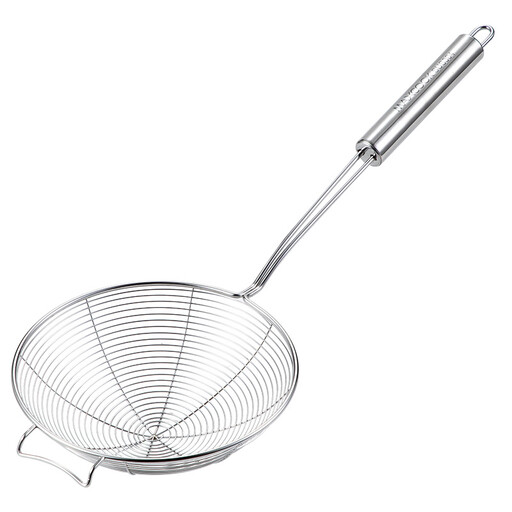
Why this product suits this profile: This skimmer combines a deep, wide strainer basket with a hook for resting on the rim of a pan. It’s suitable for pasta, dumplings, soup ingredients and simple frying tasks.
The product details specify 304 stainless steel, a hook for resting on pan rims and a hollow handle. This makes the material and features clear.
Deep strainer basket, hook for resting on pan rims and hanging hole; according to the product details, it’s designed for hotpot, pasta, dumplings and filtering residue from soup and oil.
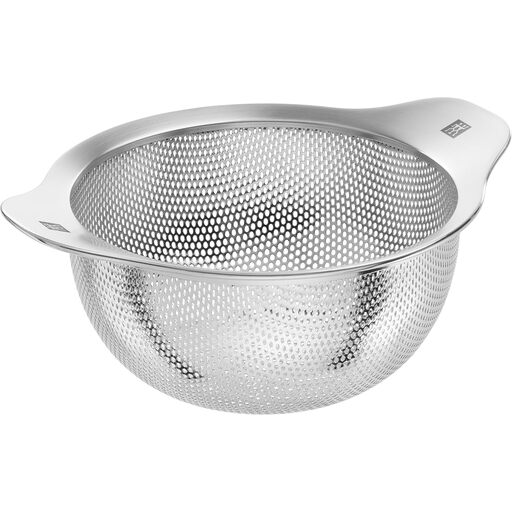
Why this product suits this profile: This model combines a strainer, draining basket and bowl, with a flat base. It’s a good fit for kitchens where a multifunctional product is a priority.
The product description specifies 18/10 stainless steel, a satin finish, a flat base and dishwasher suitability. Hand-washing is also recommended to protect the finish.
Three functions in one product; available in 16, 20 and 24 cm sizes, according to the product details, with the sizes designed to nest inside one another.
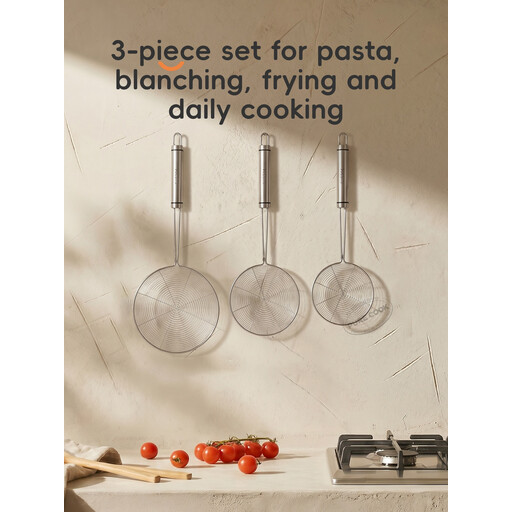
Why this product suits this profile: Three different sizes cover hotpot, blanching, pasta and frying. It’s a practical choice if you regularly use pans of different sizes and cook a variety of ingredients.
Rather than giving a single general size, the range specifies three sizes and a tightly woven, even mesh.
Three strainers made from 304 stainless steel, one-piece construction, hanging hole and, according to the product details, dishwasher-safe.
We’ve put together a complete, regularly updated list of products that meet these strict selection criteria and the safety regulations in force in the EU.
To keep a stainless steel strainer in good condition for longer, follow the manufacturer’s instructions:
For a strainer used with pasta and dumplings, also check that the openings are small enough for the type of food you’re cooking. For hotpot and fondue, a long handle and fine-mesh basket give you more control when lifting food out.
For larger quantities of pasta, a stand strainer or bowl strainer with a generous diameter is a good choice. A small spaghetti strainer or straining spoon is better suited to individual portions. The openings should let water drain quickly without allowing small pasta shapes to slip through.
It depends on the specific model. Some products are listed as dishwasher-safe in their descriptions, while hand-washing is recommended for others. Follow the relevant care instructions for models with wooden handles, plastic parts or satin finishes.
For hotpot, a long handle, a sturdy hook for resting on the rim of a pan and a deep strainer basket are useful. For frying, the frying spoon should keep your hand well away from the hot surface and have evenly spaced openings to let oil drain away. Always take care around hot water and oil.